
White pine weevil (Pissodes)
Pissodes
Description
How to identify
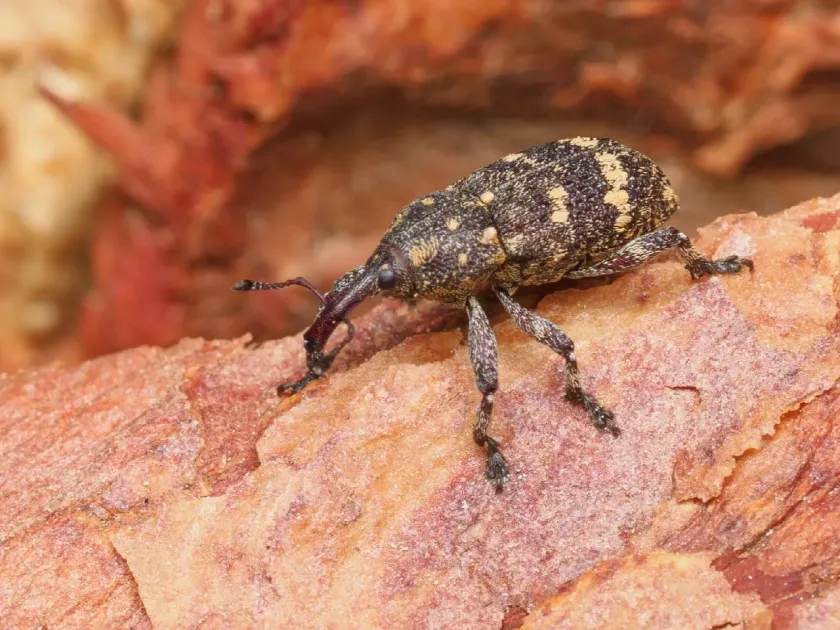
The genus Pissodes, commonly known as weevils, belongs to the family Curculionidae within the order Coleoptera. These beetles are characterized by their elongated snouts and hard, segmented bodies.
Adult Pissodes beetles typically exhibit a reddish-brown to dark brown coloration, often marked with light-colored, white or yellow scales that create distinct patterns or bands on their elytra.
Larvae are legless, fleshy, and white in color with a darker, chitinized head. They are primarily wood-boring, living in the inner bark or the cambium layer of their host trees.
The life cycle undergoes complete metamorphosis, including egg, larval, pupal, and adult stages. Depending on the species, they may overwinter as adults in duff or as larvae within the bark.
These insects are highly adaptable and are primarily recognized as pests of coniferous trees, thriving in environments where host trees are stressed or under poor management.
What it damages
Pissodes weevils primarily infest coniferous tree species, with pines, spruces, and firs being the most frequent targets of their destructive feeding behavior.
Adult beetles cause damage by feeding on the buds and young bark of shoots. However, the most significant impact comes from the larvae that tunnel under the bark.
Larval feeding destroys the vascular tissue (phloem and cambium), effectively girdling the branch or the main stem, which disrupts the transport of water and nutrients.
Severe infestations lead to the death of the terminal leader, resulting in stunted growth or significant trunk deformation, which drastically reduces the timber value.
In addition to direct damage, the entry points created by these insects serve as sites for secondary infections by fungi and pathogens, further weakening the tree's immune system.
When it appears
Adult activity typically begins in the spring when temperatures rise above the threshold for beetle emergence, usually corresponding with the start of the host tree's growth season.
Peak mating and egg-laying occur during the spring months, as the female seeks suitable host material to ensure the survival of the next generation.
The generation time varies considerably between species, with some completing a full life cycle in one year, while others may require two years to reach adulthood.
Larval development takes place throughout the summer. By late summer or early fall, the larvae have finished their development and the new generation of adults begins to emerge.
Environmental conditions, particularly temperature and humidity, play a critical role in the rate of development. Warmer seasons often lead to accelerated lifecycles and population surges.
Signs of infestation
One of the earliest signs of an infestation is the appearance of resinous droplets or "pitch flow" on the bark, resulting from female punctures made during egg-laying.
Needle discoloration, often turning from green to yellowish-brown, indicates that the vascular supply has been compromised by larval feeding underneath the bark.
On the exterior of branches or stems, one may observe small, circular exit holes, which signify that adult weevils have matured and left the tree.
Internal examination of the bark reveals distinct, winding larval tunnels filled with fine, sawdust-like material known as frass, which is packed tightly behind the larvae.
The characteristic "shepherd's crook" or severe bending of the terminal shoot is a classic symptom of terminal weevil attack, particularly in younger pine stands.
Control measures
Silvicultural management is the most effective approach, which includes the removal and destruction of infested terminal leaders before the adults emerge.
Avoiding the planting of highly susceptible species in known outbreak areas and promoting mixed-species stands can significantly reduce the risk of large-scale damage.
Chemical control using systemic or contact insecticides can be applied to the leaders during the early spring to prevent egg-laying and adult feeding on new growth.
The use of pheromone-based traps serves as an excellent tool for monitoring population density and timing the application of integrated pest management interventions.
Natural biological control, including the encouragement of parasitic wasps and insectivorous birds, is an important component of maintaining long-term ecological balance in forests.
Taxonomy
- Latin name
- Pissodes
- Order
- Coleoptera (beetles)
- Family
- Curculionidae
- EPPO code
- PISOSP
Discussion
No discussions yet — be the first.