
Cheese fly
Piophila casei
Description
How to identify
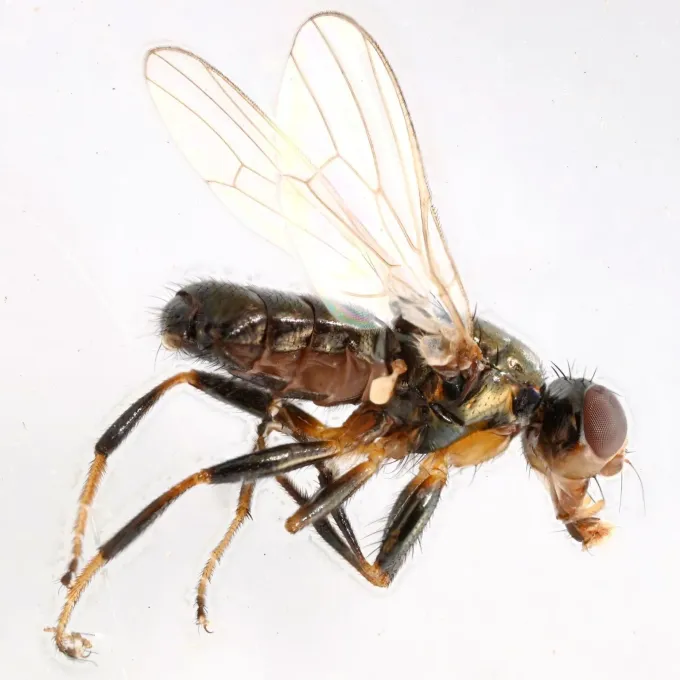
The cheese fly (Piophila casei) is a small dipteran insect belonging to the family Piophilidae. Adult flies are typically 4–5 mm long, characterized by a shiny black body with a metallic bronze or blue sheen.
The wings of the cheese fly are clear and transparent, while the legs are black with yellow joints. They are highly active and capable of rapid flight, especially in warmer environments.
The larvae are well-known for their unique locomotive behavior, being able to jump up to 15 centimeters by arching their bodies and snapping. They are creamy-white, reaching up to 10 mm in length at maturity.
The life cycle is temperature-dependent. At optimal temperatures between 20°C and 30°C, the fly can complete its life cycle in a relatively short time, leading to rapid population explosions.
Females are prolific, capable of laying over 100 eggs in cracks or crevices of food sources, ensuring the larvae have immediate access to nutrients upon hatching.
What it damages
Known primarily as a pest of stored food, the cheese fly is a generalist that infests high-protein products. It poses a significant threat to industrial food storage facilities and local pantries alike.
The fly targets various types of cheese, cured meats, dried fish, smoked products, and fats. In some cases, it can penetrate improperly sealed containers, causing internal spoilage.
Larvae consume the substrate from the inside out, creating extensive galleries and tunnels. This physical destruction makes the product structurally unsound and aesthetically repulsive to consumers.
Beyond material loss, the larvae contaminate food with waste, potentially causing health issues such as enteric myiasis if ingested, making the product a significant sanitary hazard.
Economic losses are substantial, often requiring the total destruction of entire batches of inventory once an infestation is confirmed by quality control standards.
Signs of infestation
The presence of adult flies hovering around stored meat or cheese products is the most common primary indicator of an ongoing infestation within a facility.
Visible damage to the surface of the food, such as small, distinct entry holes or irregular pitting, often indicates that the larvae have already established a colony deep within the product.
A rustling or clicking sound coming from storage crates is a diagnostic sign of the larvae jumping and moving within the infested food matter.
Unpleasant odors associated with rot and decay, combined with the visible presence of white larvae on the surface of the food, confirm a mature infestation level.
Inspection of packaging materials often reveals clusters of minute, white eggs tucked into the folds of plastic wrappers or under the tape of cardboard boxes used for storage.
Control measures
Temperature management is the primary control method. Maintaining storage temperatures below 5°C effectively arrests larval development and prevents the fly from completing its reproductive cycle.
Sanitation programs are crucial in food storage areas. Regular cleaning schedules combined with approved insecticide treatments help maintain a pest-free environment for high-risk products.
Physical exclusion is essential to prevent entry. All windows and ventilation ducts must be screened with fine-mesh netting, and doors should be kept closed or fitted with air curtains.
- Routine monitoring of inventory batches to detect early signs of pest activity.
- Immediate isolation and destruction of infested items to stop further spread.
- Installation of ultraviolet light traps to attract and capture adult flies before they can oviposit.
Vacuum-sealing food products is the most effective preventative measure for long-term storage, as it physically denies the female fly any surface area for egg deposition.
Taxonomy
- Latin name
- Piophila casei
- Order
- Diptera (flies)
- Family
- Piophilidae
- EPPO code
- PIOPCA
Discussion
No discussions yet — be the first.