
Pea crab
Pinnotheres pisum
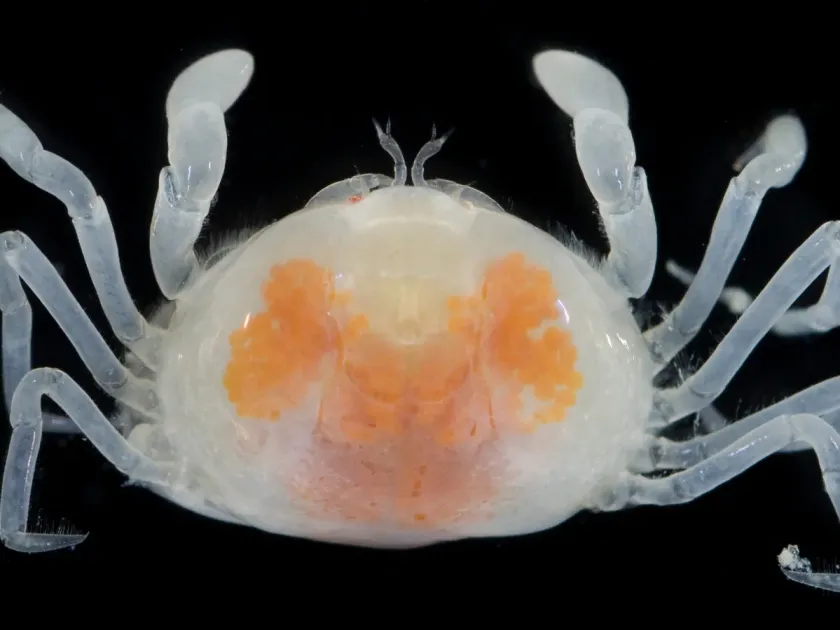
Description
How to identify
The pea crab (Pinnotheres pisum) is a diminutive crustacean belonging to the family Pinnotheridae within the order Decapoda.
Females are characterized by a soft, rounded carapace, an adaptation that allows them to live securely inside the mantle cavity of bivalve mollusks.
Males are significantly smaller and possess a harder, more robust exoskeleton to facilitate their free-swimming search for mates in the ocean.
Their name is derived from their size and shape, as they resemble small, globular peas when removed from their host.
This organism is strictly marine and lacks any physiological features that would allow it to survive or feed on terrestrial plants.
What it damages
The pea crab is not an agricultural pest; it has no impact on vegetables, crops, or any terrestrial farming systems.
Its ecological niche is exclusively within the marine environment, where it lives as a commensal or parasite inside mussels and oysters.
While it feeds on the food particles filtered by its host mollusk, causing a minor metabolic cost, it poses no threat to human-cultivated plants.
Agronomic control measures are entirely unnecessary for this species as it remains confined to saltwater habitats.
Any concerns regarding crop damage by pea crabs are based on taxonomic misconceptions, as the species is biologically incapable of terrestrial feeding.
When it appears
The life cycle of the pea crab is synchronized with the reproductive cycles of its host mollusks and water temperature fluctuations.
Larval stages are planktonic, floating in the water column and moving with currents until they locate a suitable host.
Settlement into a host usually occurs during warmer months when biological activity in coastal waters is at its peak.
After finding a host, the female settles into the mantle cavity, where it completes its growth and development over subsequent seasons.
Winter conditions lead to reduced metabolic rates for both the crab and the host, ensuring the survival of the crab throughout the year.
Signs of infestation
The presence of a pea crab is only confirmed upon opening a bivalve, such as a mussel, where the crab will be found nestled against the gills.
Hosts harboring a large pea crab may show reduced tissue mass due to the crab's competition for food particles.
There are no visible surface markings on the shells of infested mollusks that would allow for non-invasive detection.
During commercial shellfish processing, crabs are identified manually during the shucking or cleaning stage.
The presence of the crab does not render the mollusk inedible, although it may be considered an aesthetic nuisance in commercial seafood.
Control measures
No agricultural control is needed, as the pea crab does not inhabit or damage terrestrial environments.
In aquaculture, managing pea crab populations involves physical barriers and careful site selection for mussel seeding.
Chemical intervention is strictly discouraged as it would severely harm the surrounding marine ecosystem and the farmed mollusks themselves.
Efforts are focused on biological monitoring to ensure that oyster or mussel stocks remain healthy for consumer markets.
- Selection of crab-free spat for aquaculture farming.
- Physical monitoring of bivalve health during growth.
- Screening processes at processing plants to remove commensals.
Taxonomy
- Latin name
- Pinnotheres pisum
- Family
- Pinnotheridae
- EPPO code
- PINTPI
Discussion
No discussions yet — be the first.