
Weevils of the genus Phyrdenus
Phyrdenus
Description
How to identify
Beetles of the genus Phyrdenus belong to the family Curculionidae (true weevils). These insects possess the characteristic elongated rostrum, adapted for feeding on plant tissues and creating holes for egg-laying.
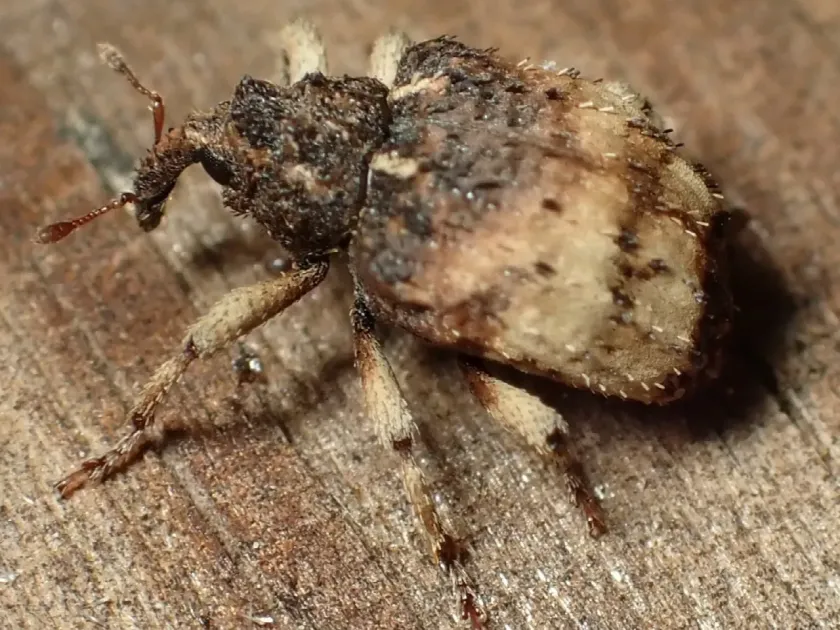
Physically, these weevils are stout-bodied, usually covered in dense scales that provide excellent camouflage against soil or plant debris. Their coloration generally ranges from gray to brown.
The larvae are legless, white or cream-colored, with a distinct dark head capsule. They lead a cryptic lifestyle, developing inside the stems or the root collars of host plants, which makes them difficult to detect.
Systematically, this genus falls under the order Coleoptera. Identifying specific species often requires microscopic examination of genital structures, as they can look very similar to other closely related pest groups.
Adults have well-developed elytra, which allows them to actively disperse to new areas in search of suitable crops, particularly in warm agro-climatic zones.
What it damages
The primary damage caused by Phyrdenus weevils occurs on solanaceous crops. They pose the greatest threat to tomatoes, eggplants, and peppers, where they can damage both young shoots and fruits.
Adult beetles feed on the epidermis of leaves and stems, creating small holes that reduce the photosynthetic area of the plant. In cases of massive outbreaks, this significantly weakens the plant's immune system.
The larval stage is the most destructive. Larvae tunnel inside the stems, which disrupts normal sap flow and nutrient transport, often leading to wilting and the eventual death of the affected plant.
The damage caused by the pest provides entry points for secondary infections, such as bacterial soft rots and fungal pathogens. Decay often develops around the puncture wounds.
Economic losses are composed of direct yield reductions and the necessity for additional protective treatments, which increase the overall production costs of vegetable crops.
When it appears
Pest activity begins in the spring when soil and air temperatures stabilize. This usually coincides with the active growth phase of solanaceous seedlings.
The summer period is characterized by peak population density. During this time, intensive adult feeding and egg-laying occur, creating a severe threat to developing fruits.
The life cycle is closely linked to temperature: during prolonged wet weather, larval development slows down, but in hot, dry conditions, their activity can reach peak levels.
By autumn, adults seek overwintering sites. They typically choose the top layer of soil, plant debris, or soil cracks to survive until the following season.
The number of generations per season depends on the climatic zone; in southern regions, two or more generations may occur, making population control significantly more complex.
Signs of infestation
The first sign of infestation is the appearance of small, round holes on the leaves of seedlings. As larvae develop inside the stem, the plant begins to show stunted growth and a chlorotic appearance.
A characteristic symptom is the sudden wilting of plant tops during the day, even with sufficient irrigation. This indicates that the larva has severed the vascular bundles inside the stem.
When inspecting the root collar, one may find entry holes bored by the larvae. Inside the damaged stem sections, pest frass (excrement), resembling fine dark dust, is often visible.
If the stem of an affected plant is cut open, the weevil larvae can easily be found. In severe cases, damaged stems may easily snap due to wind or the weight of the fruit.
- presence of beetles on the underside of leaves during morning hours
- chlorosis and yellowing of leaf margins
- deformation of the stem at the site of larval infestation
- withering of buds and premature flower drop
Control measures
Agrotechnical control methods include deep autumn plowing or tilling the soil, which helps eliminate overwintering adults by bringing them to the surface where they perish from low temperatures.
Crop rotation is crucial. It is not recommended to plant solanaceous crops in the same location for consecutive years. Returning a crop to the same plot should only occur after 3–4 years.
Systematic removal and destruction of plant residues after harvest significantly reduces the pest population by depriving them of food sources and hiding spots.
The use of biological preparations based on entomopathogenic fungi or nematodes is effective against larval stages in the soil and is considered an environmentally friendly method.
Upon reaching the economic threshold of damage, systemic insecticides may be applied. Treatments should be performed during periods of highest adult vulnerability, while strictly adhering to pre-harvest intervals.
Taxonomy
- Latin name
- Phyrdenus
- Order
- Coleoptera (beetles)
- Family
- Curculionidae
- EPPO code
- PHRDSP
Discussion
No discussions yet — be the first.