
Willow Warbler
Phylloscopus trochilus
Description
How to identify
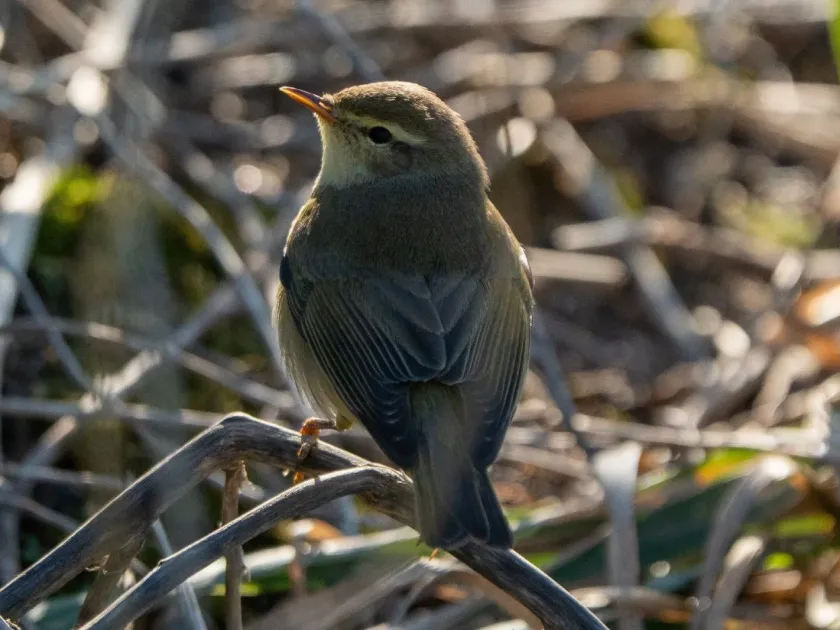
The Willow Warbler (Phylloscopus trochilus) is a small, insectivorous passerine bird belonging to the leaf warbler family, Phylloscopidae.
Physically, it features olive-brown upperparts and a pale, yellowish-white underbelly, making it well-camouflaged in the forest canopy.
It is structurally similar to the Common Chiffchaff, but can be distinguished by its distinctive, descending song and paler legs.
This species is a long-distance migrant, breeding across northern and temperate Europe and wintering primarily in sub-Saharan Africa.
Willow Warblers nest on or near the ground, concealed within dense ground vegetation, which is vital for their reproductive success.
What it damages
It is a common misconception to categorize the Willow Warbler as a pest; in reality, this bird does not damage crops, fruits, or vegetables.
Instead, it acts as a highly effective biological control agent, preying upon a vast array of agricultural and horticultural pests.
Its diet consists almost entirely of small insects, including aphids, leafhoppers, caterpillars, and various flies that can devastate fruit orchards.
By constantly foraging in the foliage of trees, the Willow Warbler helps keep populations of leaf-eating insects below damaging thresholds.
Therefore, their presence in the garden should be encouraged as they provide a natural, chemical-free way to manage common plant infestations.
When it appears
Willow Warblers arrive at their breeding grounds during the spring months, specifically from late April through May, depending on the latitude.
The period of highest activity in the garden occurs throughout June and July, coinciding with the peak of the insect breeding season.
During these months, parent birds are highly active in searching for food to supply their growing nestlings, resulting in high predation rates on pests.
By late August, the birds begin their southward migration, leaving the gardens and orchards to travel thousands of miles to their wintering sites.
The season of their beneficial activity is thus limited to the warmer months when agricultural crops are most at risk from insect attacks.
Signs of infestation
One can detect the presence of the Willow Warbler primarily through its melodious, descending song, which is a common sound in garden trees.
Observant gardeners may notice the birds hovering near the tips of branches, picking tiny insects off the undersides of leaves with great precision.
There are no signs of physical damage to plants from these birds, as they are anatomically and behaviorally unsuited for eating plant matter.
Ground-level nests are rarely seen, which is an evolutionary adaptation to avoid detection by predators during the incubation and rearing phase.
The noticeable reduction in aphid colonies on young fruit tree shoots serves as the best indicator of their successful foraging in the area.
Control measures
As a beneficial species, no control measures are necessary; on the contrary, growers should implement practices to support their presence.
Maintaining thick hedgerows and patches of tall grass provides essential cover for nesting and protects the fledglings from domestic pets.
Reducing the use of broad-spectrum pesticides is crucial, as these chemicals eliminate the bird's primary food source and may harm the birds themselves.
Providing a tranquil environment without heavy human disturbance during the spring breeding season is the best way to keep them in your garden.
- Preserve diverse ground vegetation for nesting.
- Avoid broad-spectrum chemical sprays.
- Manage domestic pets to prevent predation on ground nests.
Taxonomy
- Latin name
- Phylloscopus trochilus
- Family
- Phylloscopidae
- EPPO code
- PLOSTR
Discussion
No discussions yet — be the first.