
Green leaf weevil
Phyllobius viridicollis
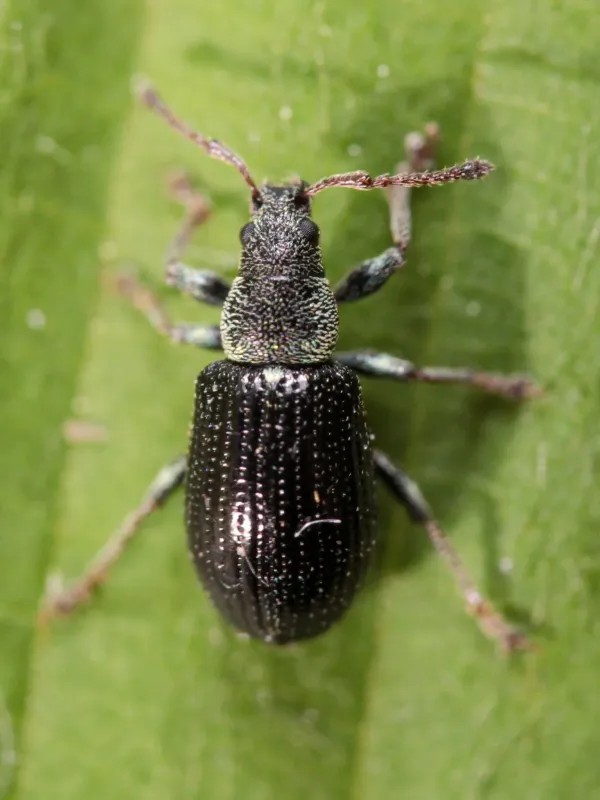
Description
How to identify
The green leaf weevil, known scientifically as Phyllobius viridicollis, belongs to the family Curculionidae. These beetles are characterized by their brilliant green or golden-green metallic color, caused by tiny scales covering their elytra.
Adult weevils are small, typically measuring 5–7 mm in length, and possess the distinctive elongated rostrum (snout) typical of the Curculionidae family. Their bodies are slightly oval and convex.
The larvae are small, legless, and white with a brown head capsule. They spend their entire developmental cycle underground, feeding on the roots of various host plants. This subterranean habit makes them difficult to monitor.
These beetles belong to the order Coleoptera and are commonly found in both woodland and orchard ecosystems. While their color is a primary diagnostic feature, it can fade as the scales wear off, sometimes causing the beetles to look dark or brown.
The adult weevils are strong fliers and are highly active during the day, especially in warm, sunny weather. This mobility allows them to colonize new host plants quickly, making them a significant pest in orchards and nurseries.
What it damages
The green leaf weevil causes damage in both its adult and larval stages. Adult weevils are active leaf eaters, feeding on the foliage of fruit trees such as apple, pear, cherry, and plum, as well as various berry bushes.
They create characteristic irregular, serrated holes along the leaf margins, often leaving the midrib intact. In severe cases, high populations can cause extensive defoliation, which severely reduces the tree's photosynthetic capacity.
Larval damage is primarily focused on the root systems. By consuming fine root hairs and young roots, the larvae can cause significant growth reduction and even kill young nursery plants.
The loss of leaf area due to adult feeding weakens the overall vigor of the host plant, making it more susceptible to environmental stressors and secondary infections such as fungi or bacteria.
Orchards and gardens with high populations of Phyllobius viridicollis often see a decline in yield and fruit quality due to the stressed condition of the trees, particularly in young or recently planted saplings.
When it appears
Adult beetles typically emerge in spring, coinciding with bud burst and the expansion of the first leaves. This is when they begin their primary feeding phase, which is critical for their reproductive development.
The peak activity of adults usually occurs in late spring and early summer, specifically May and June. During this time, mating occurs, and females lay eggs in the soil near the host plants.
After hatching, the larvae move into the soil, where they develop throughout the summer and autumn. They overwinter as larvae in the soil profile, often at shallow depths where they remain protected from extreme cold.
The lifecycle is generally univoltine, meaning one generation per year. Development resumes as soil temperatures rise in the following spring, leading to pupation and the emergence of a new generation of adults.
Understanding these seasonal patterns is essential for growers. Effective control programs should be timed to hit the adults before they start laying eggs, preventing the infestation from continuing to the next season.
Signs of infestation
The most visible sign of an infestation is the presence of serrated or ragged leaf edges, a hallmark of weevil feeding. These notches look very distinct from the smooth cuts made by some other herbivores.
You can often find the beetles themselves resting on the underside of leaves. If disturbed, they exhibit a defense mechanism known as thanatosis, or playing dead, by folding their legs and dropping from the foliage.
Wilting or yellowing of young trees that have adequate irrigation can sometimes be a sign of extensive root damage caused by larvae feeding on the root system underground.
The presence of large numbers of beetles can be confirmed by shaking branches over a white sheet during the morning hours. This is the best method to gauge the infestation level in an orchard.
In cases of heavy infestation, you may notice that the top growth of trees appears "lacy" due to extensive feeding, which is a clear indicator that immediate protective measures are required.
Control measures
Mechanical control is effective for small-scale gardens. Shaking the weevils off trees onto a cloth in the early morning, when they are sluggish, and then destroying them can keep population levels low.
Chemical control involving systemic insecticides is the standard for commercial orchards. These applications must be carefully timed to occur before the onset of full bloom to protect essential pollinators.
Cultural control practices, such as autumn and spring soil cultivation, help disturb the soil environment, exposing larvae to predators and unfavorable conditions, which can help reduce the population.
Biological control using entomopathogenic nematodes or fungi is an emerging practice. These agents can be applied to the soil to target larvae, providing a sustainable way to manage the pest without chemicals.
- Monitor tree canopies regularly in spring.
- Use pheromone or sticky traps if available for early detection.
- Manage surrounding vegetation to remove weeds that harbor the pest.
Taxonomy
- Latin name
- Phyllobius viridicollis
- Order
- Coleoptera (beetles)
- Family
- Curculionidae
- EPPO code
- PLLBVI
Discussion
No discussions yet — be the first.