
Green nettle weevil
Phyllobius urticae
Description
How to identify
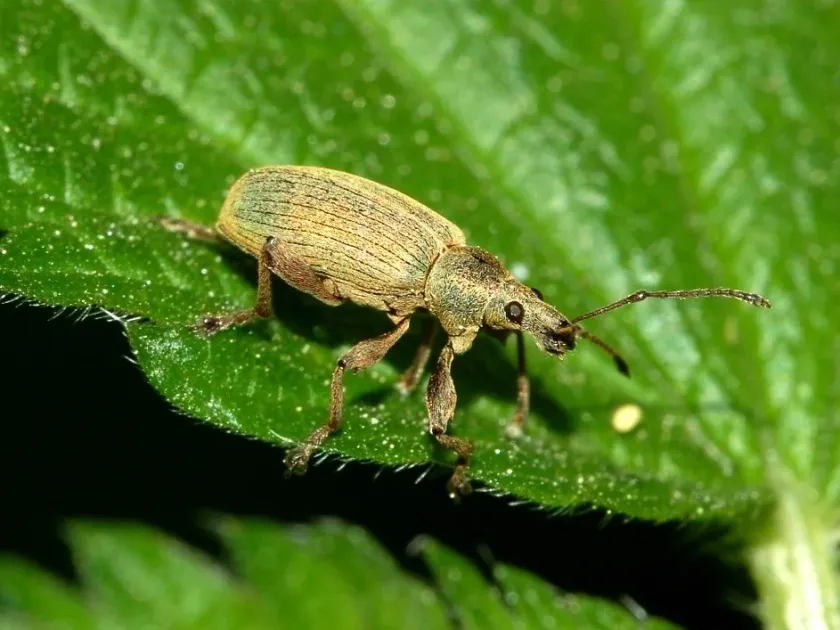
The green nettle weevil (Phyllobius urticae) is a member of the Curculionidae family. These beetles typically measure between 7 and 10 mm in length and are easily recognized by their brilliant metallic green or golden-green scales covering the elytra.
The body shape is broadly oval. Unlike many other weevils, this species has a short and broad rostrum (snout). Their legs and antennae are usually darker, often black or brownish, which creates a sharp contrast with the shimmering body.
The larvae are legless, C-shaped, and creamy white with a yellowish head capsule. They spend their entire developmental phase within the soil, feeding primarily on the fine roots of host plants.
Reproduction is sexual, and adult beetles are capable of strong flight, which facilitates their dispersal across orchards, gardens, and along forest edges where they thrive in moist environments.
They are widely distributed across temperate regions. Their preference for nettles (Urtica) often leads to significant population buildups in uncultivated areas near agricultural land.
What it damages
Adults are polyphagous, meaning they feed on a wide variety of plants. They cause the most notable damage to fruit trees such as apples, pears, and plums, as well as berry bushes like raspberries and currants.
They feed on young leaves, creating characteristic notched or serrated edges. This type of damage is often referred to as "notching," which reduces the photosynthetic efficiency of the leaves.
Besides foliage, the beetles attack developing buds. This can result in significant yield losses, as destroyed buds fail to produce flowers or fruit, essentially stripping the plant of its reproductive potential.
The larvae are damaging to roots. While their impact is often less visible than that of adults, they can severely weaken young plants, leading to stunted growth, nutrient deficiencies, and increased susceptibility to droughts.
In cases of severe infestation, the cumulative effect of adult feeding on leaves and larval damage to roots can cause considerable stress to trees and shrubs, potentially delaying plant development.
When it appears
Overwintered adults emerge in the spring, typically from late April to May, coinciding with the bud-burst stage of most fruit trees. This is when they are most active and visible.
The beetles are most active during warm, sunny days. During this time, they feed intensely on the newly emerged foliage, which is their primary source of nutrition for egg production.
The adult phase usually lasts through late spring and early summer, typically until June. After mating, females deposit their eggs into the soil near the root zone of host plants.
After hatching, the larvae move deeper into the soil to feed on roots. They remain in the soil throughout the summer and autumn, preparing to overwinter at a depth of 15-20 cm.
The species has a one-year life cycle. The larvae undergo their final development and pupation in the soil the following spring, from which new adults emerge to repeat the cycle.
Signs of infestation
The most reliable sign of a green nettle weevil infestation is the presence of "notched" leaf edges. The leaves will look as though someone has cut small semicircles out of the margins.
Visual inspection of the canopy in the morning often reveals the beetles. They have a defensive instinct to drop from branches when disturbed, landing on the ground or any placed protective cover.
Damaged or aborted buds in the spring are another indicator of their presence. If buds appear chewed or fail to open normally, it is likely that weevils have been feeding on them.
In the root zone, unexpected wilting or poor vigor in specific shrubs or small trees, especially during dry periods, may point to larval root feeding if no other obvious cause is present.
A dense population of stinging nettles nearby often serves as a reservoir for this pest. If you notice high numbers of weevils on nettles, they will likely migrate to your crops shortly.
Control measures
Physical control involves shaking the trees early in the morning. Since the beetles drop to the ground when startled, placing a cloth or plastic sheet underneath and collecting them is highly effective.
Good sanitation is crucial. Removing weeds, particularly nettles, from the vicinity of gardens and orchards reduces the breeding sites and suppresses the initial population growth.
Autumn and spring soil cultivation (tilling) around the base of trees disrupts the larval and pupal stages, exposing them to environmental stress and natural predators like birds.
If the infestation exceeds economic thresholds, targeted application of appropriate insecticides is recommended. It is vital to apply these treatments before the flowering stage to protect pollinators.
- Installation of sticky bands around tree trunks to trap climbing beetles.
- Use of entomopathogenic nematodes or fungi to manage soil-dwelling larvae.
- Encouraging natural insect predators by maintaining habitat diversity.
Taxonomy
- Latin name
- Phyllobius urticae
- Order
- Coleoptera (beetles)
- Family
- Curculionidae
- EPPO code
- PLLBUR
Discussion
No discussions yet — be the first.