
Green leaf weevil
Phyllobius pomonae
Description
How to identify
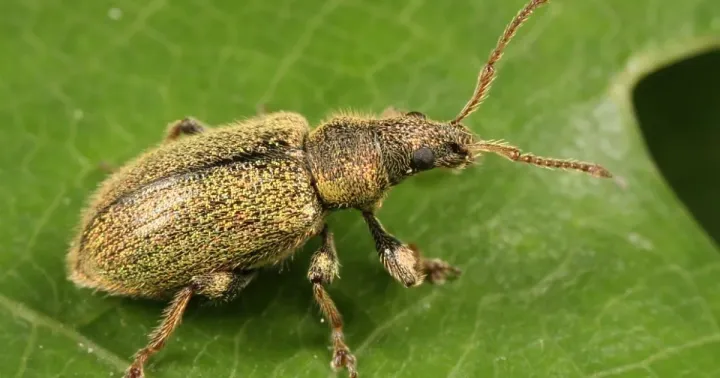
The Green leaf weevil (Phyllobius pomonae) is a species of snout beetle in the Curculionidae family. Adult beetles typically measure 7–10 mm in length and are easily recognized by their metallic green or golden-colored scales covering the body.
The head is characterized by a short, broad rostrum typical of this genus, and they possess geniculate (elbowed) antennae. Over time, the metallic scales can wear off, making the beetle appear darker or even black in some cases.
Larvae have a whitish, legless, C-shaped body with a distinct dark head capsule. They live exclusively in the soil, feeding on the root systems of various plants, which makes them invisible to casual observation.
The life cycle is primarily univoltine, meaning one generation per year. Winter is spent in the soil as larvae, which descend to deeper layers to avoid freezing temperatures during the dormant season.
In late spring, larvae pupate within the soil. By early summer, new adults emerge to climb onto trees, where they begin their feeding and mating cycle, completing the biological rotation.
What it damages
Adult weevils are foliage feeders. They consume leaf margins, often creating a notched or serrated appearance. In severe cases, they can strip leaves down to the midrib, significantly reducing photosynthetic capability.
They are polyphagous pests, known to damage a wide variety of fruit trees including apple, pear, and plum, as well as soft fruit bushes like raspberries and strawberries.
The larvae are subterranean feeders. By damaging the fine root hairs, they impair the plant's ability to uptake water and nutrients, leading to reduced vigor and stunted growth in affected saplings.
In nursery settings, heavy infestations can result in the loss of aesthetic and physiological quality of young trees. This weakens the plant's overall resilience against environmental stressors.
Although they rarely kill mature trees, cumulative damage over several seasons can lead to diminished yields and reduced fruit size, as the trees struggle to maintain energy reserves.
When it appears
Adult weevils typically emerge in May, correlating with the onset of the growing season and the formation of fresh leaves on orchard trees. They remain active through June.
During the day, adults tend to be somewhat cryptic. If disturbed, they exhibit 'thanatosis' (playing dead) and drop from the foliage to the ground, which is a key behavioral trait for identification.
Mating and egg-laying occur in the mid-summer months. Once the females have deposited their eggs into the soil surrounding the host plants, the adult population begins to decline.
Larvae emerge from eggs in the summer and actively feed on roots throughout the autumn months. They remain active until the soil temperature drops, at which point they burrow deeper for winter survival.
Monitoring for adults should be prioritized in late spring and early summer, as this is the period when they are most accessible for intervention and when damage to the foliage is most visible.
Signs of infestation
The primary visual sign is notched leaf edges. The pattern of feeding is irregular, giving the foliage a ragged, tattered look that distinguishes it from chewing damage by caterpillars.
Shaking tree branches over a white sheet is a very effective diagnostic method. If Phyllobius pomonae is present, the metallic beetles will quickly fall, making it easy to confirm their presence.
Poor tree health, chlorosis, or unexpected wilting—especially during dry spells—can indicate that the root system has been compromised by a significant population of soil-dwelling larvae.
Reduced terminal growth in young trees is a classic sign of persistent infestation. When foliage is constantly being consumed, the tree fails to build enough energy for optimal growth.
Observation of the soil surface near the trunk during the summer may occasionally reveal emerging adults, though this is less common than spotting them on the canopy leaves.
Control measures
Cultivation practices such as regular hoeing or shallow tilling of the soil under the canopy can significantly reduce the larval population by exposing them to desiccation and predators.
Manual collection in the early morning is highly effective for small gardens. Simply place a sheet under the tree and shake the branches; the beetles will fall, and you can collect and dispose of them.
Chemical control with contact insecticides may be necessary during heavy outbreaks. These should be applied according to local regulations, focusing on the pre-flowering or post-flowering stages.
Maintaining a clean orchard floor by removing weeds reduces alternative host plants for the larvae, which helps suppress the population density within the garden area.
For sustainable orchards, biological control using parasitic nematodes or entomopathogenic fungi applied to the soil can target the larval stage without harming beneficial pollinators or predators.
Taxonomy
- Latin name
- Phyllobius pomonae
- Order
- Coleoptera (beetles)
- Family
- Curculionidae
- EPPO code
- PLLBPO
Discussion
No discussions yet — be the first.