
Green leaf weevil
Phyllobius pomaceus
Description
How to identify
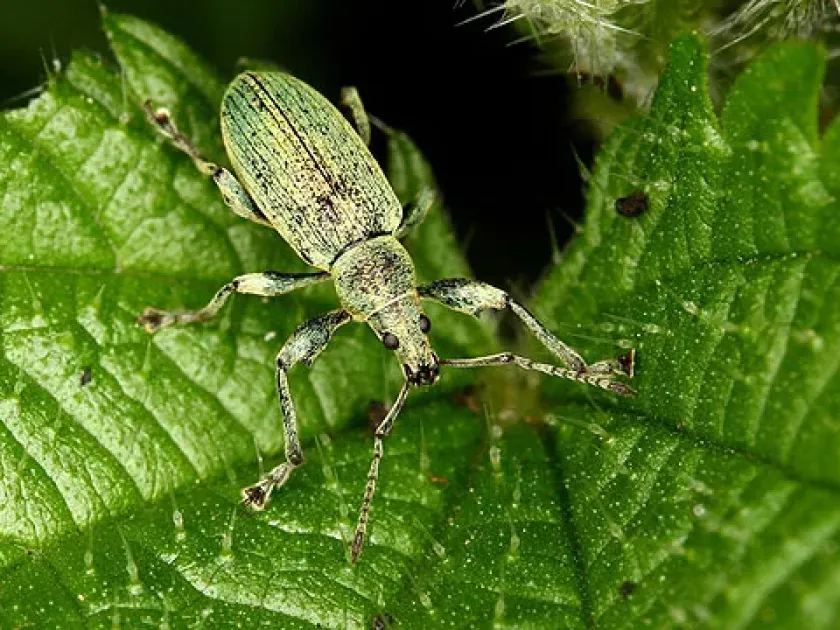
The green leaf weevil Phyllobius pomaceus belongs to the order Coleoptera and the family Curculionidae. The adult is a beetle measuring 6–9 mm in length, characterized by its bright metallic green or golden-green appearance.
The body is oval-shaped and densely covered with small scales that provide its distinctive shiny color. The snout (rostrum) is short and broad, while the legs and antennae are typically reddish-brown.
The larvae are white, legless, and have a dark head capsule. They live underground, where they spend most of their life cycle feeding on the root systems of various herbaceous and woody plants.
Adult beetles are diurnal and highly active during sunny weather. When threatened, they exhibit a defense mechanism by folding their legs and dropping from the leaves to the ground, where they remain perfectly still.
This species typically produces one generation per year. The larvae overwinter in the soil, pupating in the spring before emerging as adults just in time for the new vegetative growth of trees.
What it damages
Adult weevils primarily damage leaves, feeding on a wide range of fruit trees including apple, pear, cherry, and plum. They are also common pests of wild shrubs and herbaceous plants like nettles.
The larvae feed on roots, which can cause significant growth stunting, particularly in young saplings and nursery stock. This subterranean damage is often overlooked until the plant begins to show signs of decline.
Feeding by adults causes characteristic leaf notches. In cases of heavy infestation, trees may suffer from partial or complete defoliation, which severely reduces their photosynthetic capacity.
Economic damage is most severe in young orchards where defoliation can delay the development of the tree and reduce the formation of flower buds for the subsequent season.
Heavy infestation not only weakens the plant's health but also creates entry points for fungal or bacterial pathogens, making the tree more susceptible to secondary infections.
Signs of infestation
The most recognizable sign is the scalloped or notched appearance of the leaf margins. Beetles feed on the edges of the leaves, creating irregular semi-circular shapes.
Adult beetles can often be spotted on the foliage by carefully inspecting the underside of leaves or by gently shaking the branches over a white cloth to collect the falling insects.
Yellowing of foliage, general stunted growth, and a lack of vigor despite adequate irrigation may indicate that larvae are damaging the root system below the soil surface.
In nurseries or gardens with high weed populations, damage to the leaves of surrounding flora is often a clear indicator of a burgeoning population of green leaf weevils.
Early seasonal inspections in May and June are crucial, as the damage is usually most extensive when the first leaves are fully expanding and the beetles are at their peak activity.
Control measures
Manual collection remains a simple yet effective method for small gardens. Shaking branches over a sheet early in the morning allows for the easy capture and disposal of the beetles.
Cultural control practices, such as maintaining a weed-free environment around the base of trees, are essential to reduce the attractiveness of the area to adult weevils.
Chemical control should be employed only when monitoring suggests the population has exceeded the economic threshold. Use selective insecticides that are safe for pollinators.
Soil cultivation in the root zone can disrupt the larval stage, reducing the survival rate of the next generation and preventing them from reaching the adult stage.
- Applying approved insecticides before the onset of flowering.
- Encouraging natural predators such as birds and ground beetles.
- Monitoring the health of saplings and root zones throughout the season.
Taxonomy
- Latin name
- Phyllobius pomaceus
- Order
- Coleoptera (beetles)
- Family
- Curculionidae
- EPPO code
- PLLBPM
Discussion
No discussions yet — be the first.