
Green leaf weevil
Phyllobius oblongus
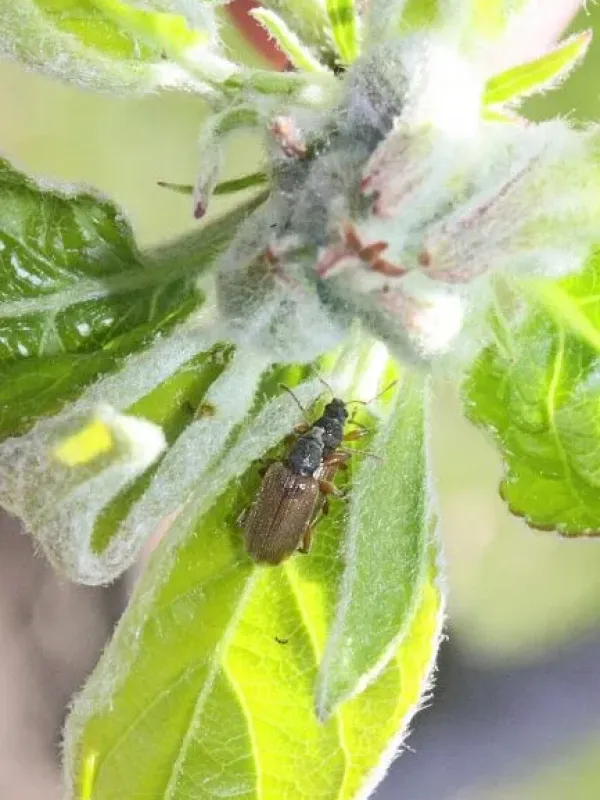
Description
How to identify
The green leaf weevil (Phyllobius oblongus) belongs to the Curculionidae family. These beetles are typically 4–6 mm long and are easily recognized by their metallic green or golden-bronze scales covering the body.
The snout of the beetle is relatively short and broad. Unlike many other weevils, this species has a robust appearance, which is common for the Phyllobius genus, and they are capable fliers on warm days.
The larvae are legless, white, and C-shaped, primarily living in the soil. They are highly specialized to reside in the rhizosphere of various woody plants, where they feed on rootlets.
The life cycle is univoltine, meaning it completes one generation per year. The larvae overwinter deep in the soil, transitioning to the pupal stage in the spring before emerging as adults.
Adults emerge from the soil at the start of the growing season, precisely when trees are producing new buds and young leaves, marking the beginning of their feeding phase.
What it damages
The green leaf weevil infests a wide range of fruit trees, including apple, pear, and plum, as well as several broad-leaved forest trees like oak, beech, elm, and hazelnut.
Adult beetles cause the most significant damage by feeding on young foliage, buds, and flowers during the spring. Heavy infestations can lead to complete skeletonization of leaves, leaving only veins.
Larval feeding on the roots is often overlooked but can be severely damaging, particularly in nurseries where it causes stunted growth and reduced vigor in young saplings.
The primary concern for growers is the reduction in leaf area, which limits the tree's photosynthetic capacity, ultimately resulting in reduced fruit yields and general tree stress.
In cases of high pest pressure, the repeated defoliation can significantly weaken trees, making them more susceptible to secondary pests and various environmental stressors.
Signs of infestation
The most prominent sign of infestation is the presence of semi-circular or irregular notches along the leaf margins, which are characteristic of adult weevil feeding patterns.
Observing the beetles is straightforward: they are often found on the undersides of leaves or resting on twigs, especially during the brighter, warmer parts of the day.
A classic diagnostic technique is the "tap test," where branches are shaken over a white sheet; the beetles will fall and play dead, allowing for quick population density assessment.
In nursery environments, declining vigor, yellowing leaves, and poor growth in young trees without any visible foliage pests often indicate root damage by larvae.
Significant bud loss or damaged blossoms early in the spring are early warnings of a burgeoning population that may lead to more severe damage later in the season.
Control measures
Cultural control practices, such as autumn soil cultivation or tilling around the base of trees, are highly effective at disturbing overwintering larvae and exposing them to predators.
Manual removal of adults by shaking branches in the morning, when the insects are sluggish, is a viable strategy for small orchards or residential landscapes.
Chemical control involving insecticides is recommended during the bud-burst stage if population thresholds are exceeded to protect the vital new growth of the fruit trees.
Maintaining optimal tree health through proper fertilization and irrigation helps trees recover more quickly from moderate leaf damage caused by adult weevils.
- Use of sticky or mechanical barrier traps on tree trunks to block weevil access.
- Application of biological control agents, including entomopathogenic fungi or nematodes.
- Monitoring population levels throughout the early spring to time insecticide applications accurately.
Taxonomy
- Latin name
- Phyllobius oblongus
- Order
- Coleoptera (beetles)
- Family
- Curculionidae
- EPPO code
- PLLBOB
Discussion
No discussions yet — be the first.