
Green leaf weevil
Phyllobius maculicornis
Description
How to identify
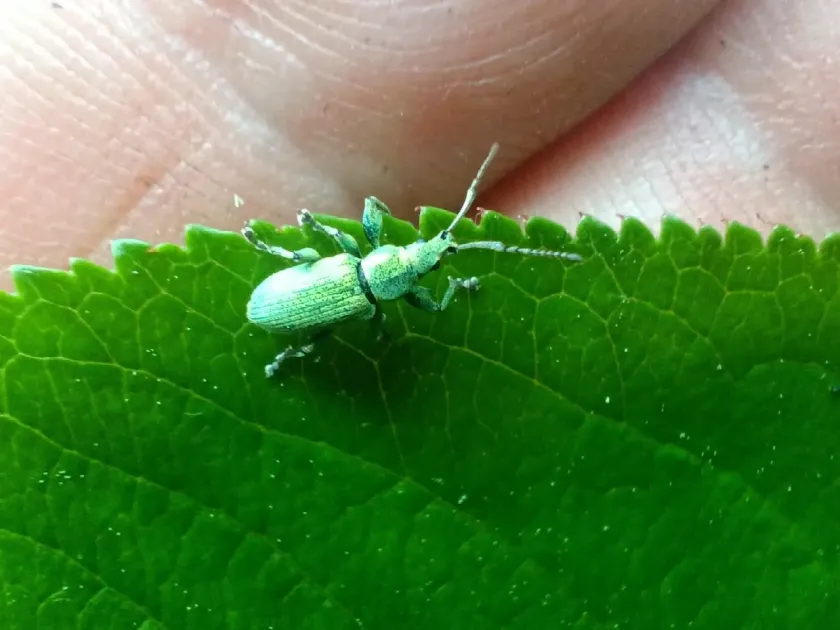
The green leaf weevil (Phyllobius maculicornis) is a beetle species in the Curculionidae family. Adult weevils are typically 5–7 mm long and are easily recognized by their metallic green or golden-green scales covering their bodies.
The morphology of the beetle features a short rostrum (snout) and elbowed antennae. The larvae are legless, white-colored with a brown head, and develop primarily within the soil.
The life cycle involves complete metamorphosis, moving through egg, larval, pupal, and adult stages. The adult stage is the most destructive, as they are active defoliators during the spring and early summer.
They overwinter as larvae deep in the soil, which provides protection from extreme winter temperatures. As the ground warms in spring, larvae move to the upper soil layers to pupate.
These weevils are highly adapted to the foliage canopy. They are known for their habit of "playing dead" and dropping to the ground when disturbed, which is a defensive strategy against predators.
What it damages
Adult weevils cause significant damage by feeding on the leaves of deciduous trees. They characteristically eat the edges of leaves, creating jagged or scalloped notches in the foliage.
Their host range includes various fruit trees such as apple, pear, plum, and cherry. They also affect forest species, specifically oaks and hazelnuts, which can be detrimental to young plantations.
Severe infestations lead to massive defoliation, which reduces the tree's ability to conduct photosynthesis, thereby hindering growth and weakening the tree's overall vigor.
Larval damage in the soil is often overlooked but affects the root systems of trees and shrubs. This is particularly harmful to nursery saplings, often causing stunted development or failure to thrive.
Repeated yearly damage can lead to crown deformation and predispose trees to secondary infections by various pathogens due to the stress induced by leaf loss.
When it appears
The emergence of adult weevils from the soil usually coincides with the bloom period or the post-blossom phase of fruit trees, typically spanning from May through June.
Activity is highest on warm, sunny days when the weevils are most mobile, feeding, and mating within the canopy of the host trees.
The egg-laying period is relatively extended, meaning that adult beetles may be present in the garden or orchard until mid-summer before they die off.
Larval development in the soil is temperature-dependent. Warm spring conditions speed up the pupation process, leading to a concentrated wave of adult emergence.
By late summer and autumn, the new generation of larvae moves deeper into the soil profile to avoid the cold, preparing for their overwintering stage.
Signs of infestation
The primary symptom of a green leaf weevil infestation is the presence of distinctive, irregular, or "scalloped" feeding marks along the margins of leaves.
Direct observation of adult beetles on the leaves is common in late spring. Shaking a branch over a sheet or tray will often cause the weevils to fall off, making them easy to identify.
Trees that appear prematurely thinned or have a "ragged" look to their foliage during the early growing season are strong indicators of significant weevil presence.
Reduced terminal growth in young saplings, accompanied by marginal leaf damage, confirms that the insect population is impacting the plant's health.
In highly infested areas, the sound of active feeding by large numbers of beetles can sometimes be detected during calm, quiet conditions in the orchard.
Control measures
Chemical control involving systemic or contact insecticides is effective if applied when the first adult beetles emerge, usually after the tree blossoms.
Cultural practices, such as cultivating the soil beneath the canopy in early spring, can disrupt the pupation process and kill larvae before they emerge as adults.
Mechanical removal by hand-shaking branches in the cool early morning hours can significantly reduce local populations in small gardens or organic orchards.
Maintaining a clean garden environment by removing weeds and debris minimizes the alternative host plants available to the larvae and adults.
- Applying entomopathogenic nematodes to the soil to target larvae.
- Installing sticky bands on tree trunks to catch climbing insects.
- Encouraging natural bird predators in the orchard to manage beetle populations.
Taxonomy
- Latin name
- Phyllobius maculicornis
- Order
- Coleoptera (beetles)
- Family
- Curculionidae
- EPPO code
- PLLBMA
Discussion
No discussions yet — be the first.