
Japanese leaf weevil
Phyllobius intrusus
Description
How to identify
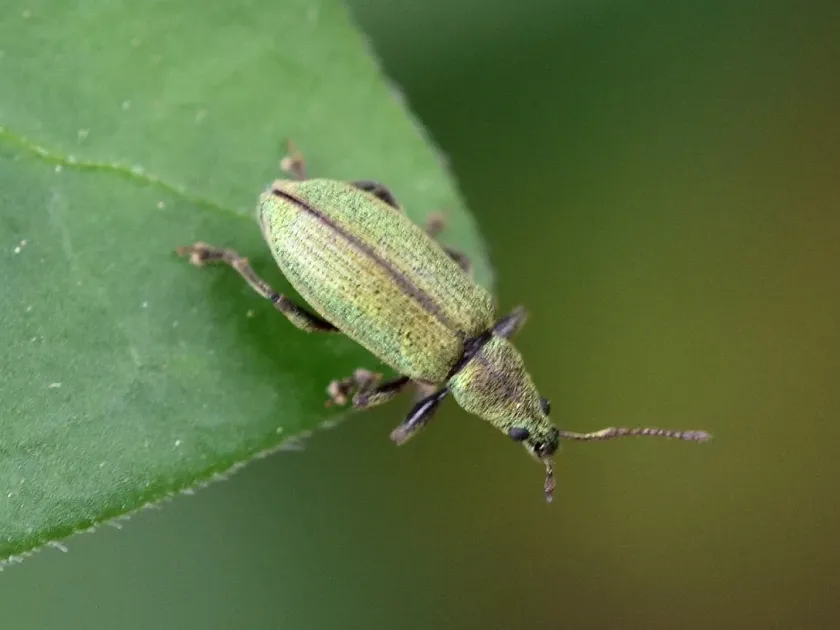
The Japanese leaf weevil (Latin: Phyllobius intrusus) belongs to the order Coleoptera and the family Curculionidae. Like other members of this family, it features a distinct snout or rostrum used for feeding.
Adult weevils are typically covered with small scales that give them a metallic green or golden sheen. This coloration serves as excellent camouflage against the foliage of host plants.
The larvae of this species have a secretive lifestyle, residing primarily within the soil. They possess a characteristic legless body shape, white color, and a dark, hardened head capsule.
Development proceeds via complete metamorphosis. The life cycle encompasses egg, larva, pupa, and adult stages, with each phase being highly dependent on soil moisture and ambient temperature.
A crucial diagnostic feature is the seasonal emergence of adults, which appear en masse on host plants during the breeding season to feed and lay eggs.
What it damages
Adult Japanese leaf weevils feed on the leaves and needles of various ornamental and fruit-bearing plants. They pose a significant threat to young plantings, where foliage damage can severely stunt growth.
Host plants include a wide range of broadleaf trees and conifers, such as arborvitae or junipers. In some cases, the pest may also affect nearby fruit-bearing shrubs.
Larvae living in the root zone cause damage equally significant to that of the adults. By feeding on fine feeder roots, they weaken the root system and diminish the plant's overall vigor.
Extensive root damage by larvae makes the plant highly susceptible to fungal infections and drought stress. This often manifests as premature yellowing and dropping of foliage.
Plants already under stress (e.g., due to poor irrigation or soil nutrition) are particularly vulnerable and may suffer total mortality if the infestation levels are high.
When it appears
Adult emergence typically occurs in late spring and early summer, coinciding with the onset of stable warm weather. This is when weevils leave their overwintering sites to begin active feeding and mating.
Oviposition takes place in the soil directly beneath host plants. Depending on the climatic region, this process may span several weeks, ensuring a staggered emergence of the next generation.
The larval stage is the most prolonged phase of the life cycle. Most of the warm season is spent in the soil feeding on roots, with larvae burrowing deeper as winter approaches to hibernate.
Pupation generally occurs the following spring within soil cells. This process is closely tied to soil warming, which makes early spring cultural practices essential for pest suppression.
Thus, the pest's life cycle is perfectly synchronized with the host plants' growing season, allowing the insect to optimize its resource utilization for survival and reproduction.
Signs of infestation
The first sign of adult infestation is the characteristic "notching" or "scalloping" along the edges of leaves and needles. Foliage will appear jagged as if punched out by a hole puncher.
In cases of heavy infestation, the tree canopy may become sparse, and young shoots may appear deformed due to excessive feeding during the period of rapid growth.
Another critical indicator is sudden wilting or discoloration not associated with drought or trunk diseases. This frequently points to root system compromise caused by underground larval activity.
Excavating the soil around the base of affected plants often reveals the larvae. They usually cluster at a depth of 10–15 centimeters, where the primary nutrient-absorbing roots are located.
Indirect evidence includes the presence of large amounts of frass on the leaves and beneath the tree canopy, which confirms high levels of adult feeding activity.
Control measures
The primary control method involves using systemic insecticides, which effectively manage both foliage-feeding adults and soil-dwelling larvae when applied as a soil drench.
Treatments are most effective when applied during the peak emergence period of adults to prevent oviposition. Repeated applications may be necessary to target different developmental stages.
Cultural control measures include regular soil cultivation around the base of trees in spring and autumn. This destroys pupal cells and exposes larvae to predators like birds.
Improving overall plant health through balanced fertilization and adequate irrigation helps enhance the resilience of the host plants against pest pressure.
- Application of biological insecticides containing entomopathogenic fungi.
- Installation of sticky barriers on trunks to trap migrating adults.
- Strict adherence to quarantine measures when purchasing nursery stock from infested sources.
Taxonomy
- Latin name
- Phyllobius intrusus
- Order
- Coleoptera (beetles)
- Family
- Curculionidae
- EPPO code
- PLLBIN
Discussion
No discussions yet — be the first.