
Green leaf weevil
Phyllobius argentatus
Description
How to identify
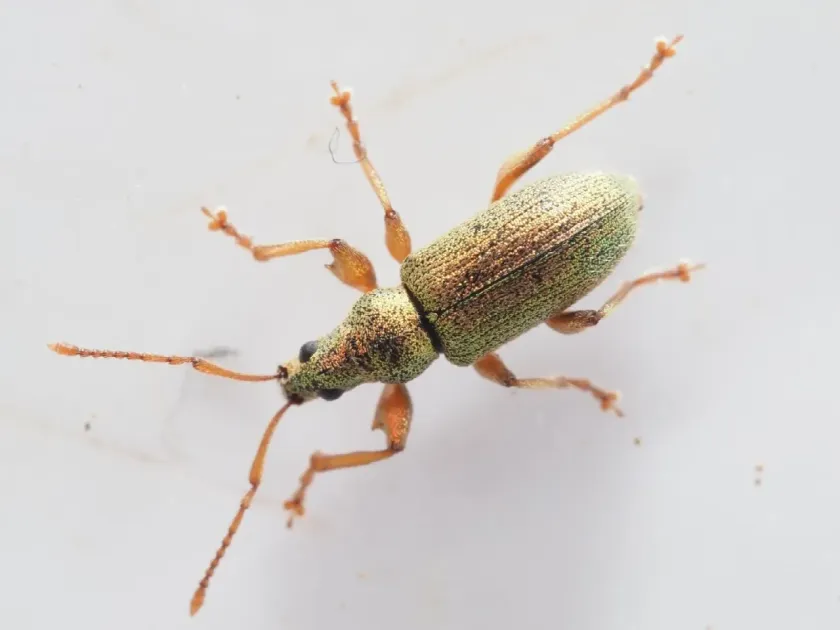
The green leaf weevil (Phyllobius argentatus) is a member of the Curculionidae family, easily recognizable by its vibrant, metallic green appearance.
Adult beetles are relatively small, usually measuring between 3 and 6 millimeters in length. Their bodies are covered with shimmering green scales that reflect light.
They possess a short, robust snout, typical of the Phyllobius genus. The legs and antennae usually exhibit a reddish-brown coloration, contrasting with the green body.
The larvae are typically C-shaped, legless, and white with a distinct brown head capsule. They live underground, feeding on the roots of various plants.
The life cycle involves complete metamorphosis, including the egg, larva, pupa, and adult stages. The insect spends the winter in the larval stage deep in the soil.
What it damages
This species is a polyphage, meaning it feeds on a wide variety of plant hosts, making it a common pest in orchards, gardens, and forests.
Key host plants include fruit trees like apple, pear, plum, and cherry, as well as forest trees like birch, alder, hazel, and beech.
The adults damage plants by eating the edges of leaves. This feeding pattern creates characteristic notches, which can reduce the leaf surface area significantly.
Larvae living in the soil consume fine root hairs. While this damage is often overlooked, high populations can stunt the growth of young trees and seedlings.
Severe infestations can lead to significant defoliation, stressing the plants and potentially reducing the yield of fruit-bearing trees during the growing season.
When it appears
The emergence of overwintering adults typically begins in the spring, coinciding with the bud-burst and the appearance of fresh green foliage.
The peak activity period for adult beetles is in May and June, when they feed intensively, mate, and move across the foliage of host trees.
After mating, females lay their eggs in the soil around the base of host plants. Most adults die off by mid-summer, ending their seasonal life cycle.
Once hatched, the larvae spend the rest of the summer and autumn feeding on roots, accumulating energy reserves for the upcoming winter dormancy.
The larvae hibernate deep in the soil throughout the winter. As spring arrives, they pupate and transform into the next generation of adult weevils.
Signs of infestation
The most visible sign of an infestation is the presence of uneven, notched leaf margins, which clearly indicate the feeding activity of the weevils.
Bright green, metallic-looking beetles can be easily spotted on the leaves, especially on warm, sunny days when they are most active.
A notable behavior is the weevil's defense mechanism: when disturbed, they drop from the leaves to the ground, appearing to play dead to escape detection.
An abundance of partially eaten leaves across the canopy is a clear indicator of a significant population density that may require control measures.
In nursery settings, a lack of vigor or stunted growth in young trees, combined with visible leaf damage, suggests the presence of both larval and adult weevils.
Control measures
Managing the green leaf weevil involves a combination of cultural, mechanical, and, if necessary, chemical strategies to protect your trees.
- Hand-picking or shaking beetles onto a sheet and destroying them early in the morning.
- Cultivating the soil around the base of trees in autumn to expose larvae to natural predators.
- Using sticky barriers on tree trunks to prevent adult weevils from climbing.
- Applying appropriate contact insecticides during the peak activity period if thresholds are exceeded.
- Encouraging natural bird populations, as they are effective predators of adult beetles.
Taxonomy
- Latin name
- Phyllobius argentatus
- Order
- Coleoptera (beetles)
- Family
- Curculionidae
- EPPO code
- PLLBAG
Discussion
No discussions yet — be the first.