
Green leaf weevil
Phyllobius arborator
Description
How to identify
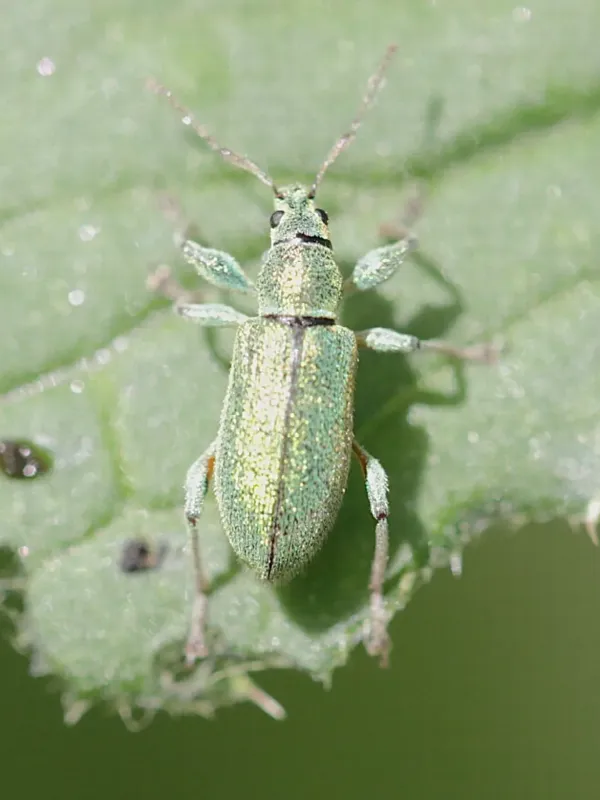
The green leaf weevil (scientific name Phyllobius arborator) is a member of the Curculionidae family. These beetles are characterized by their iridescent green or golden scales, which provide effective camouflage on leaves.
They possess a typical weevil morphology with a short, broad snout. The antennae are elbowed and inserted on the rostrum, which is a key diagnostic feature for this specific genus.
The larvae are legless, white, and crescent-shaped, with a small, hardened, brown head. They are primarily subterranean, spending their life cycle in the upper layers of the soil.
Adult beetles are highly mobile and active flyers, especially during sunny, warm spring days. This behavior allows them to move rapidly between host plants in orchards and forests.
Understanding their taxonomy and morphology is essential for correct identification, as there are many similar species within the Phyllobius genus that may require different management strategies.
What it damages
Phyllobius arborator primarily targets broad-leaved trees and shrubs. In orchards, they are commonly found on apple, pear, cherry, and plum trees, often causing noticeable defoliation.
Besides fruit trees, these weevils frequently infest forest species, including birch, alder, and hazel. Their presence can significantly impact the health of saplings in nurseries.
Adult feeding causes characteristic damage to leaf margins. They chew distinctive notches, which can lead to severe leaf loss if the population density is high enough during the spring flush.
The larvae feed on the roots of plants, which can be detrimental to young trees or those in weakened conditions. This underground damage is often overlooked until the plant starts showing signs of stress.
Cumulative damage from both adults and larvae affects the tree's overall vigor, reducing its ability to store nutrients for the following year and potentially lowering fruit yields.
When it appears
Adult emergence typically begins in late spring, coinciding with the bud-burst stage of deciduous trees. This timing ensures that beetles have immediate access to fresh, tender foliage.
The peak activity period lasts from May through June. During this window, adult weevils feed actively, mate, and lay their eggs in the soil around the base of host plants.
Egg hatching follows, and the young larvae migrate into the soil to begin their feeding cycle. They develop throughout the summer and autumn months.
The larvae continue to feed until lower temperatures in late autumn signal the need for overwintering. They burrow deeper into the soil to survive the cold months.
Pupation occurs in the spring within a soil cell, shortly before the new generation of adults emerges to restart the life cycle of the species.
Signs of infestation
The most visible sign of an infestation is the presence of "scalloped" edges on leaves. These semicircular notches are the hallmark of adult Phyllobius feeding activity.
In cases of severe infestation, the leaves may be reduced to their midribs. This skeletal appearance is a strong indicator of high beetle populations in the orchard.
Premature leaf drop and generalized wilting can occur, especially if the root system has been compromised by the larvae. Chlorosis of the leaves may also be observed in severe cases.
Beetles can often be detected by placing a white sheet under tree branches and gently shaking them. The beetles will drop and remain still, making them easy to spot.
Stunted shoot growth and a general lack of vigor in young fruit trees are common indicators of larval root feeding, necessitating an examination of the soil and roots.
Control measures
Effective management of Phyllobius arborator relies on a combination of cultural practices, mechanical removal, and targeted chemical applications.
Mechanical removal is effective for small-scale gardens. Shaking the trees early in the morning, when the beetles are less active, allows for their collection and removal from the site.
Cultivation practices, such as autumn soil turning around the trunks, help expose overwintering larvae to predators and unfavorable environmental conditions, reducing the population.
If chemical control is necessary, apply appropriate insecticides during the early stages of adult emergence before significant damage occurs to the developing leaves.
- Regular monitoring of tree canopies in late spring
- Using sticky bands on tree trunks to trap adults
- Maintaining healthy soil moisture to boost plant resilience
- Encouraging natural predators such as birds and ground beetles
Taxonomy
- Latin name
- Phyllobius arborator
- Order
- Coleoptera (beetles)
- Family
- Curculionidae
- EPPO code
- PLLBAB
Discussion
No discussions yet — be the first.