
Leaf weevil
Phyllobius
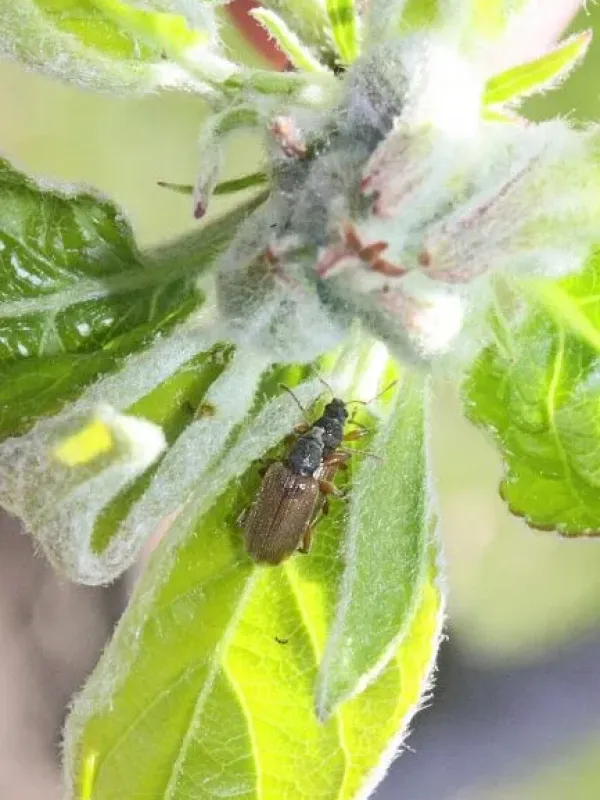
Description
How to identify
The leaf weevil (genus Phyllobius) is a small beetle belonging to the Curculionidae family. Adults typically measure between 3 and 10 mm in length, making them easily observable in the garden.
The body of these beetles is covered in iridescent scales, giving them a metallic green, golden, or copper sheen. This coloration makes them distinct among other common leaf-feeding insects.
The snout, or rostrum, of the Phyllobius species is characteristically short and broad. This anatomical feature is a diagnostic marker used by agronomists to identify the genus accurately.
Larvae of the leaf weevil are C-shaped, legless, and possess a creamy white body with a hardened brown head. They are primarily soil-dwellers and remain hidden from view throughout their development.
These beetles undergo complete metamorphosis. The life cycle is generally univoltine, meaning one generation per year, with the overwintering stage usually being the mature larva in the soil.
What it damages
The leaf weevil is a polyphagous pest, meaning it attacks a wide array of plant species. Fruit trees like apple, pear, and plum are particularly susceptible to adult feeding damage.
Ornamental shrubs, such as roses, lilacs, and hawthorns, often suffer from defoliation caused by these beetles. The aesthetic damage can be severe in residential gardens and nursery settings.
Broadleaf forest trees, including birch, oak, and linden, are also host plants. During population explosions, entire rows of trees can show significant leaf loss due to the feeding activity of the weevils.
Berry crops such as strawberries and raspberries can be severely impacted during the spring. The adults feed on the emerging leaves and buds, potentially reducing the overall fruit yield.
In addition to leaf feeding, the larvae live in the root zone and feed on the fine root hairs of plants, which can cause stunted growth, especially in young nursery stock.
When it appears
Adults emerge from the soil in mid-to-late spring, coinciding with the first flush of plant growth. Their appearance is synchronized with the availability of tender leaves and developing flower buds.
The peak feeding season occurs in May and June. During this time, the beetles are highly active, feeding throughout the day and mating to ensure the next generation.
By mid-summer, the adult population begins to decline as the reproductive phase concludes and females deposit eggs in the soil around host plants.
Larval development takes place throughout the summer and early autumn. The larvae remain active in the rhizosphere, consuming root tissues and storing energy for the winter period.
As soil temperatures drop in the autumn, the larvae migrate to deeper soil layers to overwinter, remaining dormant until the return of warm conditions in the following spring.
Signs of infestation
The most recognizable symptom of a leaf weevil infestation is the presence of scalloped or notched leaf edges. The insects consume the leaf margins, creating a characteristic semi-circular pattern.
Severe infestations can lead to heavy defoliation, where only the central veins of the leaves remain. This gives the tree a sparse, unhealthy appearance that is easily spotted from a distance.
Young buds may be completely destroyed before opening in the spring, leading to poor branch development and potentially deformed growth patterns in young fruit trees.
Direct observation is possible by shaking branches over a white sheet during the early morning hours. The beetles exhibit thanatosis (the act of playing dead) and will drop from the canopy.
Digging in the soil beneath an affected tree will often reveal the C-shaped larvae in the upper layers, confirming the presence of the pest population in the orchard or garden.
Control measures
Mechanical control is effective in small areas; this involves shaking the beetles from trees early in the morning and collecting them for disposal before they can feed or disperse.
Cultural practices, such as cultivating the soil beneath host plants in the autumn, can disrupt the overwintering larvae, exposing them to predators and harsh weather conditions.
Biological control using entomopathogenic nematodes or fungi is an increasingly popular method. These treatments target the larvae in the soil, effectively reducing the population before adults emerge.
Chemical control should be timed to match the mass emergence of adults in the spring. Contact or systemic insecticides are usually applied just after the flowering stage to protect new foliage.
An integrated pest management (IPM) approach is recommended, combining regular monitoring, proper soil maintenance, and targeted insecticide applications to minimize the use of chemicals.
Taxonomy
- Latin name
- Phyllobius
- Order
- Coleoptera (beetles)
- Family
- Curculionidae
- EPPO code
- PLLBSP
Discussion
No discussions yet — be the first.