
Castor webworm
Phycita diaphana
Description
How to identify
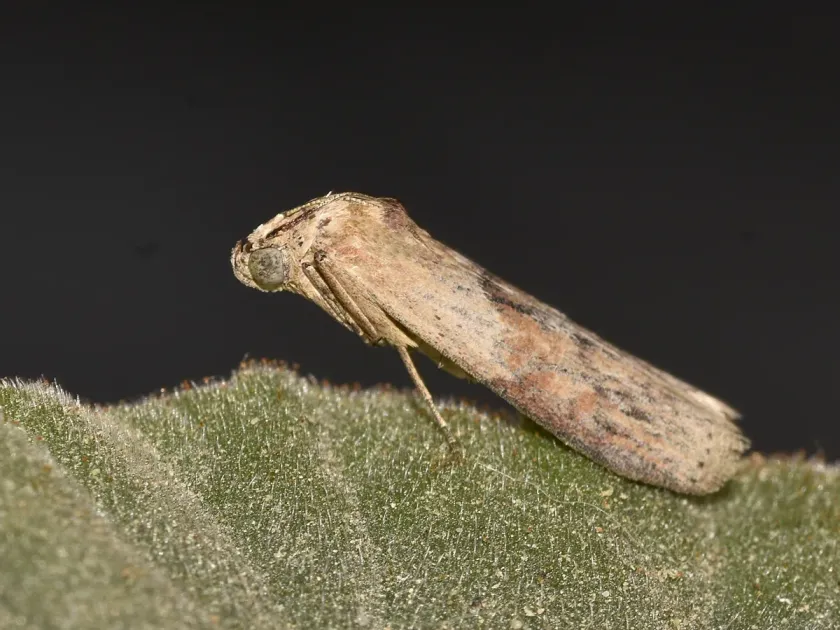
The castor webworm, scientifically known as Phycita diaphana, is a moth species belonging to the Pyralidae family within the order Lepidoptera.
Adult moths are relatively small with a wingspan of approximately 20–25 mm, characterized by grayish-brown forewings that display subtle dark patterns.
These moths are highly cryptic, blending seamlessly with the foliage of their host plants, which makes visual detection of adults challenging in the field.
The larvae progress through several instars, changing their coloration from translucent or light shades to a greenish-brown pattern with distinct longitudinal stripes.
Pupation occurs within a firm, dark brown cocoon, often sheltered inside folded leaves or within plant debris near the soil surface to ensure winter survival.
What it damages
The primary host for Phycita diaphana is the castor bean plant (Ricinus communis), which is highly susceptible to larval feeding damage.
Beyond castor, the pest may occasionally exploit other members of the Euphorbiaceae family, particularly in environments where alternate host plants are abundant.
Larvae are foliage feeders; they start by scraping the epidermis of leaves and eventually consume entire leaf blades, leaving only the main veins behind.
Infestations often extend to the reproductive parts of the plant, where larvae feed on developing buds and flowers, directly causing significant yield losses.
Heavy defoliation weakens the plant, reducing its metabolic capacity and making it more prone to secondary stresses and opportunistic diseases.
When it appears
The life cycle of the castor webworm is highly dependent on ambient temperature, with activity peaking during warm, growing months.
Depending on the climatic zone, the pest can complete multiple overlapping generations, often leading to continuous pressure on crops throughout the season.
Adult flight activity typically begins as spring temperatures rise, with mating and egg-laying occurring on the underside of the host plant leaves.
Larval populations reach their highest density during the height of the summer, necessitating increased vigilance by farmers during this specific window.
As the season shifts towards autumn, the larvae enter a pre-pupal stage, seeking secure microhabitats to undergo diapause through the colder winter months.
Signs of infestation
The most reliable indicator of an infestation is the presence of leaves that have been folded or rolled together, secured by silken threads spun by the larvae.
Frass (larval excrement) is often visible inside these folded leaf structures, providing clear evidence of the caterpillar's feeding activity.
The accumulation of webbing around the inflorescences or apical buds is a severe warning sign that the pest is targeting the reproductive growth of the plant.
Visible leaf tissue loss, ranging from small window-like patches to complete skeletonization, indicates that the larvae are in advanced stages of development.
- Rolled or webbed leaf clusters.
- Small holes or translucent patches on leaves.
- Visible larvae or frass within protected leaf shelters.
- Premature leaf drop in affected canopy areas.
- Stunted flower development or damaged capsules.
Control measures
Cultural control strategies, such as deep autumn plowing, are highly effective in destroying the pupae overwintering in the soil surface layers.
Eliminating alternative host weeds from the Euphorbiaceae family in and around fields significantly reduces the pest population density for the coming season.
Biological control can be implemented through the conservation and release of natural parasitoids, which target eggs and young larvae to maintain balance.
If economic thresholds are met, the application of selective, biorational insecticides is recommended to minimize impact on beneficial pollinator species.
Maintaining a robust monitoring program using pheromone traps can help track moth flights, allowing for precise timing of interventions before mass hatching.
Taxonomy
- Latin name
- Phycita diaphana
- Order
- Lepidoptera (butterflies)
- Family
- Pyralidae
- EPPO code
- PHYIDI
Discussion
No discussions yet — be the first.