
Phlyctinus callosus
Phlyctinus callosus
Description
How to identify
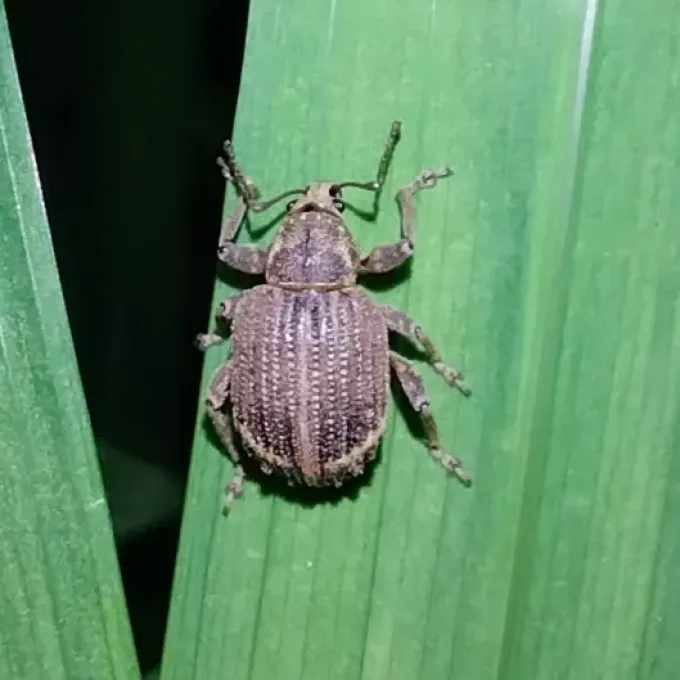
Phlyctinus callosus, commonly known as the Australian garden weevil, belongs to the family Curculionidae (true weevils), order Coleoptera. Adult weevils are approximately 7–8 mm long, with a coloration ranging from brown to grayish-brown, featuring a distinct V-shaped pale marking on the posterior part of the elytra.
The larvae are apodous (legless), creamy-white in color with a brown head capsule, growing up to 10 mm in length. They lead a cryptic subterranean lifestyle, which makes them particularly difficult to detect during the early stages of infestation.
Adult weevils are primarily nocturnal. During the day, they prefer to hide in dense foliage, under tree bark, or in soil crevices, which complicates visual identification and scouting efforts.
The insect undergoes a complete metamorphosis: egg, larva (multiple instars), pupa, and adult. Since the adults have fused elytra and are flightless, their movement within an orchard is limited to crawling up the trunks of trees, which is a critical behavioral point for control.
Identification is further hindered by the nocturnal habits of the adults and the fact that their feeding damage can often be confused with that of other leaf-chewing insects or mollusks like slugs.
What it damages
This pest is a significant polyphage capable of causing serious economic damage to various agricultural crops. The most affected plants include pome fruits, stone fruits, and commercial vineyards.
The host range includes apples, pears, peaches, nectarines, and plums. There are also documented cases of damage to vegetable crops and various berry bushes, significantly expanding its range of economic impact.
The pest damages both the vegetative parts of the plant and the fruit itself. Fruit damage, in particular, renders the produce unmarketable and susceptible to secondary infections like storage rots.
Roots of young nursery saplings are frequently targeted by larvae, which feed on the bark and young root tissues. This leads to stunted growth, reduced vigor, and in severe cases, the total death of the nursery stock.
In vineyards, the adults chew on buds and young shoots. This feeding activity can lead to substantial yield losses during the early stages of vine growth and flower cluster development.
When it appears
Adult activity begins in early spring as temperatures rise and persists until late autumn. Peak population levels are typically observed during the summer months, coinciding with active feeding and oviposition.
Eggs are deposited by females into the soil or onto the surface of fruits, particularly where the fruit touches leaves or branches. Upon hatching, larvae migrate into the soil, where they complete the majority of their life cycle.
In warm climates, development may continue year-round; however, in regions with distinct seasonal changes, the life cycle is synchronized with soil and air temperature fluctuations.
Pupation occurs within the soil profile. The timing of new adult emergence is highly dependent on accumulated degree-days, necessitating consistent monitoring of orchard conditions throughout the growing season.
As autumn approaches, adult weevils often seek sheltered overwintering sites, which frequently include accumulated plant debris or the upper layers of soil beneath the tree canopy.
Signs of infestation
The primary symptom of infestation is the presence of deep, circular pits or lesions on the fruit surface. These wounds often become entry points for pathogenic fungi, leading to rot and rapid decay.
Leaves often exhibit characteristic irregular, notched edges, as the beetles prefer consuming the soft leaf tissue while typically avoiding the harder leaf veins.
- Deep lesions and pits on the skin of fruits.
- Stunted growth and leaf chlorosis in young saplings.
- Presence of white larvae in the root zone soil.
- Bud damage and lack of foliage on spring shoots.
- Nocturnal aggregation of adult weevils on tree trunks.
When inspecting trees at night with a flashlight, adults can be spotted easily. However, they are sensitive to vibrations and will often drop to the ground and feign death upon being disturbed.
Control measures
The primary control strategy involves the installation of physical barrier bands around tree trunks. These bands prevent the flightless adults from migrating up the tree to feed on the foliage and fruit.
Cultural control plays a vital role; deep cultivation of the soil in the root zone can effectively destroy a significant portion of the soil-dwelling larval and pupal populations.
Chemical control applications should be timed to coincide with peak adult activity. Contact-action insecticides are recommended for application to the trunks and the lower canopy to target the weevils directly.
Maintaining orchard sanitation is critical: removing fallen fruit and clearing plant debris eliminates the shelter and oviposition sites favored by this pest.
Biological control, specifically the use of entomopathogenic nematodes, has proven effective in targeting larvae within the soil. This provides an environmentally friendly alternative to traditional synthetic chemical treatments.
Taxonomy
- Latin name
- Phlyctinus callosus
- Order
- Coleoptera (beetles)
- Family
- Curculionidae
- EPPO code
- PHLYCA
Discussion
No discussions yet — be the first.