
Cypress bark beetle
Phloeosinus variolatus
Description
How to identify
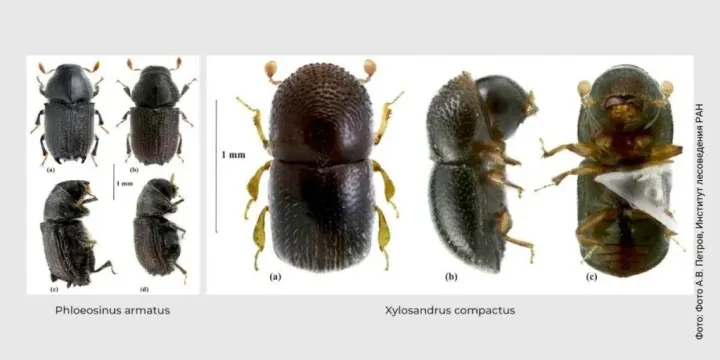
The cypress bark beetle is a small insect belonging to the weevil family, specifically the Scolytinae subfamily. Adults are typically 2 to 3 millimeters long, with a dark brown to black coloration.
The body is cylindrical and robust, which is a classic morphology for bark-boring beetles. The elytra feature distinctive rows of pits, which serve as a reliable visual marker for field identification.
Larvae are small, legless, and creamy-white with a brownish head capsule. They spend their entire developmental phase feeding within the inner bark, making them hard to observe directly.
Adults are the active stage of the beetle, responsible for colonizing healthy or stressed trees. They are generally elusive and spend most of their time beneath the bark or burrowing into twigs.
Specialists use pheromone traps for monitoring population levels. These traps are essential for timing management activities in nurseries or landscape gardens where these pests are prevalent.
What it damages
This pest primarily attacks species within the Cupressaceae family, including Cypress, Thuja (Arborvitae), Juniper, and Sequoia. Trees suffering from drought or soil compaction are the most susceptible.
Adult beetles cause damage by boring into twigs and small branches to feed, which leads to the breakage or necrosis of those specific parts of the canopy.
Larval galleries interrupt the flow of water and nutrients within the phloem and cambium layer. This girdling effect can cause entire branches to die or, in severe cases, the entire tree.
Frequent infestations weaken the tree's overall defense mechanism, making it prone to opportunistic secondary pathogens, including various wood-decaying fungi.
In high-density populations, the beetles can devastate entire hedges or landscape plantings, causing rapid decline in aesthetic value and plant health over several seasons.
When it appears
The primary emergence of adult beetles begins in early spring, once temperatures remain consistently above the threshold of 12-15 degrees Celsius.
Springtime activity is peak period for mating and colonization of new hosts. During this time, the beetles are highly mobile and easily detected via pheromone monitoring.
Depending on the climatic zone, multiple generations can occur annually. Hot, dry summers significantly accelerate the reproductive cycle of the beetle.
Activity gradually tapers off as autumn temperatures decrease. Beetles overwinter either as adults in boring galleries or, less frequently, as larvae within the wood.
Strategic timing of insecticide applications is crucial, targeting the adults during their flight periods before they successfully bore into the thick bark of the trunk.
Signs of infestation
The first external sign of infestation is the yellowing and subsequent reddening of foliage on individual branches, often called flagging, which contrasts with the green canopy.
Look for small, pin-prick-sized entry holes on the bark of twigs or the main trunk. Resin exudation is a common defense response by the tree, often visible around these holes.
Frass, or fine sawdust-like excrement, usually accumulates in bark crevices or at the base of the tree, serving as a clear indicator of active larval feeding galleries.
When the outer bark is carefully peeled away, complex branching patterns of maternal and larval galleries are revealed, typically running parallel to the wood grain.
- Reddening or flagging of branches
- Resin bleeding on the bark
- Accumulation of fine sawdust (frass)
- Dieback of twigs and smaller limbs
- Evidence of galleries under the bark
Control measures
The most important control measure is maintaining tree vigor through proper irrigation and balanced fertilization. Healthy trees are significantly more resistant to beetle colonization.
Sanitation is critical; all heavily infested branches must be pruned and immediately destroyed, preferably by burning or chipping, to prevent the emergence of the next generation.
Systemic insecticides can be used to treat trees in areas with high pest pressure. Application should be timed with the peak flight activity of adult beetles.
Prophylactic trunk sprays using contact insecticides may provide a protective barrier. It is essential to ensure full coverage of the bark surface to prevent successful burrowing.
Biological control agents, such as specialized predatory wasps or fungi that target bark beetles, are increasingly used in integrated pest management programs to lower populations naturally.
Taxonomy
- Latin name
- Phloeosinus variolatus
- Order
- Coleoptera (beetles)
- Family
- Curculionidae
- EPPO code
- PHLSVR
Discussion
No discussions yet — be the first.