
Thuja bark beetle
Phloeosinus thujae
Description
How to identify
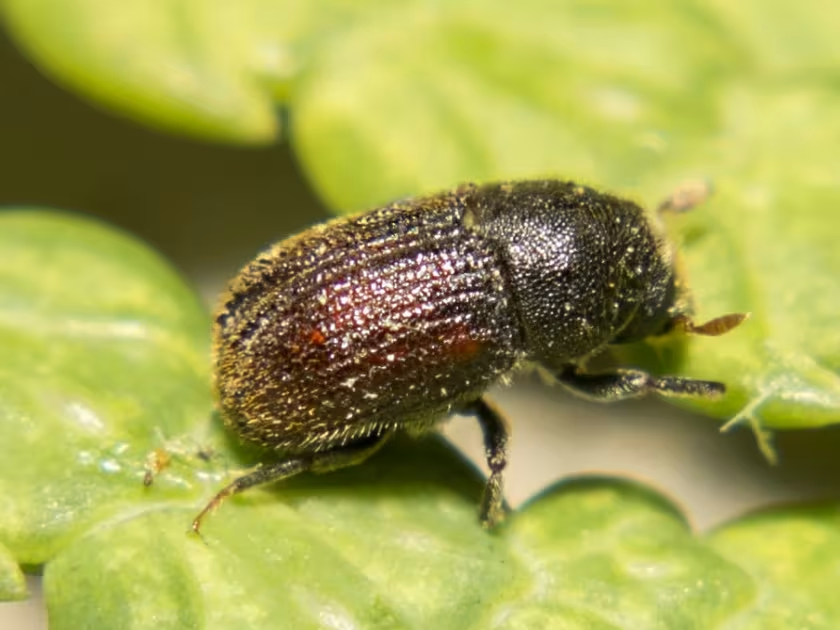
The Thuja bark beetle (Phloeosinus thujae) is a small beetle belonging to the family Curculionidae, subfamily Scolytinae. Adult beetles are approximately 1.5 to 2 mm long, characterized by a cylindrical, dark brown to black shiny body.
The larvae are legless, white grubs with a yellowish head. They are specialized to live and feed within the inner bark, known as the phloem, and the cambium layer of coniferous trees, effectively girdling the branches.
These insects are elusive, spending most of their life cycle hidden under the bark of host trees. This makes early detection difficult, as the primary evidence of their presence is often localized damage rather than sightings of the insects themselves.
The reproductive cycle involves the female creating a maternal gallery under the bark, where she deposits eggs. Upon hatching, the larvae create their own lateral galleries that expand as the larvae grow, often disrupting the vascular system of the host plant.
Under favorable climatic conditions, Phloeosinus thujae can produce multiple generations per year, significantly increasing its potential to cause widespread damage in nurseries and landscape plantations.
What it damages
The beetle primarily targets members of the Cupressaceae family. Thuja species, junipers, cypresses, and yews are the most common hosts, with weakened or stressed trees being the most susceptible to infestation.
Adult beetles inflict damage by boring into young twigs, creating feeding holes that cause the tips to wilt and turn brown. This often leads to the breakage of twigs, especially under windy conditions.
Larval feeding causes the most severe damage by consuming the cambium and phloem layers. By interrupting the flow of water and nutrients, they effectively starve the affected branches, leading to dieback.
In cases of severe infestation, the cumulative damage can lead to the death of the entire tree. This is particularly devastating in ornamental hedges where uniformity is key to the visual design.
Beyond direct damage, the beetle often acts as a vector for various fungal pathogens that thrive in the weakened tissues, further accelerating the decline of the host tree.
When it appears
Adult beetle activity typically begins in early spring, once temperatures consistently exceed +12°C. This is the period when beetles emerge from hibernation to seek out new host trees for breeding.
Peak activity occurs throughout the summer months, with a potential second flight period mid-season depending on local climate conditions. Vigilance during the entire growing season is essential for control.
As autumn approaches and temperatures drop, the adult beetles seek shelter to hibernate. They typically burrow into the thicker bark at the base of the trunk or deep into the wood to survive winter temperatures.
The developmental period from egg to adult is highly temperature-dependent. Warmer, longer summers provide ideal conditions for population spikes, necessitating intensified monitoring during these periods.
Effective management strategies must account for these seasonal windows, focusing on preventing adult colonization through timely chemical applications and habitat maintenance.
Signs of infestation
The most prominent sign of an infestation is the presence of small, round entry holes on the bark of twigs or the main trunk. These holes are often accompanied by piles of frass, known as boring dust.
Visual symptoms include the sudden yellowing or browning of specific branches or the top of the tree. While some browning may be normal seasonal needle drop, bark beetle damage is localized and branch-specific.
Upon closer inspection, one may notice the bark becoming loose or exhibiting irregular patterns in the underlying tissue. Peeling back a section of the dead bark usually reveals the intricate gallery system.
Young shoots may appear stunted, distorted, or broken off at the base due to adult feeding activity. The tree may also show signs of resin weeping in areas where the beetles have attempted to bore through the bark.
- Localized browning of foliage.
- Small, pin-prick size holes on twigs and trunks.
- Fine reddish boring dust on bark surfaces.
- Dying branches despite adequate irrigation.
Control measures
The most effective strategy for managing the Thuja bark beetle is to maintain tree vigor. Proper watering, fertilization, and avoiding physical injury to the bark significantly reduce the risk of infestation.
Sanitation is critical; all infested or dead branches must be pruned promptly and destroyed by burning or disposal to prevent the beetle population from spreading to healthy parts of the garden.
Chemical control involving systemic insecticides is effective when applied during the flight periods of the adult beetles. Targeting the bark and foliage helps kill the insects before they successfully tunnel.
In ornamental settings, pheromone traps can be used for monitoring and mass trapping to reduce the adult population density during peak activity times, minimizing the need for broad-spectrum chemical sprays.
If a tree is heavily infested and systemic control fails, it should be removed entirely, including the root system, to eliminate the potential source of re-infestation for neighboring susceptible trees.
Taxonomy
- Latin name
- Phloeosinus thujae
- Order
- Coleoptera (beetles)
- Family
- Curculionidae
- EPPO code
- PHLSTH
Discussion
No discussions yet — be the first.