
Sequoia bark beetle
Phloeosinus sequoiae
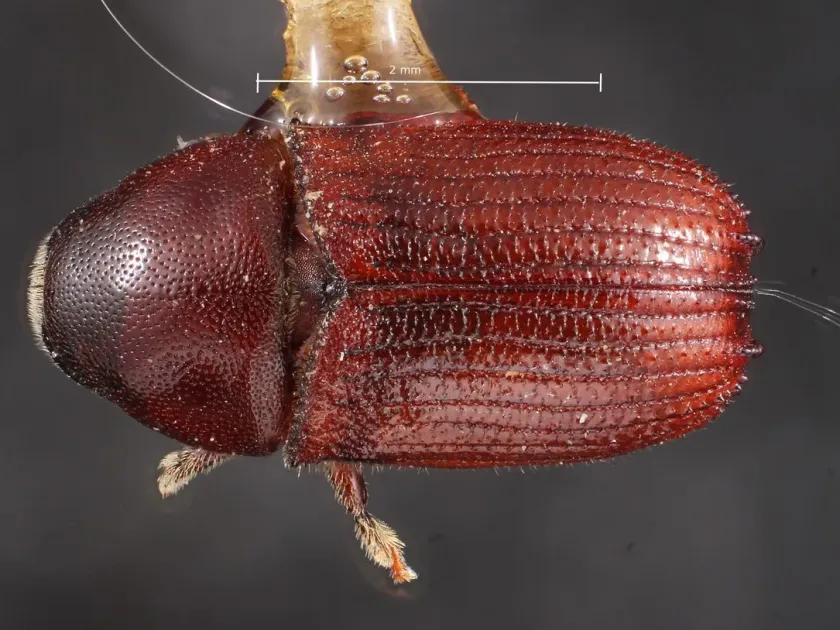
Description
How to identify
The Sequoia bark beetle (Phloeosinus sequoiae) is a small beetle belonging to the Curculionidae family and the Scolytinae subfamily. Adults are typically 2.5–3.5 mm long, with a cylindrical, dark brown or black body.
The larvae are white, legless, and have a distinctive curved shape with a yellow-brown head capsule. They spend their entire developmental phase feeding within the inner bark of host trees.
The beetles possess strong chewing mouthparts used to bore through the bark to reach the cambium and phloem layers. Their morphology is highly adapted to tunneling and surviving beneath the bark surface.
This species is specifically associated with members of the Cupressaceae family. Their biological success depends heavily on the health status of the host tree, as they prefer stressed or weakened specimens.
The life cycle includes eggs, larvae, pupae, and adults. Depending on the climate and temperature conditions, multiple generations can occur within a single growing season.
What it damages
The primary hosts of the Sequoia bark beetle include various coniferous trees in the Cupressaceae family, most notably sequoia, giant sequoia, cypress, and juniper species.
Damage is caused both by adults feeding on young twigs, which causes dieback and flagging, and by larvae tunneling under the bark of branches or trunks, which disrupts the tree's nutrient flow.
Severe infestations can lead to the death of the entire tree, especially in cases where the bark is extensively colonized by larval galleries that effectively girdle the host.
Weakened trees, whether due to drought, soil issues, or physical trauma, are significantly more susceptible to attacks than healthy, vigorous ones.
Feeding sites often serve as entry points for various fungal pathogens, which further exacerbate the decline of the infested tree and complicate recovery efforts.
When it appears
Adult activity typically begins in the spring when temperatures consistently rise, triggering the beetles to emerge in search of suitable host trees for breeding.
The peak period of reproduction and gallery construction occurs during the late spring and summer months, corresponding with the tree's active growth phase.
Winter is generally spent in the larval or adult stages, protected deep under the bark of the host tree, where they can survive colder temperatures.
A second generation of adults may emerge in mid-summer, increasing the risk of infestation for surrounding healthy plants if the population is not monitored.
Early monitoring using pheromone-baited traps is critical to detect the onset of adult flights and to implement timely control measures before the population explodes.
Signs of infestation
The initial sign of an attack is the presence of small entry holes in the bark, often accompanied by resin flow (pitch tubes) as the tree attempts to push out the invaders.
Flagging, or the yellowing and browning of foliage on individual branches or the entire canopy, is a common indicator that the vascular system is being compromised by larval galleries.
Removing a section of the bark will reveal the intricate system of egg galleries and larval tunnels carved into the inner bark and sapwood surface.
Small piles of frass, which resembles sawdust, are often visible at the base of the tree or in branch crotches as the beetles eject waste material while boring tunnels.
- small entry holes in the bark;
- pitch tubes or resin bleeding;
- yellowing or browning foliage;
- frass accumulation;
- dieback of young twigs.
Control measures
The most important control strategy is maintaining tree health through proper irrigation, mulching, and avoiding soil compaction to keep the trees resistant to beetle attacks.
Sanitation is essential; infested branches or whole trees should be promptly removed and destroyed to reduce the local population of beetles and prevent them from spreading.
Systemic insecticides can be applied as a preventive measure, particularly in high-value ornamental plantings, to deter adult beetles from successfully colonizing the tree.
Pheromone traps are highly effective tools for both monitoring the presence of the beetle and reducing the local population density in park settings.
Natural biological controls, such as woodpeckers and certain parasitic wasps, play a role in regulating beetle numbers and should be encouraged within the ecosystem.
Taxonomy
- Latin name
- Phloeosinus sequoiae
- Order
- Coleoptera (beetles)
- Family
- Curculionidae
- EPPO code
- PHLSSE
Discussion
No discussions yet — be the first.