
Phloeosinus rudis
Phloeosinus rudis
Description
How to identify
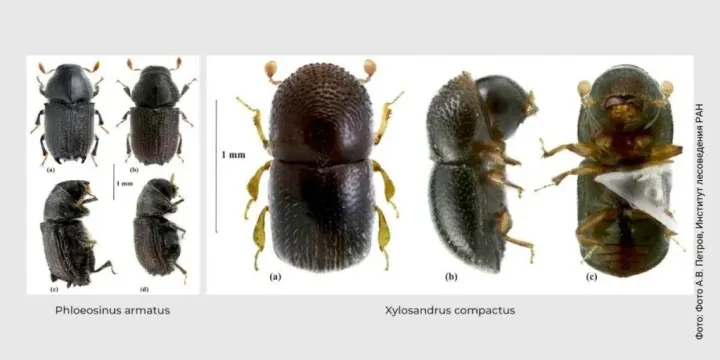
Phloeosinus rudis is a small bark beetle belonging to the Curculionidae family and the Scolytinae subfamily. Adult beetles have a cylindrical body measuring approximately 2–3 mm in length, typically colored dark brown or black.
The larvae are legless and white, featuring a yellowish head capsule. They spend their entire developmental phase feeding within the inner bark, specifically the cambium and phloem layers of their host plants.
Identification is often difficult due to the beetle's cryptic habits, but the presence of small, circular entry holes on the bark serves as a primary diagnostic indicator for the species.
Pupation occurs within small chambers, known as pupal cradles, constructed by the larvae. These chambers are found just beneath the bark surface where the insect transitions into its adult form.
As an opportunistic pest, Phloeosinus rudis primarily targets stressed or damaged trees, often thriving in environments where host plants are weakened by environmental factors.
What it damages
The host plants primarily include members of the Cupressaceae family, with cypress, thuja, and juniper being the most frequent targets of infestation.
Healthy trees generally possess effective defense mechanisms, whereas weakened or transplant-stressed trees are highly susceptible to mass colonization by these beetles.
Damage is twofold: adults engage in twig feeding which causes dieback of branches, while larvae create extensive galleries that disrupt the vascular flow, leading to tree mortality.
The rapid destruction of the phloem and cambium layers effectively cuts off nutrient transport, often resulting in the rapid decline and death of the infested host plant.
Furthermore, these beetles act as vectors for various pathogenic fungi, which invade the tree through the beetle's entry holes, accelerating the decay and necrosis of plant tissue.
When it appears
The activity of Phloeosinus rudis typically commences in early spring, once temperatures remain consistently above the threshold of 12–15 degrees Celsius.
The primary flight period for the beetles occurs during April and May, as they emerge from overwintering sites to locate new host plants for breeding and feeding.
Multiple generations can occur within a single growing season, depending on the climatic conditions of the region, which complicates management efforts significantly.
Secondary peaks of activity often occur mid-summer, representing the emergence of new generations or individuals seeking supplementary food sources.
The species overwinters as either adults or advanced-stage larvae, hiding either under the bark of previously infested trees or within the leaf litter at the base of the plant.
Signs of infestation
Initial signs of infestation often manifest as localized chlorosis or browning of the foliage on specific branches, which gradually spreads to the rest of the tree canopy.
Small entry or exit holes are visible on the stems or branches, frequently accompanied by frass — a fine, sawdust-like material created by the beetles as they bore into the bark.
Conifers often exhibit resinosis, or excessive resin flow, as the tree attempts to push out the invaders, resulting in hardened white or yellowish drops on the bark.
Shoot flagging is a common observation, where twigs or small branches break off or wither due to the feeding activities of the adult beetles, leaving debris beneath the plant.
- Foliage yellowing and thinning.
- Small entrance holes on the trunk.
- Presence of boring dust (frass).
- Excessive sap or resin production.
- Sudden dieback of branches.
Control measures
Proactive management focuses on maintaining plant vigor through appropriate irrigation, fertilization, and protecting trees from mechanical stress and site disturbance.
Sanitation is a critical control measure: all heavily infested branches or dying trees should be pruned and removed immediately to prevent further infestation of the remaining population.
Chemical control involving systemic or contact insecticides may be applied during peak flight periods to provide a protective barrier for vulnerable trees.
Monitoring using pheromone-baited or sticky traps is recommended to track population levels and time chemical interventions for maximum efficacy.
In nursery settings, systemic preventative treatments applied to the bark early in the season can significantly reduce the risk of beetle colonization and subsequent damage.
Taxonomy
- Latin name
- Phloeosinus rudis
- Order
- Coleoptera (beetles)
- Family
- Curculionidae
- EPPO code
- PHLSRD
Discussion
No discussions yet — be the first.