
Juniper bark beetle
Phloeosinus punctatus
Description
How to identify
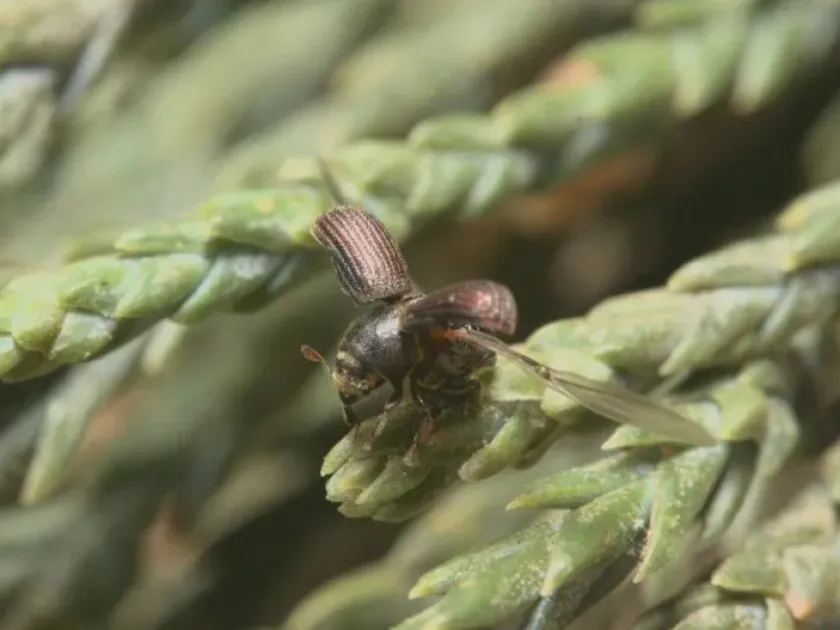
The Juniper bark beetle (Phloeosinus punctatus) is a small wood-boring insect belonging to the Curculionidae family and the Scolytinae subfamily. These beetles are typically 2 to 3 mm in length, featuring a dark brown or black cylindrical body.
Key morphological features include a slightly convex pronotum and elytra, which are marked with rows of punctures and small ridges. The head is partially hidden by the pronotum, characteristic of the bark beetle group.
The larvae are white, legless, and possess a small yellowish head. They remain hidden beneath the bark for their entire life cycle, making them elusive to the naked eye during the initial stages of infestation.
As part of their life cycle, these beetles create intricate gallery systems. These patterns consist of a main egg-laying gallery and perpendicular larval tunnels, which are etched into the cambium and xylem.
Due to their concealed nature, most gardeners only become aware of the presence of these beetles after significant damage to the plant has already occurred.
What it damages
The primary hosts for Phloeosinus punctatus include members of the Cupressaceae family, specifically junipers, cypresses, arborvitae (Thuja), and occasionally sequoias.
The beetle typically targets trees that are already stressed by drought, poor soil conditions, mechanical injury, or environmental heat, although healthy trees are not immune when beetle populations are high.
Damage occurs in two ways: adult beetles feed on the base of small twigs, causing them to wilt and die, and larvae feed beneath the bark, disrupting nutrient transport across the cambium.
Severe infestations can lead to girdling of branches or trunks, which effectively cuts off the water and nutrient supply to the upper parts of the plant, resulting in extensive dieback.
In landscaping and nursery settings, this pest can cause significant aesthetic damage, leading to the distortion of tree shapes and, in extreme cases, the total death of the specimen.
When it appears
The activity of the Juniper bark beetle begins in the spring, typically when daily temperatures consistently exceed 15–18 degrees Celsius, signaling the start of the primary flight season.
Adult beetles emerge in April or May to perform "maturation feeding," which is when they bore into healthy shoots. Following this, they seek weakened trees to mate and establish breeding galleries.
Depending on the climatic zone, the beetle may produce one to two generations per year. The reproductive cycle is continuous throughout the warm summer months, with eggs being laid over several weeks.
Pupation typically occurs within the wood during late summer or early autumn. New adults often emerge to feed before seeking overwintering sites, sometimes remaining inside the galleries.
Hot, dry summers act as a catalyst for population outbreaks, as moisture-stressed conifers provide ideal breeding environments for the beetles to thrive and reproduce.
Signs of infestation
One of the earliest signs of an infestation is the sudden yellowing or browning of individual twigs or the tips of branches, which stand out against the green foliage.
Upon closer inspection, one may find small, round entry holes at the base of the damaged twigs. Often, these holes are surrounded by fine, powdery "frass" or hardened sap droplets.
As the larvae expand their tunnels, the bark may begin to flake off or show slight depression. Removing a small patch of bark reveals the characteristic star-shaped or elongated gallery patterns.
The overall appearance of the tree becomes sparse and ragged. If left untreated, the dieback can spread from the outer branches towards the main stem, leading to crown decline.
Weakened trees may also show increased sap flow in an attempt to "pitch out" the beetles, though this defense mechanism is often unsuccessful against high populations.
Control measures
Sanitation is the most critical component of control. All heavily infested branches or dying trees should be pruned and destroyed immediately to prevent the emergence of the next generation.
Providing optimal growing conditions, such as deep irrigation during dry spells and appropriate fertilization, helps boost the tree's internal resistance to beetle attacks.
Preventive chemical treatments using systemic or contact insecticides are most effective if applied during the early spring before the beetles have successfully tunneled into the bark.
- Pruning and burning all infested plant materials.
- Maintaining tree vigor through consistent watering.
- Using pheromone traps for monitoring flight peaks.
- Applying systemic insecticide sprays to the trunks and branches.
Avoid leaving cut or fallen conifer wood in the vicinity of healthy trees, as these act as a massive breeding ground that can harbor and export the beetle population back into the landscape.
Taxonomy
- Latin name
- Phloeosinus punctatus
- Order
- Coleoptera (beetles)
- Family
- Curculionidae
- EPPO code
- PHLSPU
Discussion
No discussions yet — be the first.