
Juniper bark beetle
Phloeosinus dentatus
Description
How to identify
The Juniper bark beetle (Phloeosinus dentatus) is a small wood-boring insect belonging to the Curculionidae family and Scolytinae subfamily.
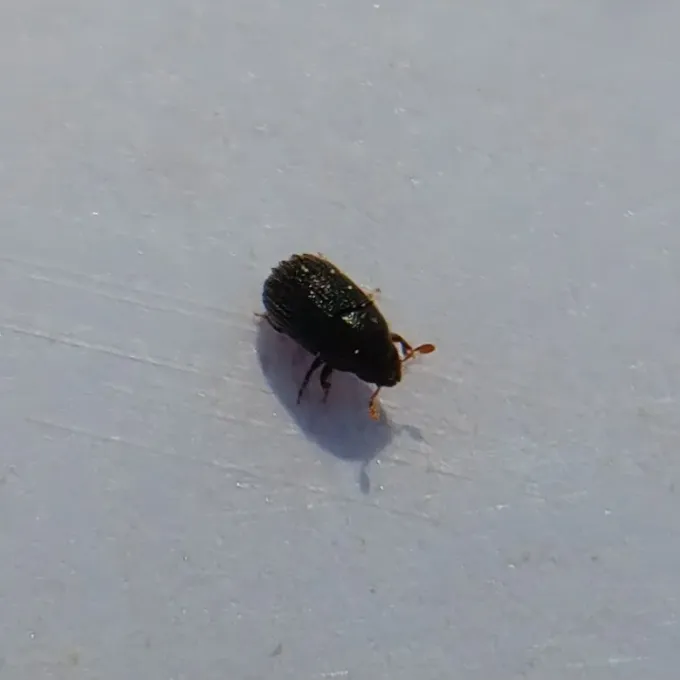
Adult beetles are tiny, typically ranging from 1.5 to 2.5 mm in length, with a cylindrical body shape and a dark brown to black coloration.
The larvae are legless, white grubs with distinct brown head capsules, which spend their entire developmental cycle beneath the bark of host trees.
This species is highly adapted to life in coniferous environments, utilizing both the bark and the wood of branches to feed and reproduce throughout the year.
Due to their small size and cryptic habits, these beetles are often overlooked until significant damage to the plant becomes visible to the owner.
What it damages
These pests primarily target various Juniper species (Juniperus), but they also commonly infest Cypress (Cupressus), Leyland cypress, and Thuja.
The beetles cause damage in two ways: adults bore into small twigs for maturation feeding, while larvae tunnel under the bark of larger branches and trunks.
Feeding activity severs the transport vessels of the plant, leading to the yellowing, wilting, and eventual death of the affected branches or the entire tree.
In ornamental gardens and nurseries, the presence of these beetles can lead to significant aesthetic and economic losses by killing valuable specimens.
Trees under stress from drought, poor soil quality, or physical injuries are much more susceptible to successful colonization by the bark beetle.
When it appears
The emergence of overwintering adults usually occurs in the early spring, triggered by rising temperatures and the onset of the growing season.
Depending on the climatic conditions, multiple generations can occur per year, which creates a continuous threat to coniferous plants from late spring through early autumn.
The period of maturation feeding in twigs is particularly intense during the warmer months, making late spring and summer critical for monitoring.
As temperatures begin to drop, adult beetles seek out overwintering sites, often boring into the base of trees or staying under debris near the root zone.
Prolonged heat waves combined with lack of precipitation exacerbate the damage, as the plants cannot produce enough resin to expel the boring insects.
Signs of infestation
A primary indicator of infestation is the presence of fine "frass" or sawdust gathering at the base of the tree or on the bark surface near the entry holes.
The sudden browning or yellowing of foliage on specific twigs or branches is a clear sign that the beetles have disrupted the tree's nutrient circulation.
Small, perfectly circular holes on the bark of branches or the main stem indicate where adult beetles have entered to feed or lay their eggs.
Resin exuding from the bark is a typical defense mechanism, though it is often insufficient to stop the beetles if the population density is high.
Peeling back the bark on suspicious branches will often reveal galleries — intricate tunnel systems carved by the larvae, which confirm the presence of the pest.
Control measures
The foundation of effective control is maintaining tree vigor through regular watering, fertilization, and soil management to increase the tree's natural resistance.
Sanitation is critical; all dead, dying, or infested branches must be pruned promptly and destroyed to reduce the local population of the beetle.
Systemic insecticides can be applied as a preventive or curative measure, especially during the peak flight periods to target adults before they bore into the plant.
If the tree is severely infested and declining, it is often best to remove and dispose of the entire plant to prevent the spread of the beetle to nearby trees.
- Regular inspection of all coniferous stock in the landscape.
- Prompt disposal of infested plant material by burning or chipping.
- Application of systemic pesticides during the active flight season.
- Proper irrigation to help the tree maintain its resinous defenses.
Taxonomy
- Latin name
- Phloeosinus dentatus
- Order
- Coleoptera (beetles)
- Family
- Curculionidae
- EPPO code
- PHLSDE
Discussion
No discussions yet — be the first.