
Cypress bark beetle
Phloeosinus cupressi
Description
How to identify
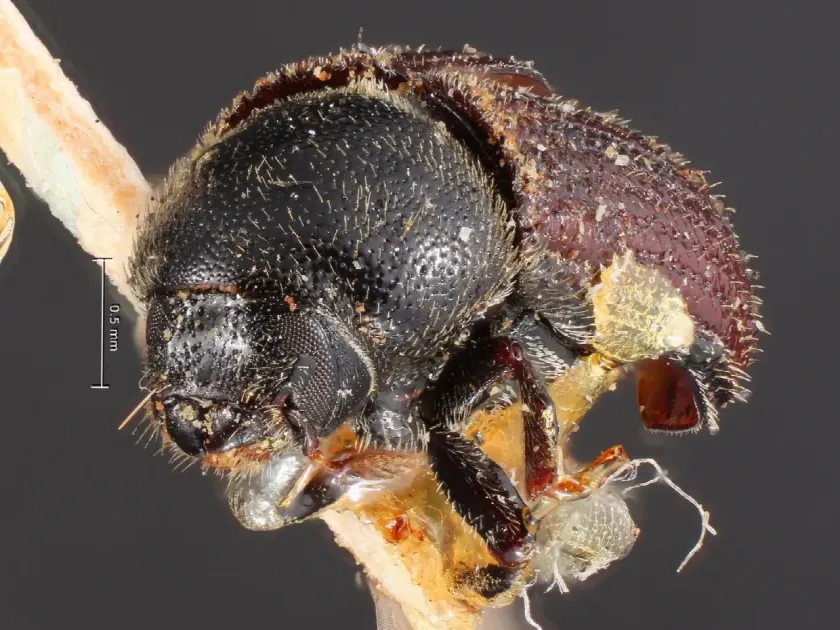
The cypress bark beetle Phloeosinus cupressi is a small insect belonging to the family Curculionidae (subfamily Scolytinae). Adults are cylindrical, about 2–3 mm long, with a dark brown to black coloration.
Larvae are legless, white with a yellowish head, and spend their entire development phase beneath the bark, consuming the cambium and phloem layers of the host tree.
They are primarily nocturnal, which makes observing them during the day very difficult for property owners and professional arborists alike.
This species is highly mobile and can migrate across significant distances, particularly when host trees are stressed by drought or environmental changes.
The life cycle is heavily influenced by climate; in warmer regions, multiple generations can emerge within a single year, exacerbating the threat to local vegetation.
What it damages
Host plants include primarily members of the Cupressaceae family, such as Cupressus (cypress), Thuja (arborvitae), and Juniperus (juniper) species.
Adult beetles damage trees by tunneling into small twigs and branches, causing "dieback" and making the canopy look patchy and diseased.
Larval galleries constructed beneath the bark are more destructive, as they effectively girdle the branches or the main trunk, cutting off the tree's vascular system.
Trees that are already stressed due to poor soil conditions, improper watering, or physical injury are the most frequent targets, though healthy trees can succumb to mass attacks.
The pest often acts as a vector for fungal pathogens, which invade the tree's internal tissues, leading to rapid systemic failure and eventual death of the specimen.
Signs of infestation
The first indicator of an infestation is often the flagging of individual branches, where the foliage turns yellow and then reddish-brown.
Small round entry holes, often referred to as "shot holes," can be seen on the bark of trunks and larger branches, sometimes with resin dripping from them.
Frass (fine sawdust produced by the beetles) is usually visible around the entry holes or accumulated in bark crevices and at the base of the tree.
When the bark is carefully peeled back on an infested branch, distinct gallery patterns become visible, indicating the presence of larvae or adult chambers.
Stunted growth and a general decline in the tree's health despite adequate fertilization and irrigation are long-term signs that a hidden infestation is progressing.
Control measures
The most effective management strategy is cultural: maintain tree vigor through proper irrigation, mulching, and avoiding mechanical damage to the trunk and branches.
Sanitation is critical; all dead or heavily infested wood must be pruned immediately and removed from the site to prevent the beetles from emerging and attacking nearby trees.
Chemical control involving systemic insecticides can be applied as a preventive measure during the peak flight periods of the adult beetles, typically in late spring.
- Pruning and destroying infested branches promptly.
- Maintaining optimal tree health to increase natural resistance.
- Using systemic insecticides to target beetles before they bore into the bark.
If a tree is severely infested throughout the main trunk, it is usually irreparable and should be removed entirely to eliminate the breeding site and protect the remaining landscape.
Taxonomy
- Latin name
- Phloeosinus cupressi
- Order
- Coleoptera (beetles)
- Family
- Curculionidae
- EPPO code
- PHLSCU
Discussion
No discussions yet — be the first.