
Cypress bark beetle
Phloeosinus aubei
Description
How to identify
The cypress bark beetle (Phloeosinus aubei) is a small wood-boring insect belonging to the Curculionidae family, subfamily Scolytinae. Adult beetles are typically 2 to 3 mm in length with a dark, cylindrical body.
Their morphology is perfectly adapted for tunneling under bark. They possess a hard pronotum and brownish-black coloration, which provides excellent camouflage against tree bark.
Larvae are small, white, and legless, with a typical C-shape. They are rarely seen as they reside exclusively within the inner bark and phloem layers of the host plant.
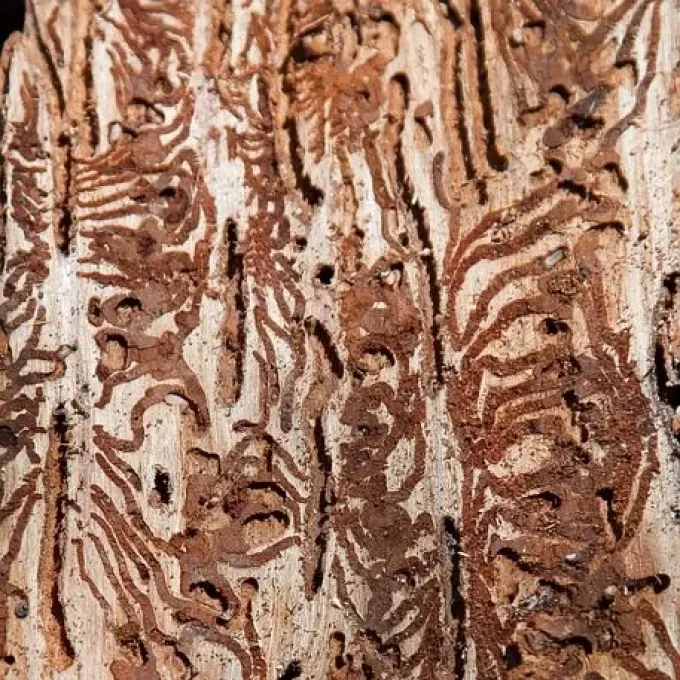
The species is primarily identified by its characteristic mating galleries and the presence of fine sawdust, often referred to as frass, appearing on the bark surface.
Identification often requires careful inspection of the tree canopy and stems, especially in species like Cypress, Thuja, and Juniper, where the beetle is most prevalent.
What it damages
This beetle primarily attacks members of the Cupressaceae family. It poses a significant threat to Cypress, Thuja (Arborvitae), Juniper, and Chamaecyparis species.
Damage is two-fold: adults feed on thin, young twigs, leading to flagging or dieback, while larvae construct galleries under the bark, which can effectively girdle and kill the tree.
Stressed trees are the primary targets. Drought, poor soil quality, mechanical damage, or previous winter damage create ideal conditions for beetle colonization.
In landscape settings, neglected hedges often become hotspots for the pest. Once an infestation takes hold, the beetles can spread rapidly to adjacent healthy plants.
The destruction of the vascular system prevents nutrient transport, causing rapid browning of the foliage and eventual death of the affected branches or the entire tree.
When it appears
The adult flight period typically begins in the spring when temperatures rise above 15°C. This activity can continue through the summer depending on the climate.
In warmer zones, the beetle can complete multiple generations within a single season, significantly increasing the pressure on local conifer populations.
Adults overwinter in hibernation galleries either under the bark of infested trees or within the twigs of healthy ones, emerging as soon as the weather permits.
The peak period of attack usually occurs in late spring and early summer. Monitoring for new entry holes during these months is critical for effective management.
Fall activity is observed as adults prepare for wintering by feeding, meaning that vigilance and management efforts should continue until the onset of cold weather.
Signs of infestation
The most visible sign is the presence of tiny, circular exit or entry holes on the bark, often accompanied by resin flow, which is the tree's natural defense.
Accumulation of fine wood dust (frass) at the base of the tree or caught in bark crevices is a strong indicator of an active colonization process.
- Flagging: Sudden wilting and browning of the tips of twigs or small branches.
- Canopy thinning and discoloration across the entire crown.
- Loose or peeling bark in sections, revealing intricate feeding galleries beneath.
- Increased bird activity on trees, which often hunt for the larvae under the bark.
When the bark is removed, the characteristic pattern of the maternal tunnel and smaller larval tunnels radiating outwards provides definitive proof of a Phloeosinus infestation.
Control measures
Maintaining tree vigor is the best defense. Adequate irrigation, proper fertilization, and mulching help trees maintain the sap pressure needed to repel beetle attacks.
Sanitation is paramount. All infested branches or severely weakened trees should be pruned and destroyed immediately to eliminate breeding grounds for the beetles.
Systemic insecticides, applied as foliar sprays or soil drenches, are effective during the flight season to stop adult beetles before they bore into the bark.
Pheromone-baited traps can be deployed in the garden to monitor beetle population levels and potentially reduce the number of adults in the immediate vicinity.
In high-value ornamental trees, professional arborists may use trunk injections of systemic chemicals to provide long-lasting internal protection against wood-boring pests.
Taxonomy
- Latin name
- Phloeosinus aubei
- Order
- Coleoptera (beetles)
- Family
- Curculionidae
- EPPO code
- PHLSAU
Discussion
No discussions yet — be the first.