
Cypress bark beetle
Phloeosinus armatus
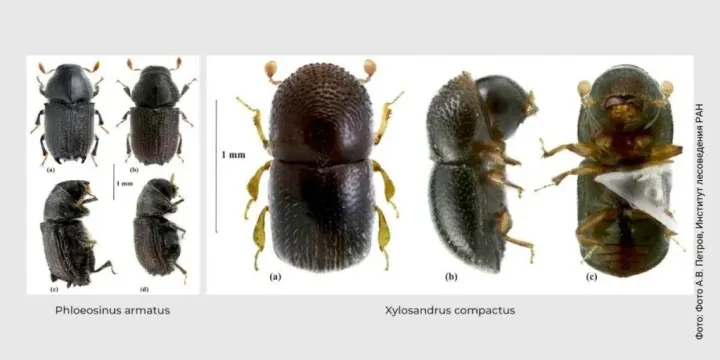
Description
How to identify
The cypress bark beetle (Phloeosinus armatus) is a member of the Coleoptera order and the Curculionidae family (subfamily Scolytinae). Adults are small, cylindrical beetles measuring approximately 2-3 mm in length.
Their coloration typically ranges from dark brown to black, providing excellent camouflage against the bark of host trees. The body is sparsely covered with short hairs, and the elytra feature distinct grooves and small teeth.
Larvae are legless, white, and curved, with a yellowish head. They develop primarily under the bark of branches and stems, where they carve complex gallery networks.
The life cycle usually spans one generation per year in temperate regions, although multiple generations can occur in warmer climates or greenhouse conditions.
Identification is best confirmed by inspecting the characteristic entrance holes and the specific pattern of galleries found underneath the bark of infested trees.
What it damages
This beetle primarily attacks members of the Cupressaceae family, including cypress (Cupressus), thuja (Thuja), juniper (Juniperus), and false cypress (Chamaecyparis) species.
Weakened, stressed, or newly transplanted trees are the most susceptible. Factors such as drought, nutrient deficiency, or root damage significantly increase the likelihood of infestation.
Damage is twofold: adult beetles bore into young shoots, causing them to wilt and break, while larvae feed on the cambium layer, effectively girdling the stem or branches.
Severe infestations can lead to the rapid decline and death of host plants, as the disruption of the vascular system prevents the transport of water and nutrients.
In ornamental gardens and hedges, the presence of this pest often results in uneven growth, thinning foliage, and significant aesthetic damage that is difficult to restore.
When it appears
Adult beetles typically emerge from their overwintering sites in early spring, once temperatures consistently exceed 12-15 degrees Celsius.
The peak period for flight and colonization of new host trees occurs throughout late spring and early summer, when environmental conditions are optimal for larval development.
During the summer months, larvae continue to feed and grow beneath the bark. Development into pupae and then adults happens within these protective galleries as the season progresses.
As temperatures drop in the autumn, adults move to secure locations, such as under the bark of larger branches or inside twigs, to hibernate throughout the winter.
Monitoring for adult flight is crucial during the spring; pheromone traps should be deployed to track populations and time insecticide applications accordingly.
Signs of infestation
Initial signs of infestation often include the yellowing or browning of individual twigs or branches, which stand out against the healthy foliage.
Upon closer examination, tiny round entrance holes (approximately 1 mm in diameter) can be found on the bark, often accompanied by piles of sawdust or "boring dust."
Resin bleeding is a common defense mechanism; droplets of sap often accumulate around the entry points as the tree attempts to push the beetles out.
- Premature shedding of young shoots and needles found on the ground below the canopy.
- Cracking or peeling bark on major branches where larval galleries are most concentrated.
- General loss of tree vigor, wilting, and potential mortality of the entire plant if left untreated.
Proactive inspection is key to spotting the beetle before it spreads to adjacent trees or deep into the structural wood of the host.
Control measures
Cultural control is the most effective strategy: keep trees healthy and vigorous through proper irrigation, fertilization, and avoiding mechanical damage to the bark.
Sanitation is mandatory: all dead, infested, or dying branches must be pruned promptly and destroyed (burned or chipped) to eliminate the breeding habitat.
Chemical control using systemic insecticides can be applied during the period of adult beetle emergence to prevent them from successfully boring into the bark.
Avoid leaving fresh pruning debris or wood stacks near healthy cypress or thuja plants, as these materials attract beetles and provide space for population growth.
Regular monitoring and the use of protective netting or biological control agents can provide additional layers of security for high-value ornamental trees.
Taxonomy
- Latin name
- Phloeosinus armatus
- Order
- Coleoptera (beetles)
- Family
- Curculionidae
- EPPO code
- PHLSAR
Discussion
No discussions yet — be the first.