
Cypress bark beetle
Phloeosinus
Description
How to identify
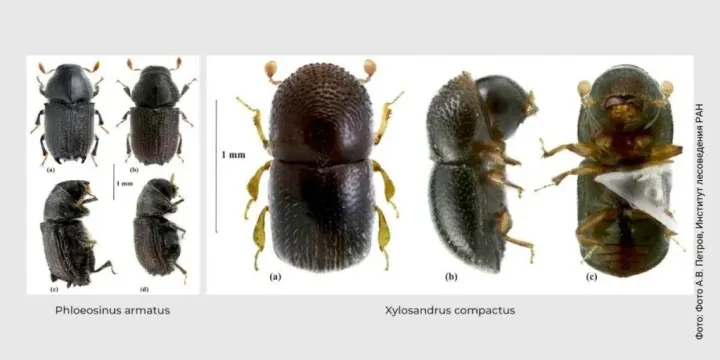
The Cypress bark beetle (genus Phloeosinus) is a small beetle belonging to the Curculionidae family and the Scolytinae subfamily. Adults are cylindrical, ranging from 1.5 to 3 mm in length, with colors varying from dark reddish-brown to black.
The larvae are white, legless grubs with a distinct brown head. They are responsible for the galleries found beneath the bark, which disrupt the flow of nutrients in the host tree.
Adult beetles have a specialized shape at the end of their elytra, which aids in clearing the feeding tunnels of boring dust and frass as they penetrate deeper into the tree tissue.
The life cycle involves multiple stages: egg, larva, pupa, and adult. The females initiate tunnel construction, often choosing stressed or weakened host plants to ensure successful development of the brood.
Identification is confirmed by the specific pattern of egg galleries and larval tunnels found under the bark, which vary slightly by specific species within the Phloeosinus genus.
What it damages
The primary hosts are conifers of the Cupressaceae family, including cypress, thuja (arborvitae), juniper, and redwood. These beetles are particularly destructive to ornamental trees and forest stands.
Adult beetles perform maturation feeding on the tender bark of young shoots. This feeding can girdle the branches, leading to top dieback and potential structural weakness of the canopy.
Larval galleries underneath the bark can effectively girdle the main trunk or larger limbs, cutting off the supply of water and nutrients, which eventually leads to the death of the entire tree.
Mass infestations often occur when trees are already stressed by drought, poor soil quality, or mechanical injury, making the cypress bark beetle a major threat to vulnerable landscapes.
Young transplants are especially susceptible to bark beetle attacks as they are struggling to establish their root systems, leaving them with low chemical defenses against the invading insects.
When it appears
Activity begins in early spring as temperatures consistently climb above 12–15°C (54–59°F). In warmer climates, this may start as early as late winter.
Depending on the region, these beetles can produce several generations per year. A long, warm summer creates ideal conditions for the rapid multiplication of the population.
Peak flight and mating periods typically occur during late spring and early summer, which is the most critical time for preventative application of chemical control agents.
During the autumn, the beetles prepare for overwintering, but they may continue feeding on shoots until temperatures drop significantly, requiring careful monitoring until late in the season.
They overwinter primarily as adults within the bark galleries or in the galleries they have created on the small twigs, waiting for the return of favorable spring conditions.
Signs of infestation
The most visible sign of an infestation is the presence of "boring dust" (frass), which is small, sawdust-like material accumulating at the base of the tree or on the branches.
Premature yellowing or browning of needles on shoot tips is a common indicator. These branches often become brittle and snap easily due to the larval tunneling inside the wood.
Small, perfectly round entry holes, approximately 1–2 mm in diameter, can be observed on the bark surface where the adult beetles have entered the tree to begin their tunnels.
Resin bleeding from the bark is a typical defense reaction of healthy conifers, but it also clearly marks the locations where the beetles have attempted to enter the tree.
Widespread thinning of the canopy and the sudden death of single limbs or the entire tree are terminal symptoms of a long-standing and unchecked bark beetle infestation.
Control measures
Sanitation is the most critical control measure; all infested, dying, or dead tree material should be removed and destroyed (burned or chipped) to eliminate breeding grounds.
Maintaining tree vigor through proper irrigation and fertilization is essential. Well-hydrated trees produce more resin, which can successfully repel attacking beetles.
Systemic insecticides can be applied to the canopy or trunk to provide protection. These chemicals work by being absorbed into the tree tissues, affecting larvae as they feed.
Pheromone traps are highly effective for monitoring beetle activity and population density, helping arborists time their chemical interventions during peak flight periods.
Applying contact insecticides as a preventative trunk spray during the start of the flight period can create a chemical barrier that stops adults from establishing new galleries.
Taxonomy
- Latin name
- Phloeosinus
- Order
- Coleoptera (beetles)
- Family
- Curculionidae
- EPPO code
- PHLSSP
Discussion
No discussions yet — be the first.