
Philopedon
Philopedon
Description
How to identify
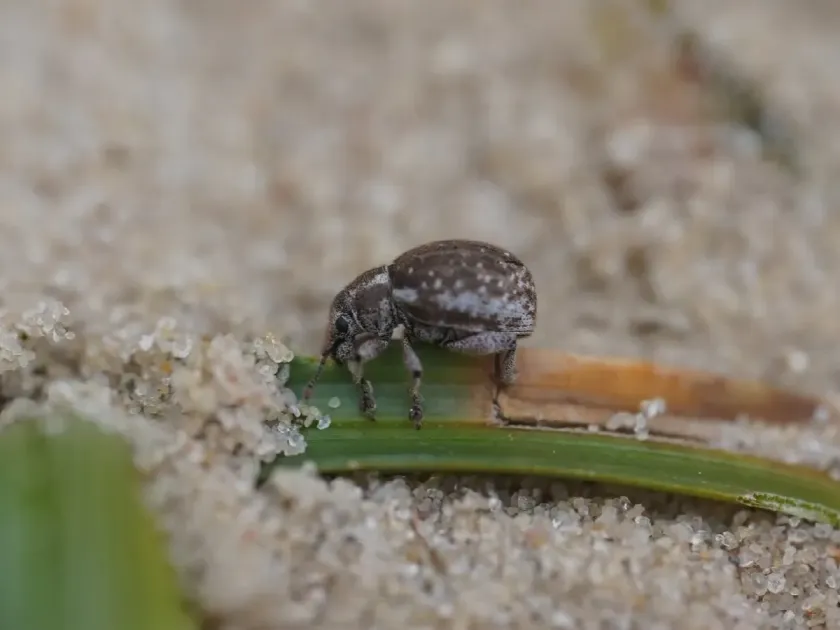
Philopedon (specifically Philopedon plagiatus) is a genus of snout beetles belonging to the Curculionidae family within the order Coleoptera. These beetles typically measure between 6 and 9 millimeters in length.
The body of the adult beetle is oval-shaped and generally displays a brown or grayish-brown coloration. Its surface is covered with fine scales, which often provide excellent camouflage against the soil environment.
The head of the beetle features a distinctive rostrum or snout, a trademark of the weevil group. The antennae are elbowed, which is a key morphological feature for identification under a magnifying glass.
Larvae of Philopedon are legless, C-shaped, and creamy white with a brownish head capsule. They reside entirely underground, feeding on the root systems of host plants, which makes them difficult to monitor.
These beetles are known for their defensive behavior of playing dead by pulling in their legs when disturbed. This tactic often helps them blend in with soil particles and avoid detection by field scouts.
What it damages
Philopedon is a polyphagous pest, meaning it feeds on a wide variety of plant species. It is particularly notorious for causing significant damage to sugar beet and table beet seedlings during the early growing season.
In addition to beet crops, these beetles readily infest cereals, sunflower, potatoes, and various legumes. Damage is caused by both the adult beetles feeding above ground and the larvae feeding underground.
Adult beetles frequently sever the stems of young seedlings at the soil surface or consume cotyledons entirely, which can result in the complete destruction of crops shortly after germination.
The larvae, which live in the soil, damage the root system by chewing on fine roots and gnawing on the primary taproot. This activity suppresses plant growth, reduces water uptake, and increases susceptibility to secondary rot.
The economic impact is most severe in years with delayed springs. The slow growth of young crops provides an extended window for the beetles to cause substantial damage, leading to thin and uneven plant stands.
When it appears
The lifecycle of Philopedon is highly dependent on soil temperature. Overwintering adults typically emerge from the soil in early spring when temperatures reach approximately 8–10 degrees Celsius.
The peak activity of the adults usually coincides with the emergence of early spring crops. During this time, they engage in intense feeding and mating behavior to ensure the continuation of the next generation.
Following mating, females lay eggs in the soil near the roots of host plants. The larvae that hatch from these eggs feed on organic matter and plant roots throughout the entire summer season.
Pupation occurs within small earthen cells in the soil. As autumn approaches, the new generation of adults develops, but they remain underground throughout the winter to emerge only in the following spring.
This single-generation lifecycle allows the pest to maintain a stable population within agricultural fields, as both the soil-dwelling larvae and the hibernating adults are well-adapted to surviving climate fluctuations.
Signs of infestation
The primary symptom of a Philopedon infestation is the appearance of jagged, irregular feeding patterns on the edges of leaves. Severe infestations can leave seedlings looking like shredded ribbons.
Large patches of missing or destroyed seedlings on the field indicate a high concentration of the pest. If plants are cut off cleanly at the base, it is a hallmark sign of beetle activity.
Stunted growth or sudden wilting of young plants, even when there is no visible damage above ground, suggests that larvae are feeding on the root system beneath the surface.
Field inspectors can detect the beetles by looking closely at the soil surface or beneath debris during early morning or late evening hours, when the beetles are most mobile and active.
The presence of root-related damage combined with chewed stem bases is a strong diagnostic indicator of Philopedon activity, distinguishing it from other pests that feed strictly on foliage.
Control measures
Effective crop management is the cornerstone of control for this pest. A well-planned crop rotation is highly recommended to prevent the buildup of Philopedon populations in fields prone to infestation.
- Performing deep autumn plowing to disturb and kill soil-dwelling larvae and pupae.
- Regular weeding to remove alternative food sources for both adults and larvae.
- Using insecticide-treated seeds to provide a chemical barrier against early-season feeding.
- Applying contact insecticides to crops once the economic threshold of damage is reached.
- Optimizing fertilizer use to accelerate seedling growth and vigor.
Chemical control should be executed with precision. Insecticide applications are most effective when timed in the evening, as the beetles are more active on the soil surface at that time.
Monitoring the field edges, especially those adjacent to permanent pastures or grasslands, is critical. These areas often serve as reservoirs from which the beetles migrate into newly planted crop fields.
By focusing on early detection and maintaining soil health, farmers can mitigate the impact of Philopedon and ensure that the crop establishes successfully without needing widespread pesticide use.
Taxonomy
- Latin name
- Philopedon
- Order
- Coleoptera (beetles)
- Family
- Curculionidae
- EPPO code
- PHIOSP
Discussion
No discussions yet — be the first.