
Koala
Phascolarctos cinereus
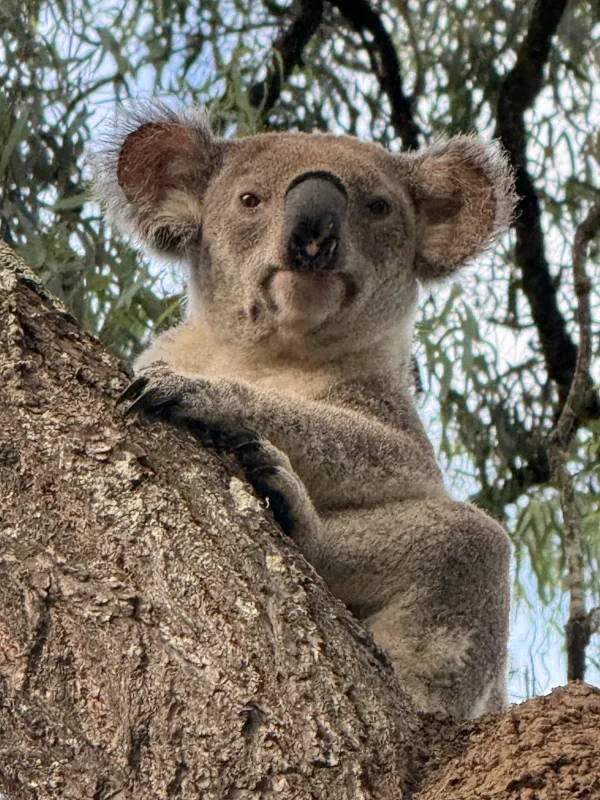
Description
How to identify
The koala (Phascolarctos cinereus) is a specialized arboreal marsupial that, while being an iconic species, can pose challenges in the context of industrial eucalyptus forestry.
It is characterized by a stocky build, thick gray fur, and large, rounded ears, adapted for life in the forest canopy. An adult koala can weigh up to 15 kilograms.
Equipped with strong limbs and sharp, curved claws, the koala is highly efficient at climbing vertical trunks to reach the foliage of preferred eucalyptus species.
Taxonomically, it belongs to the order Diprotodontia and is the sole extant member of the family Phascolarctidae.
The biology of the koala is defined by its extreme diet specialization, requiring vast amounts of eucalyptus leaves to meet its daily metabolic needs.
What it damages
The primary economic damage caused by koalas is the selective defoliation of young eucalyptus trees in commercial forestry plantations.
By feeding on the terminal shoots and leaves, koalas can significantly stunt the height growth and biomass accumulation of individual trees.
Persistent climbing and scratching by heavy individuals can damage the bark, potentially providing entry points for pathogens and wood-boring insects.
In high-density populations, the cumulative effect of constant feeding can lead to the overall weakening of young stands and uneven crown development.
While usually not killing mature trees, their feeding habits can severely degrade the wood quality of saplings, affecting future harvesting potential.
When it appears
Koalas maintain activity throughout the entire year, as they do not hibernate and must continue feeding to sustain their energy levels.
The spring and summer seasons often see increased browsing pressure, corresponding with the production of new, tender foliage on eucalyptus trees.
Breeding seasons influence the movement patterns of the population, which can lead to shifts in the areas most heavily impacted by koala herbivory.
Severe climate events, such as prolonged droughts, restrict the availability of suitable food, forcing individuals to browse on suboptimal tree species.
The annual cycle of the koala is closely tied to the physiological state of the eucalyptus trees they rely on, making seasonal monitoring essential for foresters.
Signs of infestation
One of the most reliable indicators of a koala's presence is the distinct, deep scratch marks left on the bark of eucalyptus trunks by their claws.
Small, elliptical fecal pellets found on the ground at the base of trees are clear evidence of recent usage of the site by the animal.
Visual inspection of the canopy reveals "pruned" or sparse treetops where the koala has been feeding intensively on the terminal growth.
Litter on the forest floor, including chewed leaves and broken small twigs, often signals the location of an active feeding tree.
During the breeding period, the loud bellows produced by males provide a clear audible signal that allows foresters to map the presence of the population.
Control measures
Management strategies for koalas must be strictly aligned with animal welfare regulations and conservation status, as the species is legally protected.
The establishment of buffer zones and the inclusion of non-preferred tree species in plantation edges can effectively redirect koala movement.
The use of scent-based repellents applied to the bark has shown promise in deterring koalas from protected saplings without harming the animals.
Fencing off high-value young stands is a proven physical barrier method, though it is often limited by high setup and maintenance costs.
Integrated forest management, which includes mapping population density and habitat selection, allows for the mitigation of impact on commercial timber crops.
Taxonomy
- Latin name
- Phascolarctos cinereus
- Family
- Phascolarctidae
- EPPO code
- PHQSCI
Discussion
No discussions yet — be the first.