
Phalonidia moth
Phalonidia contractana
Description
How to identify
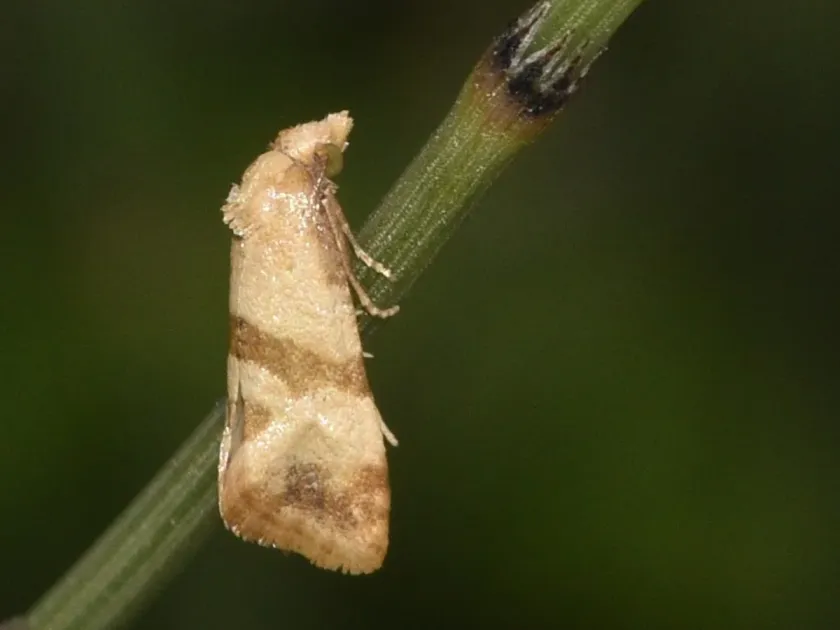
The Phalonidia moth (Phalonidia contractana) belongs to the Tortricidae family within the order Lepidoptera. It is a small moth with a wingspan ranging from 12 to 16 mm.
The forewings of the adults are ochre-yellow or brownish, marked with distinct dark transverse patterns. The hindwings are generally lighter, with a greyish hue and a fringed edge.
The larvae (caterpillars) reach 10–12 mm in length. They typically feature a cylindrical body, varying from dirty white to yellowish-green, with a dark-colored head capsule.
Pupation occurs within a silken cocoon constructed by the larva, often hidden in plant debris, crevices, or near the food source.
The life cycle involves complete metamorphosis, including the egg, larva, pupa, and adult stages, with the potential for one or more generations per year depending on the climate.
What it damages
The primary hosts for Phalonidia larvae are members of the Asteraceae family, most notably sunflowers and various related weed species.
The pest attacks the reproductive organs of the plant. Larvae tunnel into the flower heads (capitula), consuming the internal tissues and the developing seeds.
The damage caused to the seed bed facilitates the growth of secondary fungal infections, such as rot, which significantly reduces seed yield and quality.
In some cases, larvae may also feed on young leaves, webbing them together, which leads to leaf deformation and a decrease in the plant's photosynthetic capacity.
Mass infestations on sunflower fields can lead to substantial crop losses, particularly if the pest pressure occurs during the flowering and seed-setting stages.
When it appears
Adult flight for the first generation typically begins in early summer, coinciding with the active growth phase of the sunflower capitula.
Eggs are laid on the underside of leaves or directly onto the surface of the flower heads, followed by the hatching of larvae that begin immediate feeding.
The peak of larval damage occurs during the flowering and seed maturation periods when plant tissues are most nutritious and succulent.
The overwintering stage is usually the late-instar larva, which seeks shelter in plant residues, soil, or bark crevices to survive the winter.
Pupation takes place in the spring as temperatures rise, leading to the emergence of the new generation of adults.
Signs of infestation
The initial sign of an infestation is the appearance of silk webbing on the sunflower heads or between the foliage of the plant.
Frass (larval excrement) appearing as fine pellets on the surface of the flower head is a strong indicator of active larval feeding within the tissues.
Careful visual inspection will reveal entry holes bored by the larvae, often accompanied by the darkening of tissues around the puncture site.
Premature wilting of individual sections of the flower head may occur due to the damage inflicted on the plant's vascular system.
- Presence of adult moths during evening scouting.
- Silk webbing present in the flower head area.
- Darkened or decaying spots on the head.
- Tunneling damage within the developing seeds.
- Larval frass visible on the flower head surface.
Control measures
Effective management begins with cultural practices, specifically deep plowing after harvest to destroy overwintering sites in the soil.
Crop rotation and maintaining field borders free of wild Asteraceae weeds are essential to prevent the spread and buildup of the pest population.
Biological control agents, such as insecticides based on entomopathogenic fungi or bacteria, can be effective when applied against early-instar larvae.
Chemical control is applied when populations exceed economic damage thresholds, utilizing registered insecticides during the period of mass egg hatching.
Pheromone monitoring allows for the precise timing of protective interventions, ensuring that management strategies are both effective and cost-efficient.
Taxonomy
- Latin name
- Phalonidia contractana
- Order
- Lepidoptera (butterflies)
- Family
- Tortricidae
- EPPO code
- PHAOCO
Discussion
No discussions yet — be the first.