
Kelly's citrus thrips
Pezothrips kellyanus
Description
How to identify
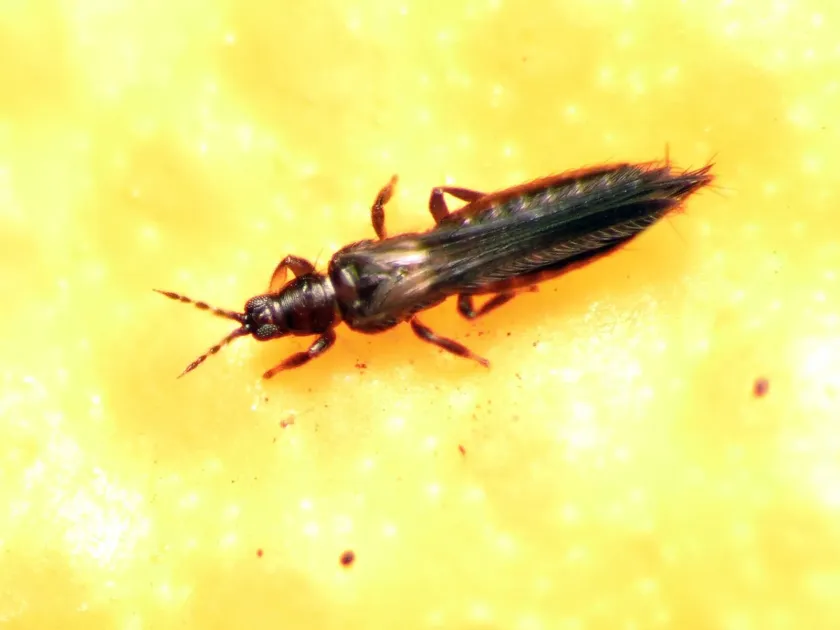
Kelly's citrus thrips (Pezothrips kellyanus) is a member of the order Thysanoptera, family Thripidae. This tiny insect, with adults reaching approximately 1.5–2 mm in length, is a significant pest.
The adult coloration ranges from dark brown to almost black, making them easily visible on light-colored plant parts. They possess transparent wings with characteristic fringed edges, typical for the order.
The life cycle consists of eggs, two larval stages, a prepupa, a pupa, and an adult. Larvae vary from colorless to pale yellow, darkening as they mature.
Development is highly dependent on temperature and humidity. Warm, humid conditions favor rapid population growth, allowing the pest to complete several generations per season.
While native to regions with subtropical climates, Pezothrips kellyanus has spread globally through international trade of nursery stock and fruit products.
What it damages
Kelly's citrus thrips primarily infest citrus crops, including lemons, oranges, and mandarins. They are also known to damage grapes, avocados, and various ornamental plants.
Both adults and larvae feed on young fruit and flower tissues. They pierce the epidermis of the plant, sucking out cellular fluids, which disrupts normal development.
The most critical window for crop damage is during fruit set. Even low populations at this stage can result in significant economic losses due to fruit downgrading.
The damage caused by these insects does not just ruin the aesthetic appearance of the fruit; it also creates wounds that serve as entry points for secondary plant pathogens.
Economic damage is severe because infested fruit often fails to meet strict phytosanitary standards for international export markets.
Signs of infestation
The most prominent sign of infestation is a distinct, circular corky scar around the fruit stem, caused by larvae feeding under the calyx of young developing fruit.
As the fruit expands, these scars stretch, resulting in rough, silver-to-brown ring-shaped markings. The fruit peel loses its smoothness and becomes toughened in the affected areas.
Flowers infested with thrips may show signs of premature wilting, drying, or petal drop. Close inspection of blossoms often reveals clusters of mobile larvae hidden inside the petals.
Leaves can also be affected, displaying silvering, curling, or the presence of tiny black spots, which are the excrement (frass) of the thrips.
Early detection is facilitated by placing blue or yellow sticky traps in the orchard to monitor the activity and population density of the adult insects.
Control measures
Effective management requires the application of registered contact and systemic insecticides, timed carefully to match the stages of flower and fruit development.
Treatments should be applied during the peak flowering stage and immediately after petal fall, as larvae are most susceptible during these periods.
Biological control programs utilize natural predators such as predatory mites (e.g., Amblyseius spp.) or anthocorid bugs, which help keep the thrips population under control.
Cultural practices include the thorough removal of weeds and debris in and around the orchard, as these act as alternative hosts and refuges for the pest.
Strict adherence to phytosanitary regulations regarding the import and movement of plant materials is essential to prevent the spread of the species into new regions.
Taxonomy
- Latin name
- Pezothrips kellyanus
- Order
- Thrips
- Family
- Thripidae
- EPPO code
- PEZTKE
Discussion
No discussions yet — be the first.