
Pezothrips
Pezothrips
Description
How to identify
Pezothrips is a genus of insects in the order Thysanoptera, family Thripidae. Among its members, Pezothrips kellyanus is recognized as a significant agricultural pest that affects various fruit and ornamental crops globally.
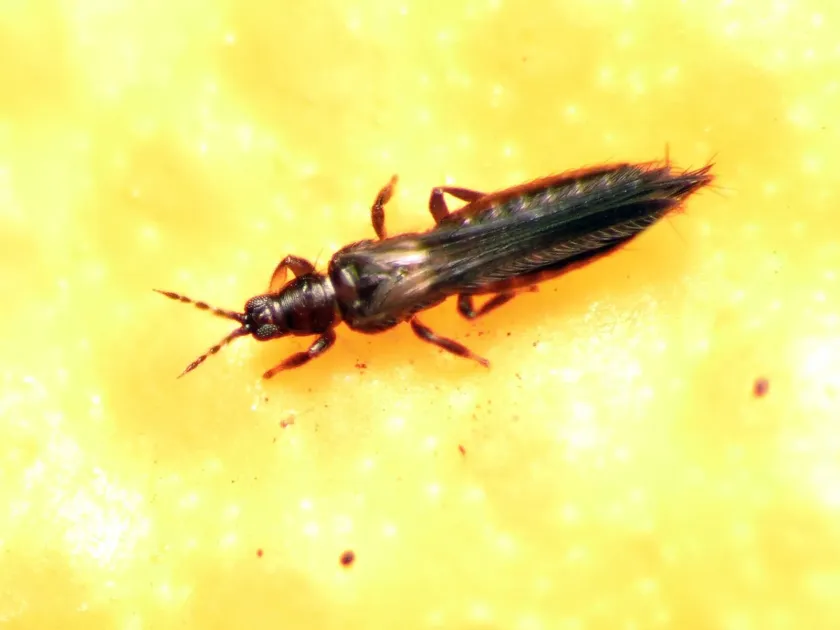
Adult insects are tiny, typically measuring between 1 to 2 millimeters in length. Their bodies are elongated and usually dark brown or black in color, making them difficult to spot against green foliage.
Their wings are narrow and fringed with long hairs, a distinct characteristic of the Thripidae family. When at rest, these wings are held folded along the back, which often conceals the insect from casual observation.
Larvae appear similar to adults but are smaller, wingless, and often lighter in color, ranging from pale yellow to orange. They are highly active and begin feeding shortly after hatching.
In field monitoring, professionals use blue or yellow sticky cards to detect the presence of adults. Shaking plant branches over a white sheet is also an effective way to identify the presence of both larvae and adults.
What it damages
Pezothrips are polyphagous, meaning they feed on a wide range of host plants. They are particularly problematic for citrus, grapes, and various flowering plants, targeting young, tender tissues.
The damage is caused by the insect's rasping-sucking mouthparts. They pierce plant cells and extract the contents, injecting saliva that often leads to tissue death, deformation, and stunted growth.
In citrus, the most iconic damage occurs on developing fruit. As the thrips feed on the young ovary, they create ring-shaped or irregular scars that remain on the fruit surface as it grows, rendering the produce commercially unattractive.
Heavy infestations can cause flower buds to dry out and drop before opening, leading to substantial yield losses. In severe cases, the entire growth tip of a plant may become deformed and necrotic.
Furthermore, these insects are vectors for some plant pathogens. The open wounds caused by their feeding provide an entry point for secondary bacterial and fungal infections, further compromising the health of the plant.
When it appears
The life cycle and activity of Pezothrips are heavily influenced by temperature and moisture. They thrive in warm, humid conditions, where they can complete their life cycle in just a few weeks.
They typically overwinter in the soil or under plant debris, emerging in the spring when temperatures rise. As soon as new growth or flowers appear on host plants, they begin feeding and laying eggs.
Population peaks usually coincide with the bloom period of target crops. Because multiple generations can overlap during the growing season, a small initial population can rapidly explode into a major infestation if conditions remain favorable.
In hot, dry regions, activity may fluctuate, but the presence of irrigation keeps populations stable. As autumn approaches and temperatures drop, their development slows down, and they begin seeking overwintering sites.
Understanding these seasonal patterns is crucial for timing control measures. Intervening before the bloom stage often prevents the most significant economic damage to the fruit.
Signs of infestation
The most visible sign of infestation is the presence of silvery or bleached patches on leaves and petals. This discoloration occurs as cells lose their contents and are filled with air.
Tiny black spots, which are the excrement of the thrips, are often found on the surface of flowers, leaves, or fruit. These are clear indicators of active feeding sites.
Deformed fruit with distinct ring-like scars or corky patches is a hallmark of Pezothrips damage. These scars are a direct result of early-season feeding on the ovary.
Plants showing stunted growth, curled leaves, or buds that fail to open are often struggling with a heavy population of these insects.
When inspecting blossoms, one might observe small, slender insects quickly darting into the folds of the petals, which is a common behavioral sign of the species.
Control measures
Integrated Pest Management (IPM) is essential for controlling Pezothrips. Cultural practices, such as weed management, help reduce alternative host plants that support thrips populations early in the season.
Biological control methods involve the release of beneficial insects, such as predatory mites (e.g., Amblyseius species) and lacewings, which feed on thrips larvae and help maintain natural balance.
Chemical control should be used judiciously, employing systemic insecticides that target the pest while minimizing impact on pollinators. Rotation of active ingredients is mandatory to prevent the development of pesticide resistance.
Monitoring with sticky traps is a critical tool for early detection. By placing these traps throughout the orchard or greenhouse, growers can monitor population trends and apply treatments only when necessary.
- Monitor fields consistently using sticky cards.
- Promote natural predators to control low-level infestations.
- Rotate chemical modes of action to prevent resistance.
- Remove crop debris and weeds to eliminate overwintering sites.
Taxonomy
- Latin name
- Pezothrips
- Order
- Thrips
- Family
- Thripidae
- EPPO code
- PEZTSP
Discussion
No discussions yet — be the first.