
Brown wheat mite
Petrobia apicalis
Description
How to identify
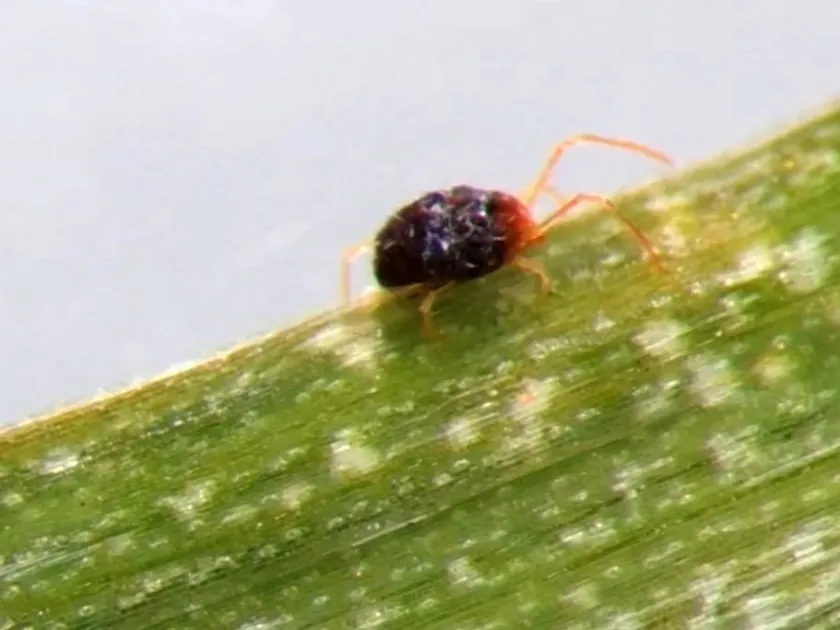
The brown wheat mite (Petrobia apicalis) belongs to the Tetranychidae family. It is a microscopic pest characterized by a brownish or reddish-brown body color, which makes it visible on green leaves despite its small size.
Unlike many other spider mites, this species does not spin a dense web, which often leads to late detection in the field. Adult females have a rounded body shape, while males are generally smaller and more active in their movement across the plant surface.
The life cycle consists of the egg stage, larva, two nymphal stages, and the adult phase. Most of their activity occurs on the upper surface of the leaves, where both nymphs and adults feed on the plant's cell sap.
Females are highly prolific, allowing for rapid population growth under favorable environmental conditions. The species overwinters primarily in the egg stage, with eggs deposited in the soil or on crop residues during the previous season.
Field identification is often performed by shaking plant material over a white sheet of paper. The mites appear as tiny brown moving dots, making them distinct enough for an experienced agronomist to detect the infestation early.
What it damages
Petrobia apicalis is a polyphagous pest that affects a variety of crops, primarily wheat, barley, and other small grains. It is particularly damaging to young crops during the early stages of the growing season.
The mite feeds by piercing the epidermal cells and extracting the fluid contents, which destroys chlorophyll and severely impairs photosynthesis. This loss of nutrients causes significant physiological stress to the plant.
Damage is most severe during prolonged periods of drought. Because the plant is already struggling with a lack of water, the additional stress from mite feeding can lead to rapid wilting and stunted development.
Heavy infestations result in leaf discoloration, which can be mistaken for nutrient deficiencies or early-stage fungal diseases. In severe cases, the foliage may curl and die prematurely, leading to reduced tillering and lower grain yields.
Grain quality is also impacted because the plant lacks the resources to fill the kernels properly. This results in smaller grain weight and reduced overall economic returns for the farmer.
When it appears
The activity of the brown wheat mite typically begins in early spring as temperatures rise. Infestations usually start at the edges of fields adjacent to non-cultivated areas or perennial grasses.
The peak period for population growth is during dry and warm spring weather. These conditions accelerate the mite's reproductive cycle, allowing them to complete multiple generations in a short period of time.
Summer heat can temporarily suppress mite activity, but the pest remains present in the field. When weather conditions improve, populations can recover quickly, especially if autumn moisture encourages new growth.
As autumn approaches, the mites transition into producing overwintering eggs. These eggs are remarkably hardy, capable of surviving freezing temperatures and harsh conditions throughout the winter months.
Monitoring should be conducted consistently from March through May. By identifying the initial migration from host plants to the crop, farmers can implement control strategies before the mites spread throughout the entire field.
Signs of infestation
The first sign of an infestation is the appearance of tiny white or yellow stippling marks on the upper surface of the leaves. These are the direct result of the mites piercing the epidermal layer to feed.
As the feeding continues, these spots coalesce, giving the leaves a marble-like, grayish, or brownish appearance. This symptom is a classic indicator of mite activity that differs from the systemic spread of fungal pathogens.
Using a magnifying glass, one can clearly see the mites and their eggs on the foliage. The leaves may also lose their natural luster, looking dry and faded due to the extensive damage to the cell structure.
- Yellowing of leaf tips in cereal crops.
- General lack of vigor and stunted growth in affected areas.
- Small, bleached necrotic spots on the leaf blades.
- Curling or drying of leaves under heavy infestation pressure.
If left unmanaged, the infestation moves from small patches to cover larger areas of the field, creating distinct yellowing patterns that can be easily seen during routine field inspections.
Control measures
Effective management of the brown wheat mite requires an integrated approach that includes cultural practices and chemical intervention. Crop rotation is essential to prevent the buildup of pest populations.
Cultural control methods such as deep fall tillage can help bury overwintering eggs, reducing the initial population pressure in the spring. Controlling weeds around field borders also helps eliminate alternative hosts.
Chemical control is warranted when the population density exceeds the economic threshold. Applying specialized acaricides or effective insecticides is the most common way to manage outbreaks during the growing season.
It is important to rotate chemical classes to prevent the mites from developing resistance. Proper application equipment and timing (early morning or late evening) are crucial to ensure thorough coverage of the leaves.
Regular scouting using sticky traps or simple leaf checks allows for localized treatment of infestation hot spots. This targeted approach is more sustainable and cost-effective than whole-field spray applications.
Taxonomy
- Latin name
- Petrobia apicalis
- Order
- Mites
- Family
- Tetranychidae
- EPPO code
- PETRAP
Discussion
No discussions yet — be the first.