
Sugar glider
Petaurus breviceps
Description
How to identify
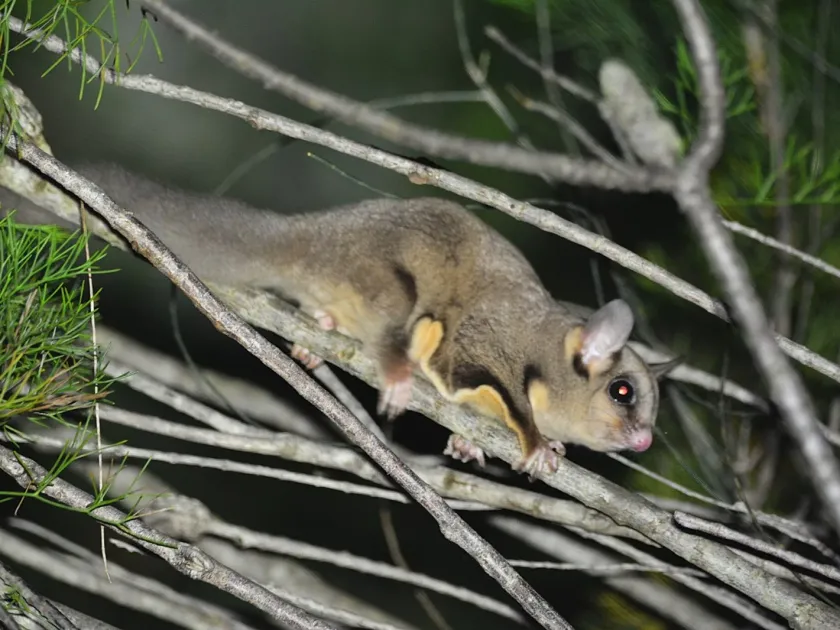
The sugar glider (Petaurus breviceps) is a small, arboreal marsupial member of the family Petauridae, native to Australia and Indonesia.
These animals are characterized by the patagium, a specialized membrane stretching from their wrists to their ankles, allowing them to glide between trees.
They have large, dark eyes adapted for nocturnal activity, soft gray fur with a prominent black stripe on the back, and a long, bushy, prehensile tail.
Adult sugar gliders typically weigh between 90 and 150 grams and possess sharp lower incisors designed for gouging holes into tree bark to feed on sap.
Because they are social animals that form small colonies, their presence in an orchard can quickly lead to widespread damage to the woody parts of trees.
What it damages
In agricultural settings, sugar gliders cause damage by deliberately gouging the bark of trees to harvest sap, which is a staple in their diet.
These repetitive gouges strip the bark and expose the underlying phloem, weakening the tree and making it susceptible to pathogens and wood-boring pests.
When fruit is available, gliders consume the flesh, damaging the skin and causing the fruit to rot or fall prematurely, resulting in significant yield losses.
Severe infestations often result in branch dieback or the death of younger trees due to girdling, where the bark is stripped completely around the trunk.
The secondary impact of their feeding includes the entry of fungi and bacterial infections into the open wounds, which further degrades the health of the orchard.
When it appears
Sugar gliders are most active during the growing season when trees are in peak vigor, producing the nutrient-rich sap they feed upon.
In regions with distinct dry seasons, their activity increases as they rely on tree sap and juicy fruits to meet their water requirements.
During the winter, when insect populations are low, sugar gliders are forced to forage more aggressively on tree bark, increasing the damage to orchards.
Their movement patterns are highly seasonal, often tracking the phenology of flowering and fruiting cycles of the trees they inhabit.
Understanding these seasonal fluctuations is crucial for timing monitoring activities and implementing protective measures before the peak damage periods occur.
Signs of infestation
The most diagnostic sign of sugar glider presence is the characteristic series of small, vertically aligned gouges or pits found on the trunks and main branches.
Evidence of feeding includes sap flowing from these wounds, which often solidifies into a gummy substance and attracts other insects and fungi.
One may notice fruit that has been partially consumed, showing distinct tooth marks from the animal's lower incisors, often occurring high in the canopy.
Nocturnal activity can be detected through their unique vocalizations, which are often described as sharp chirps or rapid, clicking sounds during the night.
- Gouged bark patterns on trunks.
- Excessive sap bleeding on tree surfaces.
- Partial consumption of orchard fruits.
Control measures
The most effective mechanical deterrent is the installation of metal collars or sheets around tree trunks, which prevents the gliders from climbing.
Orchard management practices such as trimming overlapping branches create gaps that limit the gliders' ability to move freely across the canopy.
Ultrasonic repellers, specifically designed for small arboreal animals, can be deployed to create an acoustic environment that deters them from settling.
Removal of potential nesting sites, such as dead trees or hollow branches, within the vicinity of the plantation can discourage colony formation.
In extreme cases, integrating wildlife-friendly barriers ensures the protection of high-value crops while minimizing the physical impact on the plantation's ecosystem.
Taxonomy
- Latin name
- Petaurus breviceps
- Family
- Petauridae
- EPPO code
- PTAUBR
Discussion
No discussions yet — be the first.