
Perperus
Perperus
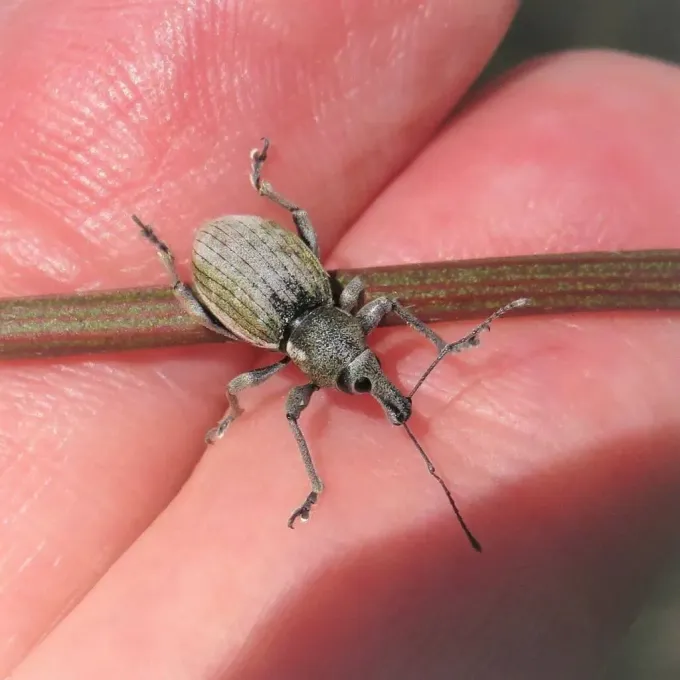
Description
How to identify
Perperus (lat. Perperus) belongs to the weevil family (Curculionidae) in the order Coleoptera. These beetles are characterized by the elongated snout, typical for the family, and a dense chitinous cover.
The coloration of adults usually varies from dark brown to grayish, allowing them to camouflage effectively on tree bark or soil surfaces. Adult insects are relatively small, typically ranging from 5 to 9 millimeters in length.
Perperus larvae have the typical legless form of weevils; they are fleshy, curved, and white or yellowish in color. The larval head capsule is well-developed and brown, which allows it to actively gnaw through plant tissues.
The life cycle of the insect includes complete metamorphosis: egg, larva, pupa, and adult. Adult beetles are primarily nocturnal, hiding during the day at the base of plants or in plant debris.
Systematically, this genus is a typical representative of the subfamily Entiminae (broad-nosed weevils), many of which are known to feed on both roots and the aerial parts of plants.
What it damages
This pest has a wide range of host plants, affecting both fruit trees and various shrubs. It poses a particular danger to vineyards and various types of stone fruit crops.
Adults cause damage to the aerial part of plants by gnawing the edges of leaf blades. This leads to characteristic "notched" defoliation, which significantly reduces the total photosynthetic surface of the crop.
Larvae lead a hidden lifestyle, living in the soil layer and damaging the root system of young seedlings and mature trees. This results in plant weakening, stunted growth, and can cause root system death during massive infestations.
The damage caused by larvae often remains unnoticed until the plant begins to show signs of deep stress. Damaged roots become entry points for secondary fungal and bacterial infections.
The economic impact of Perperus lies in its ability to significantly reduce the yield of fruit and berry crops and complicate the survival rate of seedlings in nurseries during high population densities.
When it appears
The activation of overwintering adults begins in the spring when average daily soil and air temperatures reach threshold values for the insects to start feeding.
The period of intensive feeding of adult beetles usually coincides with the phase of active plant vegetation, including bud burst and growth of new shoots, when plant tissues are most succulent and nutritious.
Egg-laying occurs in the soil near the trunk base or in cracks in the bark. Larval emergence typically happens in the second half of the growing season when they begin to actively feed on fine roots.
Pupation of the insects occurs in a soil chamber at the end of the summer or autumn period. Young beetles can remain in the soil until the next spring, providing them with reliable protection against unfavorable environmental conditions.
Seasonal population dynamics are highly dependent on regional weather conditions: a wet and warm summer facilitates the rapid development of generations and increases the density of the pest population in the area.
Signs of infestation
The first sign of the pest's presence is the appearance of jagged or uneven edges on the leaves of young shoots, which is a result of adult feeding activity.
When inspecting the root system of seedlings that show signs of wilting for no apparent reason on the aerial part, one can find traces of gnawing on roots or the larvae themselves.
The presence of beetles in the plant canopy is easily detected by nighttime inspection with a flashlight or by the method of shaking the insects onto a sheet during evening hours.
Sudden yellowing and premature leaf fall in the absence of fungal disease symptoms can also indirectly indicate root damage by weevil larvae.
The soil around the base of the trunk may be loosened, and the presence of holes in the topsoil layer indicates the emergence of adults after the pupation phase is completed.
Control measures
Mechanical control methods include the use of sticky traps or barrier belts on tree trunks, which effectively limit the movement of adults at night.
An important element is timely cultivation of the soil around the trunk (the "tree circle"), as tilling helps destroy pupal chambers and kills larvae through exposure to sunlight and predators.
The use of chemical protection is justified when the pest population density exceeds the economic threshold. Contact-intestinal insecticides are used, targeting both adults and larval stages in the soil.
Biological control involves the use of products based on entomopathogenic fungi (e.g., Beauveria bassiana) or nematodes, which effectively suppress larval development in the soil substrate.
- Regular monitoring of plants at night
- Timely weeding to remove reservoir hosts
- Application of soil-drench insecticides according to label instructions
- Maintaining proper agronomic practices to strengthen plant immunity
Taxonomy
- Latin name
- Perperus
- Order
- Coleoptera (beetles)
- Family
- Curculionidae
- EPPO code
- PRPRSP
Discussion
No discussions yet — be the first.