
Deer mouse
Peromyscus maniculatus
Description
How to identify
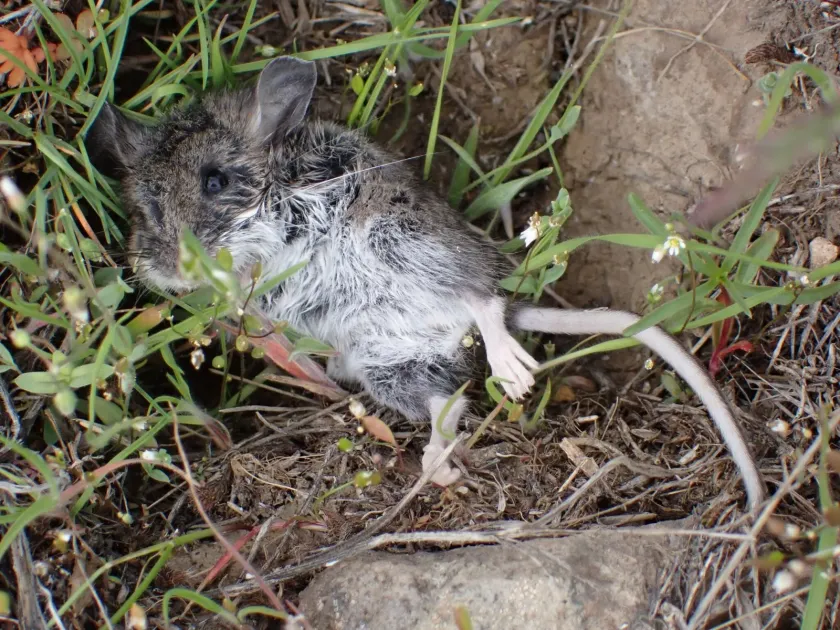
The deer mouse (Peromyscus maniculatus) is a small rodent characterized by its distinct bicolored coat, featuring a brownish or grayish-brown upper side and a crisp white belly and feet.
One of the most identifiable features of this species is its tail, which is typically dark on top and light underneath, with a length nearly equal to that of its body.
They possess relatively large, mobile ears covered in fine fur, which gives them the deer-like appearance from which their common name is derived.
Their eyes are large and prominent, adapted for nocturnal activity and excellent navigation in environments with minimal light.
Adult deer mice usually measure between 7 and 10 cm in body length and are exceptionally agile, capable of jumping and climbing to reach food sources.
What it damages
As a prolific agricultural pest, the deer mouse is omnivorous and can cause significant economic losses by consuming seeds and seedlings across various crops.
They are particularly destructive during planting seasons, as they frequently dig up sown seeds, leading to poor crop establishment and reduced yields.
In orchard settings, these rodents often gnaw on the bark of young trees at the base, which can lead to girdling, stunted growth, or the eventual death of the sapling.
Beyond field crops, they invade storage facilities, where they spoil large quantities of grain, hay, and animal feed through consumption and contamination.
Beyond physical damage, they are recognized as significant disease vectors, carrying pathogens such as hantaviruses that pose risks to farm workers.
When it appears
Deer mice are active throughout the year, but their impact on agriculture peaks during spring planting and autumn harvest periods when food is most accessible.
They do not hibernate, which means that during harsh winter months, they often migrate toward human structures, barns, or storage sheds for warmth and food.
Their life cycle is marked by rapid reproductive rates; a female can produce multiple litters per year, allowing population numbers to surge quickly under favorable conditions.
Breeding activity is most intense during the warmer months when a sufficient supply of seeds, nuts, and insects is readily available in the wild.
During periods of drought or extreme weather, these rodents tend to congregate in irrigated fields or farmsteads where environmental stress is lower.
Signs of infestation
Evidence of a deer mouse infestation includes small burrow openings located near plant bases, fence lines, or dense vegetation cover.
Feeding activity is often marked by the presence of seed hulls, husks, and gnawed plant remnants left behind in specific gathering spots.
Large-scale damage is frequently visible as missing rows in newly planted fields, where seeds have been removed by rodents before germination could occur.
The presence of small, dark, capsule-shaped droppings is a definitive indicator that a deer mouse population is actively utilizing an area.
Because they are nocturnal, direct sightings are rare, but their presence can be confirmed using trail cameras or by examining tracks in loose soil.
Control measures
Effective management begins with cultural practices like deep plowing, which disrupts burrow systems and exposes rodents to predators and harsh weather.
Maintaining clean fields by clearing weeds and brush around perimeters reduces available nesting sites and diminishes the attraction of the area for rodents.
Rodenticide application must be handled with precision to avoid secondary poisoning of natural predators such as hawks and owls that provide biological control.
In orchards and nurseries, protecting the bases of young trees with hardware cloth or plastic guards effectively prevents gnawing damage.
- Ensure all grain storage facilities are rodent-proofed with sealed containers.
- Encourage natural predation by installing owl boxes or raptor perches.
- Use ultrasonic repellent devices in small, confined storage areas.
Taxonomy
- Latin name
- Peromyscus maniculatus
- Order
- Rodents
- Family
- Muridae
- EPPO code
- PERMMA
Discussion
No discussions yet — be the first.