
Deer mouse
Peromyscus
Description
How to identify
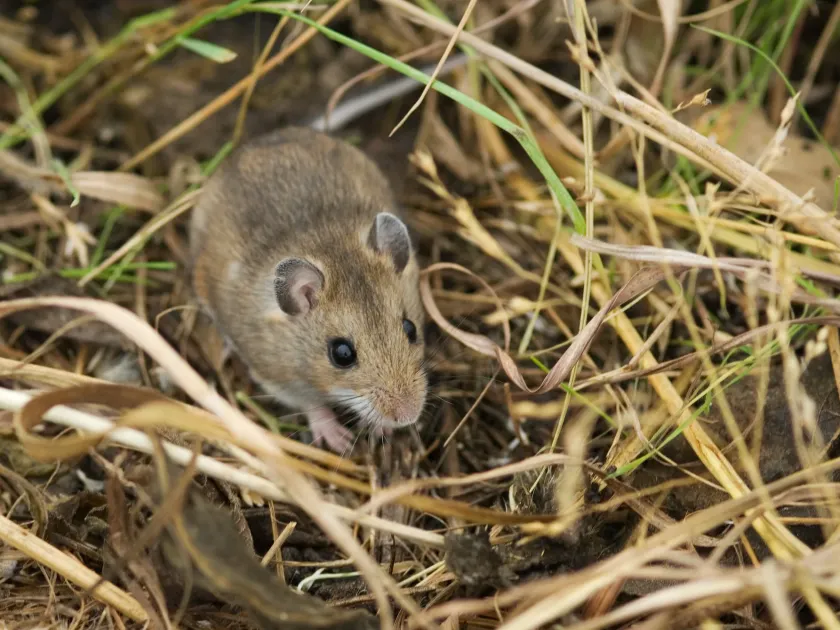
The deer mouse (Peromyscus) belongs to the Cricetidae family and is characterized by its large, deer-like agility, provided by powerful and relatively long hind legs.
These rodents are easily identified by their bicolored appearance: they have a brownish or grayish-brown upper body and a stark white belly, chest, and paws.
An adult deer mouse typically measures between 8 and 15 centimeters in length, often possessing a tail that is equal in length to its body, with a clear color boundary.
Their physical features include large, prominent eyes and large ears covered in fine fur, which are distinct adaptations for their primarily nocturnal foraging habits.
Deer mice are exceptionally cautious and agile, moving with quick bursts of speed that allow them to escape predators and navigate dense vegetation effectively.
What it damages
Deer mice are significant agricultural pests that cause extensive damage by consuming seeds planted in fields before they have a chance to germinate properly.
During the harvest season, they frequently attack standing cereal crops, gnawing on stalks and consuming grains, leading to direct economic losses for farmers.
In orchards, these rodents are known to girdle young trees by chewing on the bark near the base, which can restrict nutrient transport and kill young saplings.
Stored agricultural products are also at risk, as deer mice infiltrate silos and barns, contaminating grain with their waste and consuming large amounts of inventory.
Their role as carriers of various diseases and pathogens makes them not only a nuisance to crop yields but also a potential health hazard in farming environments.
When it appears
Deer mice remain active throughout the entire year, as they do not hibernate and must continuously secure food sources to survive the winter months.
Autumn is a period of peak activity, during which they focus on gathering and hoarding seeds, nuts, and grain in underground caches for winter consumption.
Spring presents a challenge during the planting season, as the abundance of seeds in the soil attracts large numbers of these rodents to freshly sown fields.
Throughout the year, their reproductive capacity is high, with females producing multiple litters per season, which allows populations to grow rapidly in favorable conditions.
During colder weather, they tend to migrate toward protected areas, such as barns, haystacks, or wooded edges, maintaining their activity near human structures.
Signs of infestation
One of the primary indicators of a deer mouse infestation is the presence of small, excavated holes in fields where seeds have been dug up and eaten.
Damaged seedlings or gnawed corn shoots appearing shortly after germination are clear signs that these rodents are actively foraging in the area.
In barns and storage facilities, the presence of droppings, chewed-through bags, and distinct gnaw marks on wood or plastic indicate their recent activity.
Searching near the base of trees often reveals girdled bark, a classic sign of deer mouse damage during periods when alternative food sources are scarce.
The discovery of hidden seed caches in logs, abandoned bird nests, or soil burrows confirms that the area serves as a habitat for this rodent species.
Control measures
Effective management of deer mice requires a combination of sanitation practices and physical barriers to minimize their impact on agricultural operations.
Removing tall weeds, brush, and debris around the perimeter of fields reduces the cover available to rodents, making the habitat less hospitable for them.
Tilling the soil regularly helps destroy subterranean nest systems and burrows, which is an effective strategy to reduce local population density before planting.
Securing storage facilities by sealing entry points and using mesh wire can prevent mice from gaining access to grain supplies and causing further damage.
When chemical control is necessary, always place rodenticides in secure, tamper-resistant bait stations to prevent secondary poisoning of non-target wildlife.
Taxonomy
- Latin name
- Peromyscus
- Order
- Rodents
- Family
- Muridae
- EPPO code
- PERMSP
Discussion
No discussions yet — be the first.