
Peritelus
Peritelus
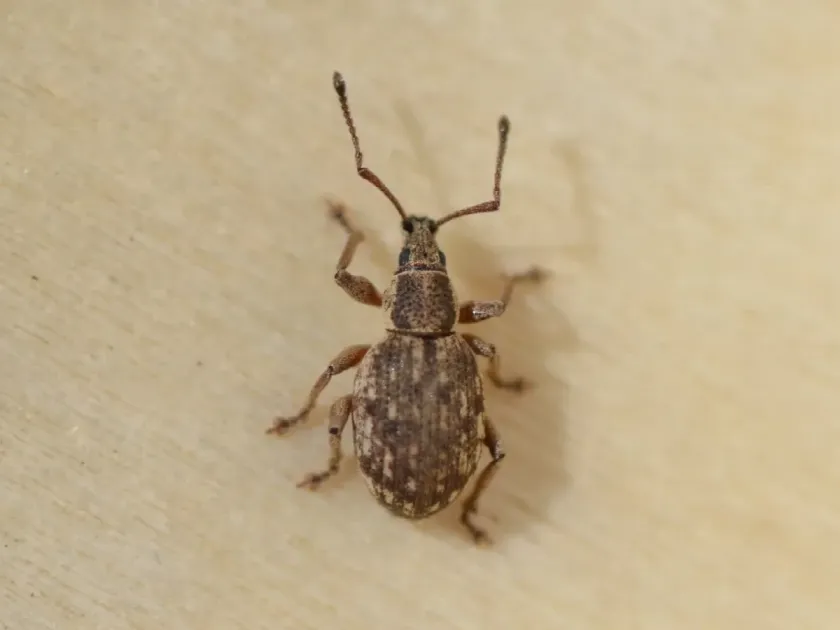
Description
How to identify
Peritelus is a genus of snout beetles belonging to the Curculionidae family. These beetles are characterized by a distinct elongated rostrum and a body covered in fine scales, which often provide a grey, brown, or mottled appearance, serving as effective camouflage against tree bark and soil.
Typically, adult Peritelus beetles measure between 5 to 8 millimeters in length. They are known for their defensive behavior of playing dead when disturbed, dropping from plants to the ground, where they remain motionless and nearly impossible to spot against the substrate.
The larvae are subterranean, white, legless grubs with a C-shaped body and a darker head capsule. They reside within the root zone, feeding on the fibrous roots of host plants, which makes them a silent threat to the overall vitality of the crop.
Systematically, they are classified under the order Coleoptera. Their life cycle undergoes complete metamorphosis, including egg, larva, pupa, and adult stages, with most species overwintering as adults in the topsoil or under organic debris.
Because they are nocturnal by nature, adults are rarely observed during daylight hours, meaning that damage often precedes the identification of the actual pest. Proper field scouting using flashlights after sunset is essential for accurate identification.
What it damages
Peritelus species are known to affect a wide variety of crops, including fruit trees, berry bushes, and vineyards. Their primary damage occurs during the early spring when adults emerge and start feeding on swelling buds.
Feeding on leaves results in characteristic semi-circular or irregular notches along the margins of the leaf blades. In cases of high infestation, the damage can be extensive, leaving only the midribs of the leaves intact.
The subterranean larvae pose a significant threat by damaging the root systems of perennial plants. This root feeding restricts the plant's ability to uptake water and nutrients, leading to stunted growth, yellowing foliage, and increased susceptibility to secondary stressors.
Bud destruction is particularly devastating for fruit production, as it can cause complete crop loss on specific branches before the flowering season even begins. This impact is most severe on young, sensitive trees and vines.
Economic damage is cumulative; the combination of bud consumption by adults and root damage by larvae can significantly lower the plant's vigor and yield capacity over several growing seasons if left unmanaged.
When it appears
Adult emergence typically begins in the early spring, triggered by rising soil temperatures (usually around 10-12°C). This timing corresponds closely with the phenological stage of bud break in many host plants.
Peak activity occurs throughout May and June, when the adults are most aggressive in their feeding and subsequent mating. Following this period, females deposit eggs into the soil near the base of host plants.
The larval stage occupies the entire summer season, during which they feed actively on the roots. Their growth is dictated by environmental temperature, and they reach maturity as the summer wanes.
Pupation occurs in the soil, usually within specialized earthen cells, during the late summer or early autumn. Once the pupal development is complete, the new generation of adults emerges but remains in the soil for the winter.
Understanding this cycle is crucial for effective control. Intervention is most successful when targeting the adult population before egg-laying occurs, or by disrupting the pupal development in the soil through tillage.
Signs of infestation
The most recognizable sign of an infestation is the presence of distinct, notched feeding marks along the leaf edges. These patterns are characteristic of many Curculionidae species and are easily identified by experienced growers.
In the spring, premature bud loss or hollowed-out buds are strong indicators of Peritelus activity. If buds are disappearing without signs of fungal disease, a nocturnal search for the beetles is highly recommended.
Unexpected plant wilting, particularly in dry conditions, may indicate root damage caused by larval activity. This is frequently observed in nursery settings or orchards planted in sandy, well-aerated soils where these beetles thrive.
Searching at night with a flashlight is the definitive method to confirm the presence of this pest, as the adults emerge to feed under the cover of darkness. They can often be found on the foliage or the stems of the plants.
- Semicircular notches on leaf margins.
- Damage to or total absence of spring buds.
- Sudden wilting or stunted plant growth.
- Observation of weevils on plants during nocturnal checks.
Control measures
Chemical control involving insecticides with contact or systemic activity is the most common management strategy. Applications should be timed to coincide with adult emergence in the spring, ideally before the plants reach the full flowering stage.
Mechanical control is feasible for small-scale operations. Shaking plants over a white sheet during the night or early morning causes the beetles to fall, allowing them to be collected and destroyed manually.
Cultural practices such as shallow cultivation or hoeing the soil beneath the canopy during the pupation period can physically destroy pupae, thereby reducing the number of adults that emerge in the following season.
Sanitation is equally important; removing weeds and ground cover reduces the availability of secondary food sources and wintering sites, which can significantly inhibit population growth within the orchard.
Biological control options, such as the application of entomopathogenic fungi or nematodes to the soil, provide an eco-friendly way to manage the larval stage, reducing the reliance on broad-spectrum chemical pesticides.
Taxonomy
- Latin name
- Peritelus
- Order
- Coleoptera (beetles)
- Family
- Curculionidae
- EPPO code
- PERESP
Discussion
No discussions yet — be the first.