
Pentarthrum
Pentarthrum
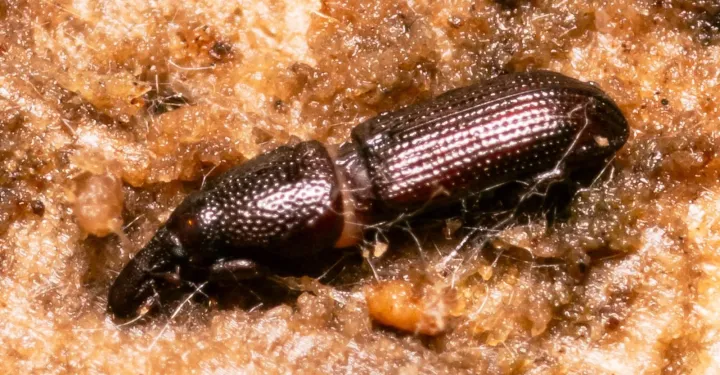
Description
How to identify
Pentarthrum is a genus of weevils belonging to the family Curculionidae and the subfamily Cossoninae. These beetles are typically small and cylindrical, specially adapted for a boring lifestyle within wood tissue.
Adult beetles are usually between 2 and 4 mm in length. Their bodies are smooth, glossy, and range in color from reddish-brown to almost black, allowing them to navigate inside narrow tunnels.
The head is extended into a characteristic rostrum, which is relatively short and broad in this genus. The elbowed antennae are a diagnostic feature confirming their classification within the weevil family.
The larvae are legless, whitish or cream-colored, with a hardened dark head capsule. They are biologically equipped to thrive by consuming wood fibers from the inside out.
Due to their cryptic behavior, adult specimens are rarely observed outside their galleries unless they are emerging to reproduce.
What it damages
This pest predominantly infests damp, decaying, or weakened wood. It is commonly found in timber that has been compromised by moisture, fungi, or poor storage conditions.
Pentarthrum often attacks structural timber, beams, and wooden objects in buildings where moisture levels are consistently high, such as basements or damp crawl spaces.
The larvae create extensive networks of galleries, which destroy the structural integrity of the timber, eventually leading to a loss of strength and overall material decay.
Because they favor fungus-ridden wood, their presence often indicates an existing moisture management issue that needs immediate attention.
Economic damage occurs when these beetles colonize load-bearing wooden structures, necessitating costly repairs or replacement of the affected elements.
Signs of infestation
The primary sign of infestation is the emergence of tiny, circular exit holes on the surface of the wood, through which the adult beetles leave after pupation.
Inside the timber, these galleries are packed with frass, a mixture of fine wood dust and larval waste, which is a clear indicator of active colonization.
Affected wood often appears soft or punky, crumbling easily when probed. There is often a distinct musty or rotting odor associated with infested areas.
In residential areas, adult beetles may occasionally be spotted on floors or surfaces near the site of infestation during the summer months.
- Exit holes measuring approximately 1 mm in diameter.
- Fine wood dust (frass) accumulation near wooden structures.
- Reduced density and structural softness of the wood.
Control measures
The most effective strategy against Pentarthrum is moisture control. Keeping wood dry is essential, as the pest cannot successfully survive or develop in healthy, dry timber.
Any wood showing signs of active infestation should be removed and destroyed to prevent the spread of the beetles to the surrounding structure.
Treatment with specialized deep-penetrating insecticides or wood preservatives can help protect susceptible timber from future colonization.
For severe infestations, structural fumigation performed by pest control professionals is the most reliable method for total eradication of the beetle population.
Preventive maintenance, including the application of high-quality sealants and ensuring proper ventilation in wooden buildings, is the best way to avoid infestation.
Taxonomy
- Latin name
- Pentarthrum
- Order
- Coleoptera (beetles)
- Family
- Curculionidae
- EPPO code
- PENRSP
Discussion
No discussions yet — be the first.