
Pentarthrum
Pentarthron
Description
How to identify
Pentarthrum is a genus of weevils (family Curculionidae) belonging to the order Coleoptera. These small beetles are commonly found in warehouses, flour mills, and grain storage facilities worldwide.
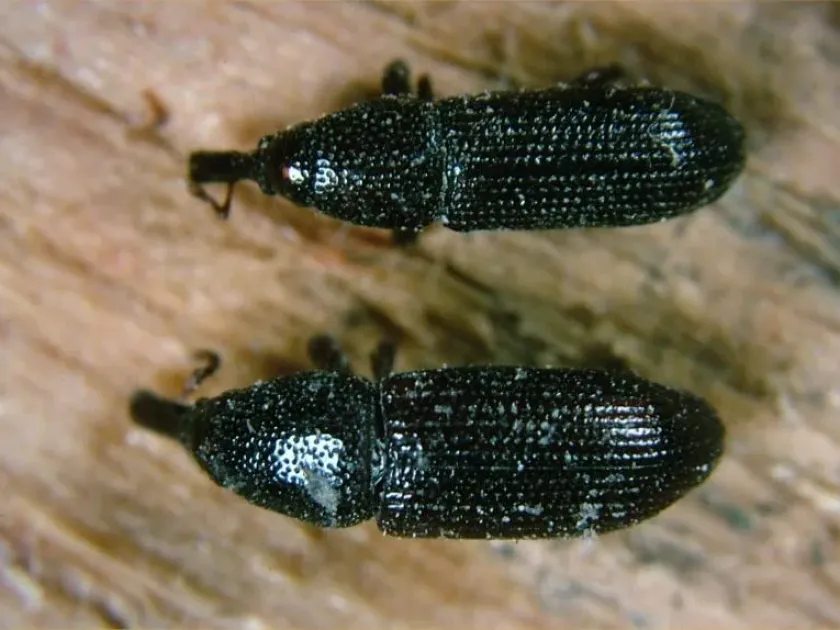
Adult insects have an elongated body, typically 3-4 mm long, with a dark brown or black coloration. A key feature is the presence of a long snout, which is characteristic of the weevil family.
The larvae are legless, fleshy, and white or cream-colored with a brown head. They live a hidden life, developing inside grain kernels or plant debris, which makes early detection quite difficult.
The development cycle is heavily dependent on temperature and humidity. Optimal conditions for rapid population growth include temperatures ranging from +22 to +28 degrees Celsius and high substrate humidity.
These beetles are capable of flight, allowing them to migrate between storage facilities and infest new batches of products. In the absence of food, they can survive for long periods in floor cracks, wall crevices, or residues of old grain.
What it damages
This pest is a specialized storage dweller that causes significant damage to stored supplies. It primarily infests whole grains such as wheat, barley, corn, and rye.
In addition to raw grain, Pentarthrum often inhabits processed products, including rusks, flour, animal feed, and even dried fruits or vegetables. Infestation leads to rapid loss of commercial quality and nutritional value.
During the feeding process, larvae consume the internal part of the kernel, leaving only the empty hull behind. This results in significant weight loss of the batch and a sharp decrease in seed germination rates.
In areas of high infestation, the grain mass begins to overheat due to insect metabolic activity and associated fungal growth. Rising temperatures accelerate the spoilage of the entire batch, making the product unsuitable for human or animal consumption.
Economic losses include not only the direct weight loss of the grain but also the costs associated with fumigation and the disposal of infected stock. The pest can spread mold spores, posing a health risk to livestock and humans.
Signs of infestation
The primary sign of infestation is the presence of adult beetles in the grain mass, which can be detected during sieving or thorough inspection. The use of light traps and pheromone indicators is essential for regular monitoring.
Visually, damaged grain exhibits characteristic exit holes created by adults as they emerge from the kernels after completing their development cycle. The surface may be covered in a fine, powdery dust.
A distinctive "noise" coming from deep within the grain mass, caused by larval feeding, can serve as an indirect sign of a heavy infestation. Touching the grain may reveal "hot spots" where the temperature is significantly elevated.
A specific musty or rotting odor indicates that the spoilage process has already reached deep into the grain layers. The presence of insect frass in storage facilities is a clear indicator of an active population outbreak.
Laboratory diagnostics often involve splitting test grains or using X-ray imaging, which allows for the detection of hidden infestations when larvae are still inside the kernels and no external damage is visible.
Control measures
The cornerstone of control is maintaining strict sanitation in storage areas. It is crucial to regularly clean warehouses to remove dust and old grain residues that serve as breeding grounds for the pest.
Disinfestation of empty storage structures using authorized contact and fumigant insecticides is a key step. Aerosol treatments are effective at reaching beetles hiding in crevices and inaccessible areas.
Controlling the microclimate inside the storage facility is vital; reducing grain moisture to below 12% and maintaining temperatures below +10 degrees Celsius can effectively stop or significantly slow down the development of Pentarthrum.
Fumigation of grain in silos is the most radical and efficient method for treating already infested batches. Applying aluminum phosphide-based preparations allows for the elimination of all stages of the pest's life cycle.
- Ensuring the airtightness of storage facilities.
- Regular laboratory analysis of batches upon receipt.
- Utilizing active ventilation systems for grain cooling.
- Conducting preventive disinfestation before storing new batches.
Taxonomy
- Latin name
- Pentarthron
- Order
- Hymenoptera
- Family
- Trichogrammatidae
- EPPO code
- PENOSP
Discussion
No discussions yet — be the first.