
White shrimp
Penaeus setiferus
Description
How to identify
The white shrimp, scientifically known as Penaeus setiferus, belongs to the order Decapoda and the family Penaeidae. It is a commercially significant crustacean found in the Atlantic Ocean.
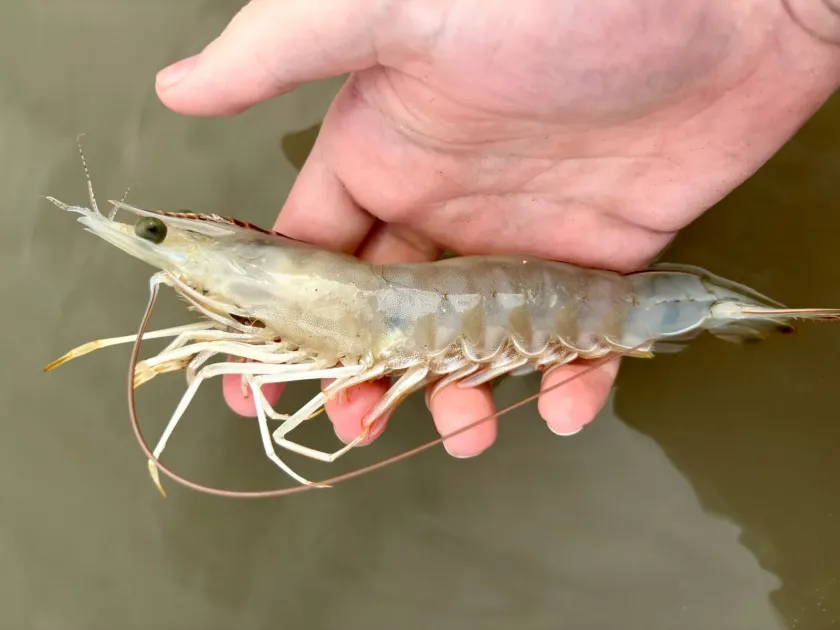
Anatomically, they possess a slender, compressed body with a light-colored, semi-translucent exoskeleton. They are well-adapted to bottom-dwelling lifestyles in sandy and muddy substrates.
They are characterized by long antennae and a serrated rostrum. Their life cycle is complex, involving distinct larval stages that rely on estuarine environments for protection and growth.
In their natural habitat, they play a crucial role as scavengers, processing organic matter on the seabed. They are not terrestrial organisms.
Misidentifying this marine animal as a plant pest is scientifically inaccurate, as its biological requirements are strictly aquatic and marine.
What it damages
Penaeus setiferus does not pose any threat to terrestrial agriculture or crops. There is no historical or biological evidence of this species damaging plants.
As omnivorous scavengers, their primary food sources are microscopic algae, detritus, and tiny invertebrates. They have no mechanisms to attack or feed upon crops.
Their only potential impact on flora is limited to aquatic environments where they might consume aquatic weeds or algae if introduced to artificial aquaculture ponds.
Farmers should not confuse this species with soil-borne or foliar pests that threaten plant health, as the white shrimp lacks any such interaction with crops.
The economic impact of this species is purely positive as it is one of the most popular seafood products in the North American market.
Control measures
Since the white shrimp is not a plant pest, no control measures or pesticides are required for agricultural protection.
In aquaculture management, if limiting their population is necessary, physical barriers and filtration systems are used to prevent them from entering specific tanks.
Environmental management involves monitoring water salinity and quality to ensure the health of surrounding ecosystems.
It is strongly advised against using any chemical treatments on crops to manage marine life, as this would cause ecological damage without addressing the nonexistent pest issue.
Sustainable aquaculture practices focus on managing the shrimp as a resource rather than a nuisance, ensuring proper water quality and biological safety.
Taxonomy
- Latin name
- Penaeus setiferus
- Family
- Penaeidae
- EPPO code
- PENSSE
Discussion
No discussions yet — be the first.