
American pelecinid
Pelecinus polyturator
Description
How to identify
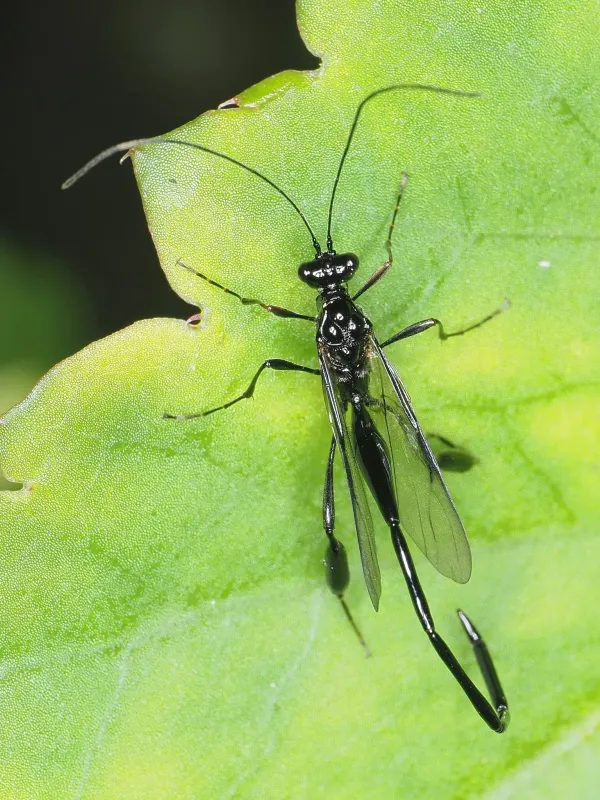
The American pelecinid (Pelecinus polyturator) is a fascinating wasp belonging to the family Pelecinidae. It is most easily recognized by the female's extremely long, slender abdomen, which gives the insect a very distinctive and elongated silhouette.
The body is typically glossy black, measuring between 30 to 70 millimeters. While the males are occasionally found, they are much smaller and significantly less common than the females, as the species primarily reproduces through parthenogenesis.
Despite its intimidating, wasp-like appearance, the American pelecinid possesses no stinger and is completely harmless to humans and domestic animals. It is a solitary insect that is rarely seen in high densities.
The long, segmented abdomen is a specialized tool used by the female to navigate soil and reach the larvae of subterranean beetles for oviposition. It is a primitive but highly specialized insect.
In the field, it can be mistaken for other ichneumon wasps, but its unique abdominal structure is a diagnostic feature that separates it from all other North American Hymenoptera.
What it damages
The American pelecinid is not a plant pest. In fact, it serves as a beneficial organism because it is a parasitoid of the larvae of June beetles (Scarabaeidae), which are significant pests of turf and crops.
The larvae of Pelecinus polyturator develop inside the grubs of these beetles, eventually killing the host. Therefore, their presence should be considered a natural biological control mechanism rather than a threat to agriculture.
They do not consume or damage any part of cultivated plants. The adult stage feeds primarily on nectar, and the larval stage is strictly internal to its beetle host.
Growers should not consider this insect as a target for eradication. Treating fields with broad-spectrum insecticides will only destroy these natural helpers, potentially leading to a rebound of the beetle populations they control.
Recognizing the difference between a crop pest and a beneficial parasitoid is crucial for integrated pest management (IPM) strategies to maintain a balanced farm ecosystem.
When it appears
Adult American pelecinids are typically observed during the warm summer months, generally from mid-June through August, depending on the latitude and local climate conditions.
The females emerge from the soil after completing their development within the host grub. They spend their short adult life seeking nectar sources and scouting for suitable host larvae buried deep in the earth.
The lifecycle is tightly synchronized with the development of Scarabaeidae beetle grubs. Soil moisture is a critical environmental factor for the survival of the larvae and the emergence of adults.
Because the development happens entirely underground, it is difficult to predict exactly when a large emergence will occur. They are most active on sunny, warm days when flying conditions are optimal.
At the end of the season, the new generation of larvae remains dormant or continues feeding within the host in the soil, protected from the elements until the next summer cycle begins.
Control measures
No control measures are necessary for the American pelecinid. It is not an economic pest, and there is no reason to apply pesticides to eliminate it from an agricultural or residential landscape.
If you encounter these insects in your garden, it is a positive sign of a healthy, functioning ecosystem where natural predators are working to manage beetle populations.
Integrated Pest Management guidelines emphasize the preservation of parasitoids. Avoiding the prophylactic use of pesticides helps ensure that beneficial insects like Pelecinus polyturator can thrive.
Management should focus solely on the true pests, such as white grubs, rather than on the beneficial organisms that hunt them. Proper soil management and crop rotation are the standard practices here.
In summary, the American pelecinid should be protected and encouraged as a natural ally in the fight against soil-dwelling agricultural pests that damage root systems.
Taxonomy
- Latin name
- Pelecinus polyturator
- Order
- Hymenoptera
- Family
- Pelecinidae
- EPPO code
- PELNPO
Discussion
No discussions yet — be the first.