
Pelecinus
Pelecinus
Description
How to identify
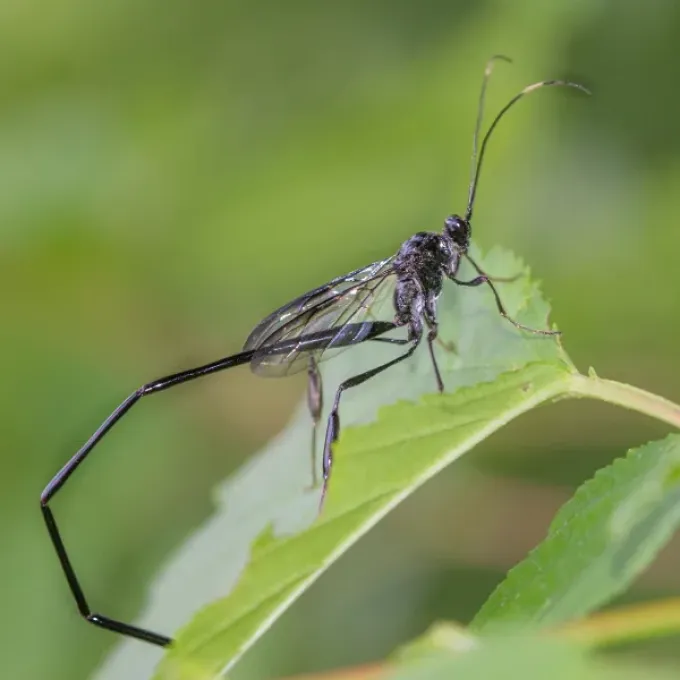
Pelecinus (genus Pelecinus) belongs to the order Hymenoptera and is the only genus in the family Pelecinidae. They are easily recognizable by their exceptionally long, slender, and black abdomens.
Females are characterized by their elongated, multi-segmented abdomens, which can be several times longer than the rest of their body. Males are much smaller and less frequently observed.
The insects have a glossy black appearance and transparent wings. Due to their unique shape, they often attract attention, although they are completely harmless to humans and plants.
Taxonomically, they are specialized parasitoids. Their morphology is an adaptation for reaching host larvae that are buried deep within the soil profile.
They are frequently misidentified as pests due to their intimidating appearance, but they are actually important members of the natural ecosystem.
What it damages
Pelecinus is not a crop pest. They do not feed on plant tissues, stems, leaves, or roots, meaning they cause no direct damage to agricultural production.
On the contrary, they are considered beneficial insects. Their larvae are parasitoids of subterranean scarab beetle larvae, including the common cockchafer.
By preying on these soil-dwelling pests, Pelecinus helps to naturally regulate their population levels, reducing the need for chemical soil treatments.
Their presence in a field is a sign of a healthy, functioning ecosystem where biological control mechanisms are actively working to protect plant roots.
Therefore, no damage assessment is necessary for this species, as they are partners in sustainable farming rather than enemies of the harvest.
When it appears
Adult Pelecinus wasps are most active during the mid-to-late summer months, typically ranging from July to August, depending on the local climate.
Their seasonal appearance coincides with the period when they seek out host larvae in the soil for egg-laying, ensuring the survival of their offspring.
The life cycle involves an egg stage, several larval instars within the host, a pupal stage, and the emergence of the adult wasp from the soil.
Adults are commonly found foraging for nectar on various flowers, especially those in the Apiaceae family, during the height of their seasonal activity.
As temperatures begin to drop in the autumn, the adults die off, while the next generation remains in the soil as larvae, prepared for winter dormancy.
Signs of infestation
There are no signs of infestation because Pelecinus is not a pest. They do not cause wilting, yellowing, or physical damage to any parts of the plants.
The only sign of their existence is the visual encounter with adult wasps flying low over the ground or visiting nearby flowering weeds.
If you see a wasp with a very long, thin abdomen probing the soil, it is a female searching for a scarab beetle larva to host its eggs.
In soil samples, you might occasionally find the remains of beetle larvae that have been successfully parasitized by these wasps.
Absence of signs is the default state; if you see them, simply observe them as beneficial agents and avoid unnecessary pesticide applications.
Control measures
Chemical control is never recommended for Pelecinus. Targeted application of insecticides could inadvertently kill these beneficial parasitoids and trigger a surge in the scarab beetle population.
The best management strategy is conservation. Maintaining wildflower margins and hedgerows around fields provides essential nectar sources for adult wasps.
Integrated Pest Management (IPM) practices prioritize the protection of such natural enemies over the use of harsh chemical controls.
Farmers should be educated to recognize these wasps as allies to avoid erroneous pest control attempts that would damage the agroecosystem.
- Avoid broad-spectrum insecticide usage.
- Preserve flowering habitats near crop areas.
- Foster ecosystem health to support biological control.
Taxonomy
- Latin name
- Pelecinus
- Order
- Hymenoptera
- Family
- Pelecinidae
- EPPO code
- PELNSP
Discussion
No discussions yet — be the first.