
Greenhouse thrips
Parthenothrips
Description
How to identify
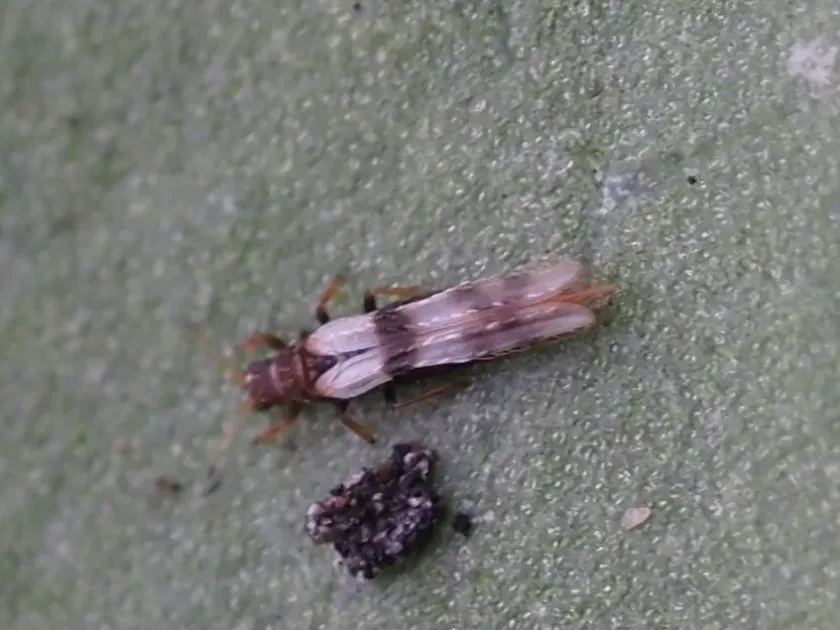
Parthenothrips dracaenae, commonly known as the greenhouse thrips, is a small insect belonging to the order Thysanoptera and the family Thripidae. The adults are typically 1.2 to 1.5 mm long.
The body coloration ranges from yellowish-brown to dark brown, allowing them to blend into the leaf surface. They possess thin, fringed wings typical for the order, which they use for short-distance flight.
The larvae are pale and sluggish, often found in clusters along the leaf veins on the underside. They are easily overlooked by inexperienced growers due to their cryptic behavior.
The life cycle consists of egg, larva, propupa, pupa, and adult stages. Because they thrive in stable greenhouse environments, they can complete their life cycle continuously throughout the year.
Reproduction is primarily parthenogenetic, meaning females produce offspring without mating, which enables them to rapidly establish large populations in suitable indoor habitats.
What it damages
The greenhouse thrips is a significant pest of ornamental foliage plants, particularly palms, Dracaena species, Ficus, and orchids kept in indoor or greenhouse conditions.
These insects feed by piercing the leaf epidermis and sucking out the cell contents. This feeding pattern causes the collapse of leaf tissues and results in unsightly silver or bleached patches.
Heavy infestations lead to leaf wilting, severe chlorosis, and premature leaf drop, which significantly impacts the aesthetic value of ornamental specimens.
In addition to direct physical damage, their feeding creates wounds that serve as entry points for various secondary infections, including fungal diseases.
If left unmanaged, the pest can cause significant growth stunting, especially in young plants that have not yet established a robust root system.
Signs of infestation
The earliest symptom is the appearance of small, silvery-white spots on the undersides of the leaves, which gradually enlarge as the feeding damage progresses.
Tiny black spots of frass (excrement) are commonly found near the feeding sites. These spots are a definitive diagnostic sign of a thrips infestation.
Distortion of new leaves and the development of brown, necrotic tissue are visible signs of damage once the population density has reached an advanced stage.
In some cases, the presence of a sticky, shiny film on the leaves may indicate a heavy infestation, often complicated by the growth of sooty mold.
If you observe any signs of plant stress or unexpected leaf yellowing, turn the leaf over and inspect the underside with a magnifying glass to confirm the presence of larvae or adults.
Control measures
Maintaining high relative humidity is an effective cultural control, as greenhouse thrips prefer dry conditions and are discouraged by regular misting and cleaning.
Blue sticky traps are highly recommended for monitoring purposes and for reducing the number of active flying adults within a greenhouse or conservatory.
Systemic insecticides are the most effective chemical control, as they are absorbed by the plant and kill the thrips when they ingest the cell sap.
Consistent treatment is necessary because eggs embedded in leaf tissues are protected from contact sprays, requiring multiple applications at specific intervals.
- Isolate infested plants immediately
- Use blue adhesive cards for monitoring
- Apply systemic insecticides based on local regulations
- Remove and destroy heavily damaged leaves
- Ensure regular leaf washing with soapy water
Taxonomy
- Latin name
- Parthenothrips
- Order
- Thrips
- Family
- Thripidae
- EPPO code
- PARESP
Discussion
No discussions yet — be the first.