
Bearded reedling
Panurus biarmicus
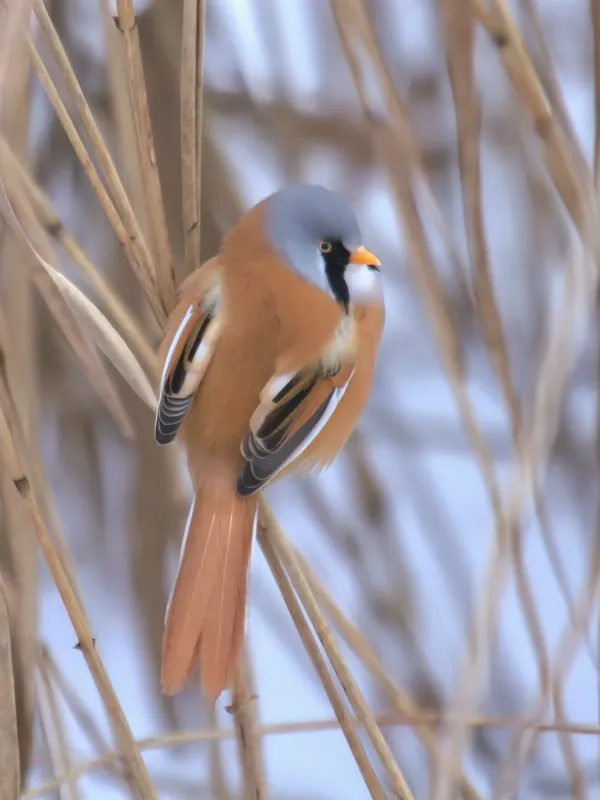
Description
How to identify
The bearded reedling (Panurus biarmicus) is a small passerine bird belonging to the Paradoxornithidae family, typically found in dense reed beds.
Males are easily identifiable by their distinctive black moustachial stripes. They possess a long, tail and a buff-colored body, which provides excellent camouflage.
These birds are exceptionally agile, moving vertically along reed stems with ease. They are known for their metallic "ping" calls, which help birdwatchers identify them.
They are highly social birds that spend most of their lives within the thick vegetation of wetlands. Their morphology is perfectly adapted to navigating narrow, flexible stalks.
Unlike most tits, their diet changes significantly throughout the year, switching from insects in the summer to seeds in the late summer and autumn.
What it damages
In agricultural settings where reeds are grown as a commercial crop, the bearded reedling can act as a localized pest species.
The primary damage occurs when large flocks feed on the seeds of the Phragmites australis, stripping the seed heads and reducing yields.
High bird density can lead to significant economic loss in nurseries or experimental plots where seed purity and yield are paramount.
Physical damage to the panicles can also facilitate the entry of fungal pathogens, which further degrades the quality of the reed crop.
While not a major pest in broad-acre agriculture, their impact on specific wetland-based farming systems requires monitoring and management.
When it appears
The period of highest risk to crops is during late summer and autumn, which correlates with the seed maturation phase of the reed.
During these months, birds congregate in larger flocks to prepare for the winter, causing intense localized feeding on agricultural fields.
In winter, the birds persist in the reed beds, but their impact on seed availability is reduced as most seeds have already been consumed or dispersed.
Spring is generally characterized by nesting activities, where the diet switches back to insects, making them harmless or even beneficial during this phase.
Effective crop protection strategies must be timed to coincide with the period of peak seed maturation and migratory flock formation.
Signs of infestation
The most prominent sign of infestation is the presence of shredded or empty seed heads (panicles) at the top of reed stems.
Large quantities of seed husks found at the base of the plants indicate heavy feeding activity by a flock.
The metallic, repetitive calls of the birds emanating from the center of the crop are a clear indicator of their presence within the field.
Visual observation of birds climbing the reed stalks and shaking the seed heads is a common site during the feeding season.
Mechanical bending of the stems, often resulting from the birds' weight and movement, can also be observed in highly affected areas.
Control measures
Acoustic deterrents that play recordings of alarm calls or raptor sounds are effective in keeping flocks away from sensitive areas.
Visual deterrents, including hawk kites or reflective tapes, can disrupt the birds' sense of security and force them to move elsewhere.
For high-value seed production, protective netting is the most reliable way to prevent access to the panicles during maturation.
Integrated pest management should include maintaining natural predator habitats nearby to help regulate local bird population densities.
- Acoustic bird scarers.
- Reflective deterrent ribbons.
- Protective mesh for high-value plots.
- Encouraging natural bird of prey populations.
Taxonomy
- Latin name
- Panurus biarmicus
- Family
- Panuridae
- EPPO code
- PNRUBI
Discussion
No discussions yet — be the first.