
Bearded reedling
Panurus
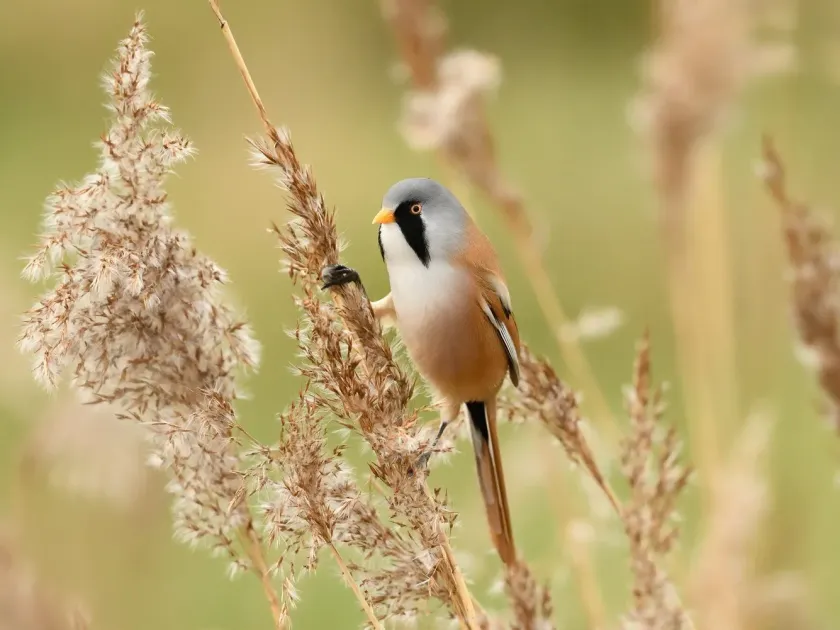
Description
How to identify
The bearded reedling (Latin: Panurus biarmicus) is a unique species of passerine bird, often classified within its own family, Panuridae. It is characterized by a long, graduated tail and distinct black whiskers in males.
This bird species is highly specialized for living within dense reed beds, where it moves with agility along the vertical stems. Their biological requirements for constant moisture keep them restricted to wetland margins.
As a sedentary species, bearded reedlings rarely venture far from their nesting territories, making their interaction with commercial farmland extremely limited.
Their systematic classification places them close to Sylviidae, reflecting their small size and insectivorous tendencies during the summer breeding season.
The survival of the species depends on the integrity of large reed formations, serving as an indicator of the health of wetland ecosystems near agricultural lands.
What it damages
Bearded reedlings are not considered agricultural pests. They predominantly feed on reed seeds in winter and small invertebrates, such as beetles and spiders, during the spring and summer.
Agricultural damage is negligible or non-existent, as the birds do not congregate in fields or exhibit the swarm behavior typically associated with crop pests.
By consuming various insect larvae and adults, they provide a valuable ecosystem service by naturally reducing populations of harmful insects around the field edges.
There are no recorded instances of bearded reedlings causing significant loss to yield, making the status of 'pest' scientifically and economically inaccurate.
The minor interaction between this bird and crops is limited to rare foraging near water-adjacent plots, which does not impact the overall productivity of the field.
Control measures
Control measures are unnecessary and generally not applicable for this protected species. In many countries, the bearded reedling is a protected bird that must not be disturbed.
If bird presence needs to be discouraged near specific sensitive research plots, basic land management practices are sufficient and highly effective.
Maintaining clear irrigation ditches and managing reed encroachment near fields will naturally reduce the attractiveness of the area to these specific birds.
Visual deterrents or mechanical protection are only recommended for scientific trials to ensure data integrity, rather than for broad agricultural pest control.
- Maintenance of drainage ditches.
- Vegetation control along water edges.
- Use of protective netting for research trials.
Taxonomy
- Latin name
- Panurus
- Family
- Panuridae
- EPPO code
- PNRUSP
Discussion
No discussions yet — be the first.