
Pantomorus
Pantomorus
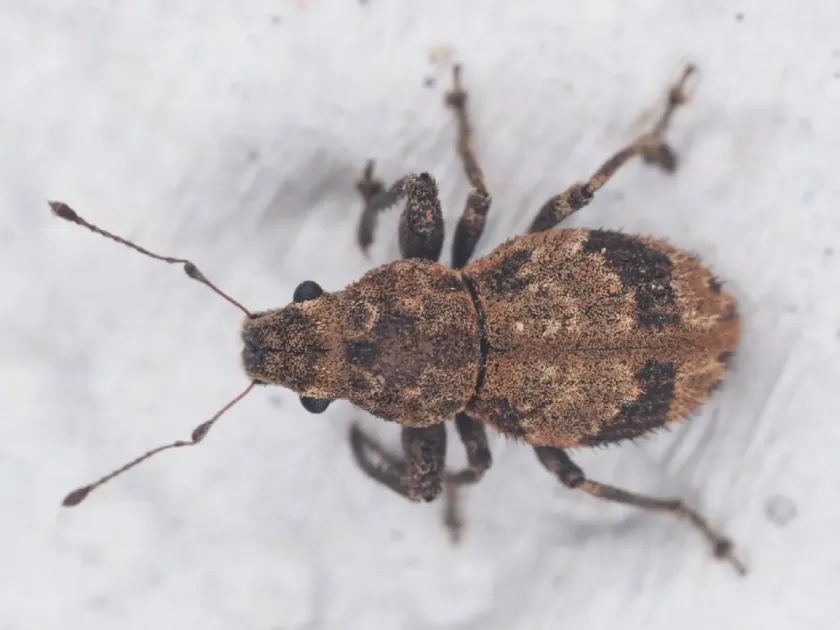
Description
How to identify
Pantomorus is a genus of insects belonging to the Curculionidae family, commonly known as snout beetles or weevils. These beetles are generally small, measuring between 7 to 10 mm in length, with the distinct snout typical of the family.
The body is covered with fine scales, which provide a camouflage effect, ranging in color from grey to brownish. This allows the insects to blend perfectly with tree bark, soil, or leaf surfaces, making them difficult to spot.
Most species within this genus are flightless because their elytra are fused together. Consequently, their movement is primarily restricted to crawling, meaning they often travel between plants via interconnected branches or through the soil.
The larvae are typical of the weevil family: legless, cream-colored, and possessing a hard, dark-colored head capsule. They live exclusively underground, where they develop by feeding on the root systems of various host plants.
The life cycle involves complete metamorphosis, progressing through egg, larval, pupal, and adult stages. The larval stage is particularly significant for plant health due to its hidden, damaging activity in the soil.
What it damages
Pantomorus beetles are known as polyphagous pests, meaning they feed on a wide range of host plants. They are particularly troublesome in citrus orchards, vineyards, and various ornamental shrubbery species.
Adult beetles cause visible damage by chewing the edges of leaves, creating characteristic notched or serrated patterns. While this reduces the leaf area, the primary danger is often the subsequent larval damage.
The larvae feed on the roots, consuming fine root hairs and damaging the outer bark of the root system. This feeding significantly hinders the plant's ability to absorb water and essential nutrients from the soil.
Severe infestations can lead to stunted growth, yellowing foliage, and reduced yields. In extreme cases, especially with young or drought-stressed plants, the damage to the root system can result in the death of the tree.
The feeding sites created by larvae also serve as entry points for various soil-borne pathogens, including fungi that cause root rot, further exacerbating the decline of the infested plants.
When it appears
Adult activity typically begins in the spring when temperatures rise, prompting the beetles to emerge from their overwintering sites in the soil or ground debris to feed on new leaves.
The breeding season lasts throughout the warmer months. Females deposit eggs in clusters, often concealing them under bark flakes, inside leaf folds, or under fruit sepals to protect them from predators.
Larval populations reach their peak in the soil during the late summer and autumn. During this time, they feed aggressively on roots to store energy for their development into pupae.
Overwintering occurs primarily in the larval stage deep within the soil, though some adults may survive in protected leaf litter or under organic mulch during milder winters.
Because the beetles are often nocturnal, the best time for seasonal monitoring is at night, using a flashlight to inspect the foliage for adult presence.
Signs of infestation
The most reliable sign of a Pantomorus infestation is the notched appearance of leaf margins, often referred to as "ragged edges," resulting from adult feeding.
To confirm the presence of adults, you can gently shake branches over a light-colored cloth or tray at night, which usually causes the beetles to fall and become visible.
General plant decline, including yellowing leaves (chlorosis) and reduced vigor despite adequate irrigation, is a strong indicator of root damage caused by the larvae.
Careful inspection of the root collar and surrounding soil may reveal burrowing tunnels created by larvae. In severe cases, small rootlets may be completely severed.
Small, discolored spots on fruit, particularly near the calyx, indicate where eggs were laid, which can lead to early fruit drop and significant economic loss in commercial orchards.
Control measures
Effective management of Pantomorus requires an integrated approach that targets both the adult beetles in the canopy and the larvae in the soil.
Mechanical control measures are very effective; placing sticky bands around tree trunks prevents flightless adult beetles from climbing up into the canopy to feed and oviposit.
Biological control using entomopathogenic nematodes (such as Heterorhabditis species) applied to the soil has proven successful in reducing larval populations in an environmentally friendly way.
Chemical control should focus on timing applications with the peak emergence of adults to stop the reproductive cycle before significant egg-laying occurs.
- Cultivating the soil around the base of trees to expose larvae to natural predators.
- Monitoring adult activity using nocturnal inspections or traps.
- Removing weeds and debris from the base of trees to eliminate hiding spots.
- Applying systemic or contact insecticides during the adult emergence phase.
Taxonomy
- Latin name
- Pantomorus
- Order
- Coleoptera (beetles)
- Family
- Curculionidae
- EPPO code
- PANMSP
Discussion
No discussions yet — be the first.