
Scorpionfly
Panorpa communis
Description
How to identify
The Scorpionfly (Panorpa communis) belongs to the order Mecoptera and the family Panorpidae. It is a distinct insect that is easily identified by its unique physiological features.
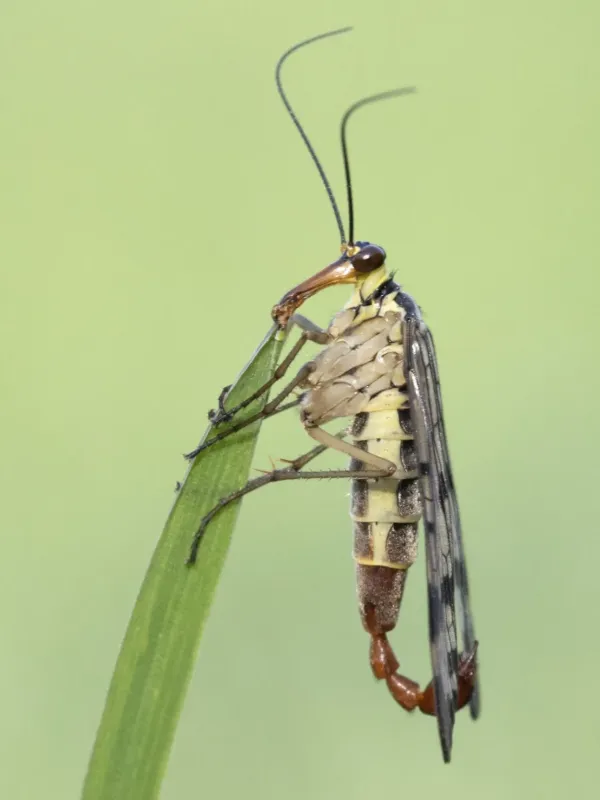
Adults possess a brownish-yellow body with clearly visible dark bands on their wings. They have a very prominent, beak-like rostrum, which is a specialized elongated part of the head.
The most striking feature of the male is the tip of its abdomen, which is curved upwards and enlarged with a pincer-like structure, closely resembling the tail of a scorpion.
Despite this intimidating appearance, the scorpionfly is completely harmless to humans as it lacks a venomous sting and is not aggressive towards people or larger animals.
Larvae of the scorpionfly look somewhat like moth caterpillars, possessing six thoracic legs and several pairs of abdominal prolegs, allowing them to move efficiently through soil.
What it damages
The Scorpionfly is not an agricultural pest. It primarily functions as a scavenger within forest edges, hedges, and damp garden environments.
Larvae live in the soil, feeding on decaying organic matter, leaf litter, and occasionally on dead insects they encounter, contributing to the decomposition process.
Adults are known to feed on nectar, honeydew, and the fluids from dead insects. They are frequently observed on decaying fruits but do not feed on healthy, living plant tissues.
There are no recorded instances of Panorpa communis damaging vegetable, fruit, or cereal crops, as their nutritional needs do not involve plant consumption.
In fact, their presence in a garden should be seen as neutral. They do not pose any threat to the yield or health of the cultivated plants in your garden.
When it appears
The life cycle of the common scorpionfly is univoltine, meaning there is only one generation produced per year in temperate climates.
The insect overwinters as a larva in the soil. As temperatures rise in late spring, the larvae transition into the pupal stage within protective earthen chambers.
Adult activity peaks during the summer months, from May through September. They prefer shady, humid areas where they can find moisture and suitable food sources.
Mating occurs during the summer, after which females lay eggs in the soil. The eggs hatch into larvae, which begin feeding on organic matter, starting the cycle anew.
The duration of each stage is highly dependent on local weather conditions, particularly humidity and temperature levels throughout the growing season.
Control measures
Since the scorpionfly is not a pest, there is no need for any chemical or mechanical control measures to reduce their population in agricultural or garden settings.
The application of insecticides is strongly discouraged as it would negatively impact other beneficial insects, pollinators, and natural predators without providing any agronomic benefit.
Standard horticultural practices, such as maintaining cleanliness around the garden and managing soil health, are sufficient to manage the overall ecosystem of the site.
Promoting a healthy environment with diverse vegetation will ensure that beneficial insects thrive while keeping the population of any particular species balanced naturally.
Always prioritize the preservation of biodiversity in your garden, and do not perceive the scorpionfly as an enemy, as it plays its role in the decomposition of soil organic matter.
Taxonomy
- Latin name
- Panorpa communis
- Family
- Panorpidae
- EPPO code
- PNRPCO
Discussion
No discussions yet — be the first.