
Fruit leafroller
Pandemis dumetana
Description
How to identify
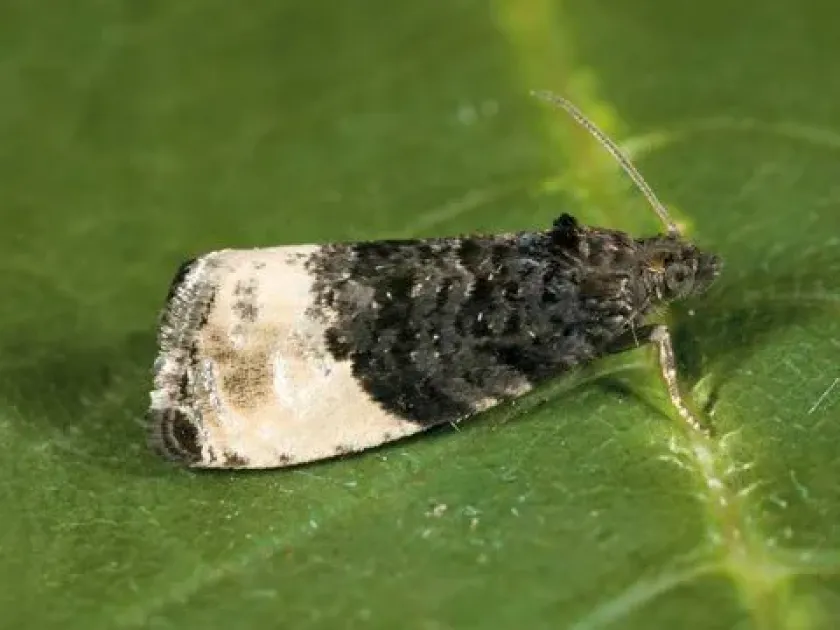
The fruit leafroller Pandemis dumetana belongs to the Tortricidae family of moths. The adult moth has a wingspan of approximately 18–24 mm, with forewings typically marked with distinctive dark transverse bands against a brownish background.
The larvae, which are the primary damaging stage, are pale green with a lighter-colored head and thoracic shield. They typically reach a length of 20-22 mm when fully mature.
This species is a polyphagous pest, meaning it feeds on a wide range of host plants. It is widely distributed across temperate regions and typically completes one or two generations per year.
Overwintering occurs at the larval stage. The small caterpillars construct silk hibernacula in protected spots, such as crevices in tree bark or among fallen leaves under the host plant.
As spring temperatures rise, the overwintered larvae emerge to resume feeding, initially targeting developing leaf buds and flowers, which can cause significant growth stunting.
What it damages
Pandemis dumetana is a significant pest of pome and stone fruits, including apple, pear, plum, and cherry trees, as well as various ornamental shrubs.
The larvae are notorious for their ability to feed on young leaves, rolling them up into protective bundles using silken threads. This reduces the photosynthetic capacity of the foliage.
In addition to foliage, the larvae frequently feed on developing fruit. They create shallow, irregular gouges on the skin, which can lead to fruit deformation and secondary fungal infections.
Nursery stock and young orchards are particularly vulnerable, as larval feeding on terminal buds can distort the tree's architecture and inhibit primary shoot elongation.
Severe infestations can lead to significant economic loss due to decreased fruit quality and weakened tree vigor, making the trees more susceptible to environmental stress.
When it appears
The flight period of the first generation of adults generally occurs between late May and June, coinciding with the critical early stages of fruit development.
A second generation of adults typically emerges in August. These moths lay eggs that produce larvae which feed on foliage and fruit before entering their winter dormancy.
Eggs are laid in clusters on the upper surfaces of leaves, covered in a protective transparent layer to shield them from environmental factors and natural predators.
The egg stage usually lasts for 8 to 12 days, depending on the ambient temperature. After hatching, the neonate larvae immediately seek out suitable feeding sites on the plant.
Weather conditions, especially high humidity and moderate heat, are critical drivers of the population dynamics, often determining the intensity of the outbreak in a given season.
Signs of infestation
The most characteristic sign of an infestation is the presence of leaves rolled into tubes or clusters, bound together by fine but strong strands of silk.
Larvae feed within these shelters, creating a patchy, skeletonized appearance on the leaves as they consume the green tissue while leaving the veins intact.
- Tightly rolled or clustered leaves webbed with silk.
- Small circular holes or gouges on the skin of developing fruits.
- Tattered leaf edges caused by larval feeding.
- Presence of frass (larval excrement) trapped inside the rolled leaves.
When populations are high, significant webbing can be observed connecting leaves and fruit clusters, making the tree canopy appear ragged and unhealthy.
Control measures
Integrated Pest Management (IPM) is essential. Using pheromone traps is the most effective way to monitor adult flight activity and time insecticide applications.
Good orchard hygiene, such as removing debris and scraping away old, loose bark during the dormant season, can help reduce the number of overwintering larvae.
Biological control agents, including Bacillus thuringiensis sprays, are highly effective against young larvae and are safer for beneficial insects and pollinators.
If chemical intervention is necessary, insecticides should be applied when larvae are most active but have not yet fully enclosed themselves in protective leaf rolls.
It is important to rotate products with different modes of action to prevent the development of resistance in the leafroller population over successive seasons.
Taxonomy
- Latin name
- Pandemis dumetana
- Order
- Lepidoptera (butterflies)
- Family
- Tortricidae
- EPPO code
- PANDDU
Discussion
No discussions yet — be the first.