
Hazel tortrix
Pandemis corylana
Description
How to identify
The Hazel tortrix (Pandemis corylana) is a moth belonging to the family Tortricidae. It is a widespread pest that primarily affects deciduous trees and fruit orchards.
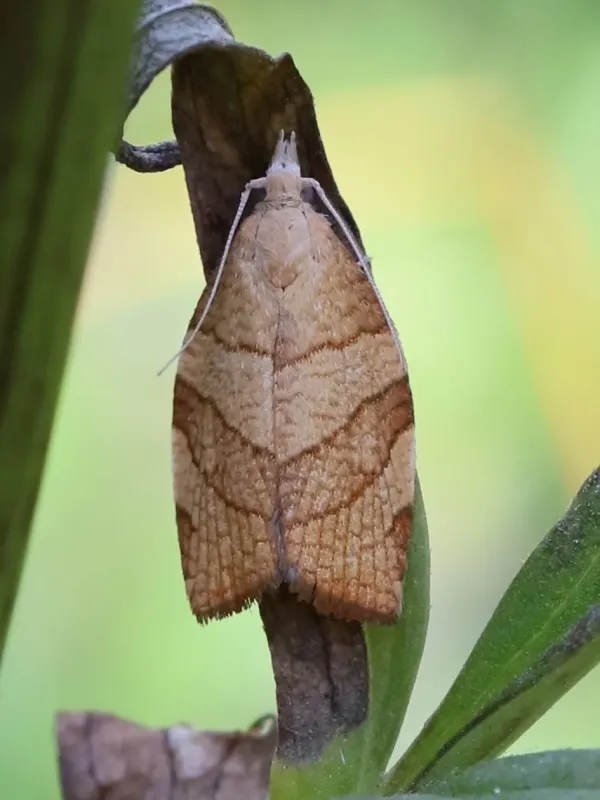
Adult moths have a wingspan ranging from 18 to 25 mm. The forewings are typically ochreous-brown with two distinct, darker diagonal bands and a basal patch.
The larvae are bright green with a light brown head. When fully grown, they reach approximately 20–25 mm in length and are quite active when disturbed.
The pupae are dark brown, typically found inside the rolled leaves or in protected areas on the tree bark, often wrapped in silken threads.
This species is nocturnal, with adult moths resting during the day on the undersides of leaves or in crevices of the tree trunk to avoid predators.
What it damages
This moth is a polyphagous pest, capable of feeding on various plants including apple, pear, plum, cherry, and apricot trees, as well as hazelnuts.
The larvae cause damage by feeding on buds in early spring, later shifting to leaves and young fruit. This leads to reduced tree vigor and significant yield loss.
Leaf damage manifests as skeletonization and rolling. The larvae spin silk to pull leaves together, creating a shelter while feeding on the leaf tissues inside.
Fruit damage involves surface-level feeding, which causes scarring and deformation. These wounds can also facilitate the entry of rot-inducing pathogens.
Severe infestations can lead to partial defoliation of the trees, particularly in young orchards, negatively impacting the tree's overall growth and productivity.
When it appears
The Hazel tortrix typically completes one generation per year. Larvae overwinter in the second instar inside small silken cocoons hidden in bark crevices.
Activity resumes in the spring as soon as buds begin to burst. The larvae emerge and begin feeding on the developing buds and young foliage.
Adult flight occurs throughout the summer months, typically from June to August. During this period, mating and egg-laying take place on the leaves.
Eggs are laid in clusters on the upper leaf surface and are covered with a protective layer. Larvae from these eggs hatch in late summer and feed briefly before hibernation.
The timing of these stages can vary depending on the local climate and seasonal temperature fluctuations, making monitoring a key component of effective management.
Signs of infestation
The most visible sign of an infestation is the presence of rolled or folded leaves held together by silken webbing, often housing the larvae.
Skeletonized leaves, where only the vein structure remains, are clear evidence of larval feeding activity on the foliage of affected trees.
Presence of surface lesions on young fruits, often accompanied by silk webbing near the damage, indicates the activity of this tortricid moth.
An accumulation of frass (larval excrement) within the rolled-up leaves or near the feeding sites is another common indicator of an active population.
In early spring, the failure of buds to open or evidence of boring into the heart of the bud is a critical sign of overwintered larval activity.
Control measures
Cultural control measures include removing loose bark from tree trunks in early spring or late autumn to destroy the overwintering sites of the larvae.
Pheromone traps are highly effective for monitoring the flight period of adult moths, allowing for the precise timing of insecticide applications if necessary.
Biological control, such as the use of Bacillus thuringiensis, is an excellent option for targeting larvae while minimizing the impact on beneficial insects.
Sanitation practices, such as the removal and destruction of fallen leaves and infested fruit, can significantly reduce the potential population for the following year.
Encouraging natural predators like birds and parasitic wasps within the orchard helps keep the population of the Hazel tortrix below the economic threshold.
Taxonomy
- Latin name
- Pandemis corylana
- Order
- Lepidoptera (butterflies)
- Family
- Tortricidae
- EPPO code
- PANDCO
Discussion
No discussions yet — be the first.